
Zero Emission Trucking Framework for India: C40 & Climate Pledge
If you've ever been stuck behind a heavily loaded truck on the Delhi-Meerut Expressway, or watched a convoy of freight vehicles crawl through Chennai's port road at rush hour, you already know the problem — even if the numbers make it starker. Trucks move roughly 70% of India's goods, and they do it...
Editorial Team
If you've ever been stuck behind a heavily loaded truck on the Delhi-Meerut Expressway, or watched a convoy of freight vehicles crawl through Chennai's port road at rush hour, you already know the problem — even if the numbers make it starker. Trucks move roughly 70% of India's goods, and they do it almost entirely on diesel. That's a lot of fuel, and a lot of emissions, baked into the very foundation of how this country functions.
In cities like Mumbai and Delhi, freight vehicles are among the leading contributors to particulate matter pollution. This isn't abstract. It's the air people breathe near industrial corridors, logistics hubs, and highway stretches that cut through urban neighborhoods.
So when C40 Cities — a global network of mayors committed to climate action — and The Climate Pledge, a coalition of major businesses pushing toward net-zero goals, jointly propose a framework for zero emission trucking in India, it's worth paying attention. These aren't fringe groups. They carry serious institutional weight.
The proposed framework essentially maps out a transition pathway — covering technology adoption, charging and fueling infrastructure, and policy incentives — designed specifically for Indian conditions. It's early days, but the direction is clear. Cleaner freight isn't just an environmental goal anymore. It's becoming an economic and regulatory reality that will reshape logistics costs, fleet decisions, and ultimately the roads every driver shares.
What Exactly Is the C40 and Climate Pledge Framework Proposing for India?
Strip away the policy language and the core ask is fairly straightforward. The framework wants large fleet operators, corporations, and city administrations to commit — in writing — to phasing out diesel trucks in favour of zero-emission alternatives. The proposals rest on four broad pillars.
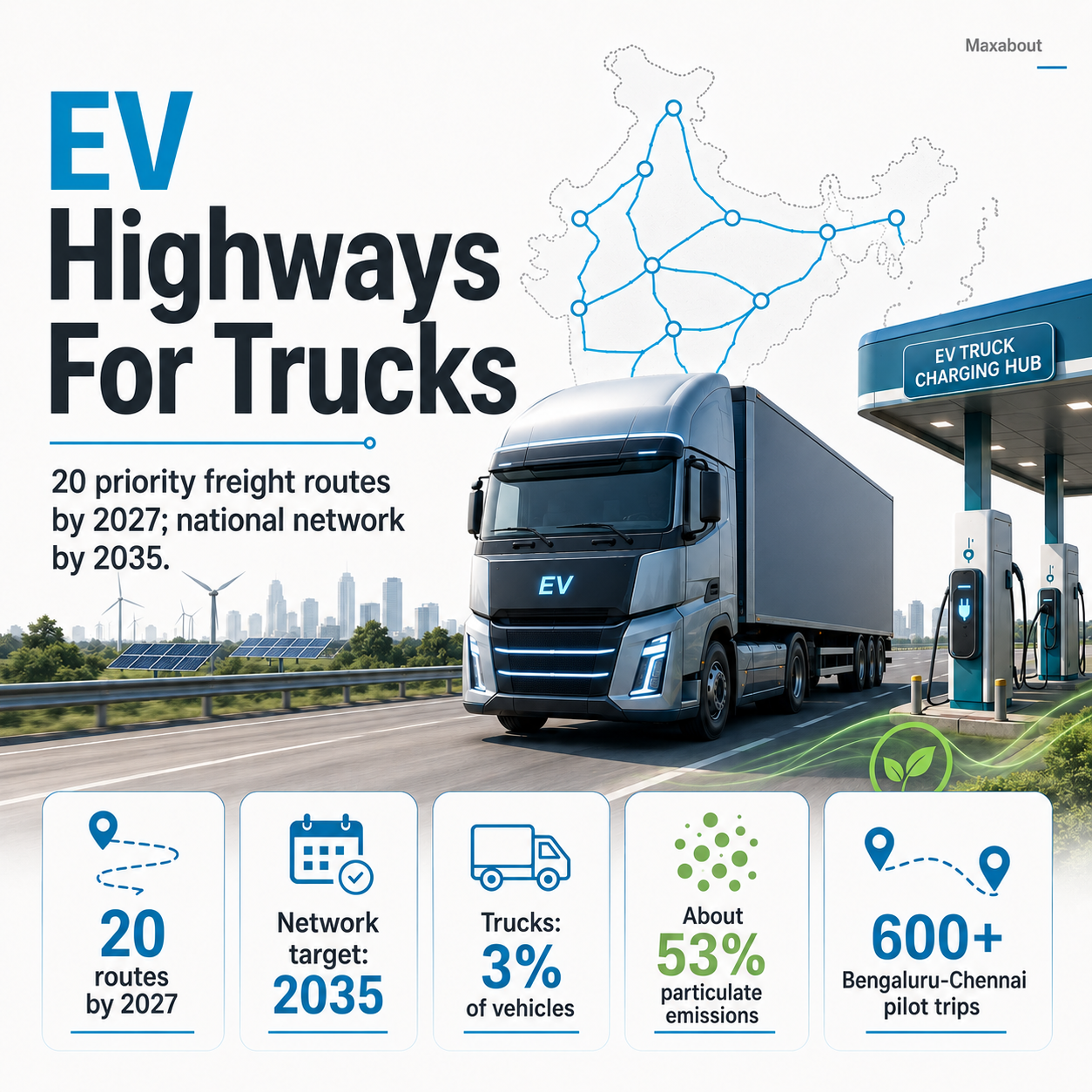 Fleet electrification targets sit at the centre. The near-term ask focuses on 2030, pushing for meaningful EV adoption in last-mile and medium-duty urban freight. The longer horizon — 2040 to 2050 — targets full zero-emission transitions for heavier interstate trucking, where hydrogen fuel-cell technology is being positioned alongside battery-electric options.
Infrastructure mandates are equally prominent. Based on learnings from Amsterdam's freight corridors and Los Angeles port logistics, the framework proposes dedicated charging hubs at industrial clusters and hydrogen refueling pilots along key freight corridors.
Corporate procurement commitments ask large companies — particularly those signed onto The Climate Pledge — to preference zero-emission logistics partners when contracting freight services.
City-level policy alignment rounds it out, targeting municipal regulations around freight zones and incentives for fleet upgrades.
Realistic? Honestly, the 2030 targets feel ambitious given India's current charging infrastructure gaps and the high upfront cost of electric commercial vehicles. The framework borrows from mature EV markets but India's freight economics are fundamentally different — industry reports consistently flag payload sensitivity and long-haul range as unresolved challenges.
India's Trucking Reality: Why Going Zero Emission Is Harder Here Than Anywhere Else
Let's be honest about something the framework doesn't fully grapple with. India's trucking sector isn't a monolith of large fleet operators who can run financial models and absorb transition costs. The overwhelming majority of trucks on Indian highways belong to small operators — someone who owns one or two vehicles, drives one himself, and treats that truck as both livelihood and life savings. Asking that person to finance an electric truck at two or three times the diesel equivalent isn't a policy conversation. It's a personal financial crisis.
Then there's the infrastructure problem, which goes well beyond the obvious. Yes, highway charging corridors are sparse outside a few select routes. But the deeper issue is grid reliability in the tier-2 and tier-3 towns that actually move India's freight — places like Nagpur, Siliguri, Ludhiana, Coimbatore. These are critical freight hubs where power supply remains inconsistent. An electric truck parked overnight waiting for a charge that never completes isn't a range anxiety story. It's a missed delivery and a broken contract.
Battery performance adds another layer. India's climate extremes are genuinely brutal on battery chemistry. A truck hauling goods through Rajasthan in May faces ambient temperatures that can cross 48°C. The same vehicle rerouted through a Himalayan corridor in January faces the opposite extreme. Neither condition is kind to lithium-ion packs, and real-world range drops significantly under both.
And then there's overloading — the quiet reality nobody in policy circles addresses directly. Trucks routinely carry well beyond rated capacity on Indian roads. That practice destroys range projections entirely.
The Business Case: Can Zero Emission Trucks Actually Save Money for Indian Fleet Operators?
Range anxiety and infrastructure gaps are real concerns. But honestly, the conversation that moves fleet operators is simpler: does this make financial sense? And here, the picture is genuinely interesting.
Diesel fuel and maintenance together represent roughly 60-65% of a heavy truck's operating cost in India, according to industry reports. Electric drivetrains have far fewer moving parts — no complex gearboxes, no diesel particulate filters, dramatically lower servicing intervals. Over a 5 to 7 year period, total cost of ownership projections suggest electric trucks could undercut diesel equivalents meaningfully, even accounting for higher acquisition prices.
That upfront cost, though, remains the genuine sticking point. A heavy electric truck currently costs significantly more than its diesel counterpart at purchase. For small operators running two or three vehicles, that gap is simply not bridgeable through fuel savings alone in the short term.
This is where government support becomes critical. FAME scheme incentives and PLI allocations targeting EV components are designed partly to compress that gap. Whether the benefit reaches smaller operators rather than concentrating among large fleet companies is a fair question the framework still needs to answer.
Perhaps more interesting is the emerging market pull from large corporate shippers. Companies that have signed The Climate Pledge are increasingly expected to green their entire supply chains — including freight partners. That creates real commercial pressure on logistics providers to electrify, independent of government mandates.
Battery leasing models offer one practical path forward for smaller operators, separating the most expensive component from vehicle acquisition and reducing entry costs considerably.
Infrastructure: The Make or Break Factor for Electric Trucks on Indian Highways
Commercial pressure and policy frameworks mean very little if a truck driver cannot charge his vehicle between Delhi and Mumbai. That is the blunt reality sitting at the center of this entire conversation. The infrastructure question is not a footnote — it is arguably the defining challenge for zero emission trucking in India.
The current state along major freight corridors is, honestly, quite thin. The Golden Quadrilateral — connecting Delhi, Mumbai, Chennai, and Kolkata — moves roughly 40% of India's road freight, yet fast-charging infrastructure for heavy commercial vehicles along this network remains extremely limited. A few pilot installations exist, but nothing approaching the density that fleet operators would need for reliable commercial operations.
The Delhi-Mumbai Industrial Corridor presents a slightly more optimistic picture, given the concentrated industrial activity and stronger grid connectivity along that stretch. But even there, charging points capable of handling the enormous power demands of a loaded freight truck are far from routine.
Hydrogen fuel cell trucks enter this picture as a genuinely serious alternative for long-haul routes, not just a futuristic concept. For runs exceeding 400 to 500 kilometres, battery electric trucks face real range and payload constraints. Hydrogen refueling is faster and the energy density advantage matters significantly at that scale. NITI Aayog has acknowledged this in recent strategic documents, identifying green hydrogen as critical to decarbonizing hard-to-abate sectors — heavy freight included.
The grid capacity question deserves an honest answer rather than optimistic deflection. India's power infrastructure, while expanding rapidly, would face serious stress if large-scale highway truck charging arrived without coordinated planning. A single fast-charging session for a heavy truck can demand power equivalent to dozens of households. Multiply that across a busy highway corridor and the grid implications become significant.
Where the near-term opportunity genuinely exists is depot charging for urban last-mile delivery trucks. This is a fundamentally different problem — trucks return nightly, charging happens overnight at lower speeds, and grid load is predictable and manageable. Several logistics operators in cities like Bengaluru and Pune are already running small electric fleets on exactly this model, and it works.
Indian Cities Leading the Charge: Who Is Already Moving on Clean Freight?
The good news is that some Indian cities are not waiting for a national mandate to arrive. Progress is happening — unevenly, yes, but it is real and it is building momentum.
Delhi is perhaps the most visible example. The city's aggressive push toward CNG and electric buses through the DTC fleet demonstrates that large-scale public fleet transition is operationally possible in Indian conditions. It is not perfect — charging infrastructure gaps remain — but the administrative will and procurement machinery clearly exist. Applying that same institutional muscle to freight is a logical next step, and recent official announcements suggest the Delhi government is at least beginning to think in that direction.
Mumbai's port ecosystem is another area worth watching. The movement of containers between the port, warehouses, and distribution centers follows predictable, short-radius routes — exactly the kind of fixed corridor where electric trucks make immediate sense. Industry reports indicate early-stage pilots involving electric yard trucks and short-haul port vehicles, though large-scale adoption is still some distance away.
Then there is Bengaluru, which is arguably where last-mile electric freight momentum feels most organic. E-commerce growth has pushed logistics operators here to experiment out of necessity — urban congestion, parking restrictions, and rising fuel costs have made the economics of smaller electric delivery vehicles genuinely attractive. From what industry observers report, several operators running hyperlocal delivery routes have quietly built functional electric fleets without much fanfare.
The honest contrast, though, is this: urban freight electrification and intercity long-haul trucking are almost entirely different problems. Cities can solve the first. The second needs something much bigger.
What This Means for the Broader Indian Automotive Ecosystem
Here is where things get genuinely interesting for anyone who follows Indian automotive trends beyond just passenger cars. The electrification of heavy commercial vehicles does not happen in isolation. It pulls everything else along with it.
Battery technology is the obvious starting point. When manufacturers like Tata Motors, Ashok Leyland, and Olectra are forced to engineer batteries that survive fully loaded highway runs, the improvements in energy density and thermal management eventually flow downstream into passenger EVs. That is simply how automotive development works.
Charging infrastructure is the other pressure point. Fleet operators running electric trucks need fast, reliable corridor charging — and that investment benefits every private EV owner on the same highway. Scale drives cost down for everyone.
Perhaps most importantly, a credible framework signals to global manufacturers that India means business. That kind of policy clarity attracts serious investment in local EV truck manufacturing, which creates jobs and reduces import dependency.
From a policy perspective, momentum in commercial vehicles historically influences emission norm timelines for all vehicle categories. If heavy trucking moves, passenger and two-wheeler regulations tend to follow faster than expected. For the average Indian car buyer, that is worth paying attention to.
Realistic Outlook: Bold Vision, But India Needs More Than Pledges
The C40 and Climate Pledge framework is genuinely meaningful. That much deserves acknowledgment. Getting major cities and corporations to formally commit to zero emission trucking timelines creates real pressure — on manufacturers, on policymakers, on financiers. That pressure matters.
But from what I can observe on the ground, the gap between framework aspirations and Indian realities remains substantial. Small fleet operators running two or three trucks on thin margins cannot absorb EV transition costs through goodwill alone. Charging infrastructure along key freight corridors — the kind that actually works reliably — is still years away from meaningful scale. And diesel dependency runs deep, not just economically but politically.
What would actually move the needle? Three things, honestly. Aggressive government fleet procurement mandates that create immediate demand volume. Viability gap funding specifically for freight charging infrastructure, not just passenger corridors. And continued pressure on technology cost curves — because when EV truck economics genuinely compete with diesel on total cost of ownership, adoption accelerates without coercion.
This is a long game. India will not decarbonize trucking within a single policy cycle. But India's active participation in shaping these global standards matters enormously for its own urban air quality future — for every city breathing in diesel particulates daily. Frameworks like this are the starting point. Execution is everything that follows.
No comments yet
Be the first to share your thoughts!
Want to read more automotive news?
Stay updated with the latest car launches, reviews, and industry insights.
Browse All News