
Why Maruti Dzire Became India's Bestselling Car in FY2026
There's something quietly remarkable about a car that keeps selling in massive numbers while the market around it transforms completely. The Maruti Suzuki Dzire did exactly that in FY2026, crossing impressive sales milestones to claim the title of India's bestselling car — not just in the sedan segm...
Editorial Team
There's something quietly remarkable about a car that keeps selling in massive numbers while the market around it transforms completely. The Maruti Suzuki Dzire did exactly that in FY2026, crossing impressive sales milestones to claim the title of India's bestselling car — not just in the sedan segment, but across all passenger vehicle categories.
This isn't a story about flashy launches or aggressive discounting. It's something more interesting. In a market increasingly drawn toward SUVs and crossovers, a compact sedan with a modest footprint quietly outsold everything else. That deserves a proper look.
From what industry reports indicate, the Dzire recorded consistently strong monthly numbers throughout the fiscal year, reinforcing its position as a genuine people's car. For buyers in cities like Jaipur, Lucknow, Coimbatore, and Pune — where practical ownership matters far more than weekend road trip bragging rights — the Dzire's appeal remained remarkably steady.
The reasons aren't complicated, but they are worth understanding. Affordability, fuel efficiency, low maintenance costs, and Maruti's unmatched service reach formed a combination that competitors simply couldn't replicate at the same price point. This is the story of how those factors came together to make the Dzire FY2026's standout success.
The Sales Numbers That Tell the Real Story
Numbers rarely lie, and in FY2026, the Dzire's numbers were difficult to argue with. According to official announcements and industry reports, the Dzire consistently moved between 18,000 to 22,000 units per month through much of the fiscal year — figures that kept it firmly ahead of every rival in the compact sedan space and, on several months, ahead of popular hatchbacks too.
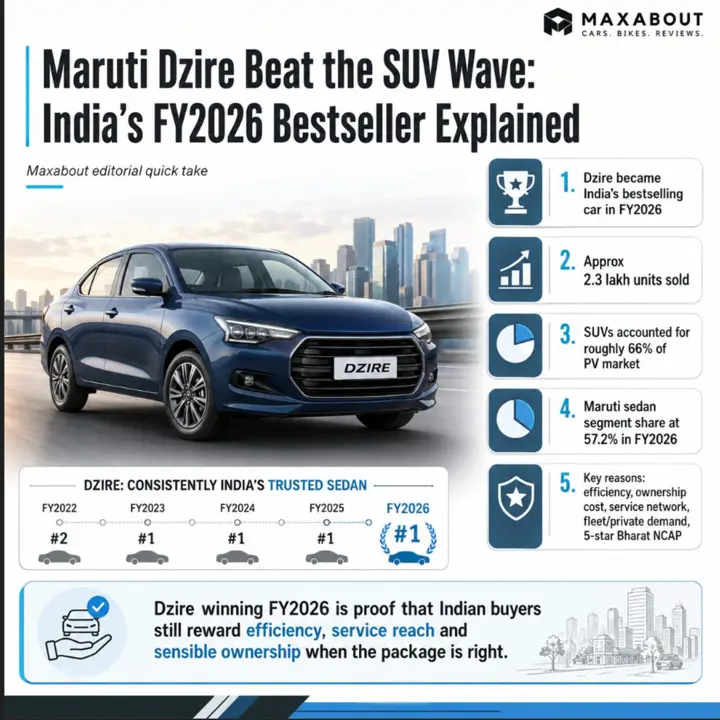 For context, its closest segment competitor rarely crossed 4,000 to 5,000 units in the same period. That gap isn't just impressive — it's structural. It suggests buyers weren't choosing the Dzire over alternatives after careful comparison. Many weren't comparing at all.
By the close of FY2026, the Dzire had logged over 12 consecutive months as the top-selling sedan in India, commanding an estimated segment share above 60%. In practical terms, that means for every 10 compact sedans registered at an RTO across Chennai, Jaipur, or Nagpur, roughly six were Dzires.
What does that mean for dealers? Shorter waiting periods, yes — but also stable resale confidence and reduced pressure to offer deep discounts. A car selling this consistently doesn't need heavy incentives to move. Demand held its own. That's a meaningful distinction in a market where many models survive on quarterly exchange schemes and festive bonanzas.
These aren't numbers worth celebrating blindly. They do, however, demand serious attention.
Why the Price Point Still Hits the Sweet Spot for Indian Buyers
Pricing a car well in India isn't just about being cheap. It's about being exactly affordable enough for the right buyer at the right life stage. Maruti seems to understand this better than most.
The Dzire currently spans from roughly ₹6.8 lakh for the base LXi up to around ₹10.4 lakh for the top ZXi+ variant (ex-showroom). That's a reasonably wide band. A government school teacher in Bhopal looking at their first car sees a credible entry point. A mid-level bank officer in Lucknow stretching for the VXi sees something manageable. Neither feels priced out entirely.
The CNG variant deserves special mention here. Sitting around the ₹8–9 lakh range, it has become the quiet hero of this whole story. Cab aggregator drivers, daily office commuters covering 60-plus kilometres each day in Pune's outskirts — for these buyers, the running cost calculus is everything. From what industry data suggests, CNG Dzire ownership costs can run significantly lower per kilometre compared to petrol alternatives. That matters enormously.
Then there's the EMI reality. Financed over five years, even the mid-spec variant stays within ₹14,000–₹16,000 monthly for most buyers — a figure that feels digestible against a modest household income. Combine that with resale values that hold surprisingly firm, and the total cost of ownership argument becomes difficult to argue against.
Maruti hasn't slashed prices to win here. They've simply held the line where it counts most.
Fuel Efficiency and the CNG Advantage in Everyday Indian Driving
If affordability gets buyers through the showroom door, fuel efficiency is what keeps them loyal. And on this front, the Dzire makes a genuinely compelling case — especially when you factor in what Indian roads actually look like on a Tuesday morning.
The petrol variant returns roughly 22–23 km/l under test conditions, but real-world numbers from city driving — say, Bengaluru's Outer Ring Road or Delhi's Lajpat Nagar stretch during peak hours — typically settle around 16–18 km/l. Honest, not spectacular, but consistently reliable. Highway runs toward Pune or Chandigarh push that figure closer to the official claim. Mixed driving lands somewhere comfortable in between.
Then comes the CNG variant, which has arguably been the bigger story. With CNG priced significantly below petrol across most Indian cities, the running cost drops to roughly ₹1.8–₹2.2 per kilometer compared to nearly ₹5–6 per kilometer on petrol. Fleet operators and cab aggregator drivers — the people who clock 200-plus kilometers daily — noticed immediately. From what drivers and fleet managers have reported consistently, the monthly fuel saving alone can cross ₹6,000–₹8,000, which changes the economics entirely.
There is one honest compromise worth mentioning. The CNG cylinder sits in the boot, cutting usable luggage space noticeably. For private owners carrying weekend bags or airport luggage, that does sting. Most cab drivers, however, consider it a worthwhile trade.
The numbers simply work where it matters most — at the fuel station, every single day.
Features and Comfort That Actually Matter to Indian Families
Once you move past fuel costs, the next real question is: does this car actually work for a family of five on a 400-kilometre drive to Shirdi or Coorg? From what owner reviews and road test reports consistently suggest, the answer is mostly yes — with a few honest asterisks.
The interior has genuinely improved in the latest generation. The nine-inch touchscreen infotainment system feels responsive and supports wireless Android Auto and Apple CarPlay. For a family with a teenager navigating and parents managing music, that matters more than most spec sheets suggest. The connected car technology — remote engine start, geofencing, vehicle tracking — sounds like a premium feature, and it largely works as advertised based on owner feedback.
Automatic climate control is a significant upgrade over the older manual setup. On a hot afternoon leaving Bengaluru on the Mysuru highway, having the cabin cool itself without someone constantly adjusting the dial is a genuine comfort improvement. Small thing, but real.
Rear seat space is adequate for two adults on shorter trips. On longer journeys, a third adult in the middle will find it tight — the floor hump does not help, and the seat cushioning at the rear is flatter than ideal. This is probably the Dzire's most consistent criticism in honest owner reviews.
The boot offers around 382 litres in the petrol variant — enough for two large suitcases and a weekend bag, which covers most family travel scenarios comfortably.
On the safety front, six airbags and ESC now come standard across higher trims, which feels like a long-overdue addition rather than a bonus. Ground clearance sits at approximately 163mm — not outstanding, but manageable on typical Indian roads including moderate potholes and broken village stretches.
What feels missing? Ventilated front seats, a panoramic sunroof, and a 360-degree camera — all of which rivals offer at comparable price points. The Dzire does not pretend to compete on feature density. It competes on reliability, running costs, and delivering exactly enough for what most Indian families actually need day to day.
Maruti's Service Network: The Invisible Reason Behind Buyer Confidence
Features sell cars at showrooms. Service networks keep buyers loyal for life. And this is where Maruti Suzuki operates in a completely different league from every competitor in India.
With over 4,000 authorized service centers spread across the country, Maruti has built something no rival has managed to replicate — genuine peace of mind. Not just in Mumbai or Bengaluru, but in places like Aligarh, Siliguri, Raipur, and smaller towns where owning a non-Maruti vehicle can mean waiting days for a spare part or driving hours to find a qualified technician.
That accessibility matters enormously. From what I have observed, first-time car buyers in tier-2 and tier-3 towns consistently rank service availability above features when making a purchase decision. The Dzire benefits directly from this trust.
Maintenance costs are genuinely competitive. A standard service typically runs ₹3,000 to ₹5,000, and spare parts remain affordable and widely stocked. Over a five-year ownership cycle, this difference adds up considerably compared to rivals whose parts sourcing can be inconsistent outside major cities.
There is also a generational dimension worth acknowledging. Families who drove 800s and Altos in the 1990s are now buying Dzires for their children — not out of habit alone, but because decades of reasonably dependable service have built genuine confidence in the brand.
To be fair, service quality is not perfectly consistent everywhere. Some smaller dealerships draw complaints about repair turnaround times and technician expertise. But even with those inconsistencies, the sheer density and reach of Maruti's network remains an advantage no competitor currently matches.
Who Is Actually Buying the Dzire and Why
The Dzire's sales numbers only start making sense when you look at who is actually walking into showrooms to sign the paperwork. It is not one type of buyer. It is several very different people, with very different motivations, all arriving at the same conclusion.
In cities like Patna and Jaipur, a significant chunk of buyers are first-time car owners — people who spent years on a two-wheeler and are now ready to move up. For them, the Dzire is not just transportation. It carries a quiet sense of arrival. A sedan, even a compact one, signals something in smaller cities that a hatchback simply does not. The boot, the slightly formal silhouette, the back seat that can comfortably carry parents — these things matter more than they might in Mumbai or Bengaluru.
Then there is the fleet operator community, and this group has genuinely transformed Dzire sales figures in recent years. CNG variants have made the economics almost impossible to argue against. Operators running cabs in Nagpur, Lucknow, or Pune will tell you that the running cost per kilometre on CNG keeps their margins alive in a competitive market. The Dzire's boot accommodates the CNG cylinder without making the cabin feel strangled — a practical detail that operators notice immediately.
Government employees in tier-2 and tier-3 towns represent another quietly loyal segment. Stable income, conservative spending instincts, and a strong preference for resale predictability make the Dzire a natural fit. Word travels fast in government circles — when a colleague sells a five-year-old Dzire at a price that genuinely surprises people, that story gets repeated at the office.
Finally, there are families buying a practical second car. The first car might be an SUV for weekend trips. The Dzire handles school runs, grocery trips, and city parking without drama. At this price point, it asks very little and delivers what most urban families actually need on a Tuesday morning.
What is striking is how status, economy, and utility — motivations that rarely overlap cleanly — all find their answer in this one model. That convergence is not accidental. It is what separates a genuinely successful product from one that simply sells well for a season.
Can the Dzire Hold Its Crown or Will Rivals Catch Up?
Dominance is never permanent in any market, and the Dzire's position deserves honest scrutiny rather than assumptions. The compact sedan space has quietly thinned out — the Honda Amaze is a capable alternative, and the Hyundai Aura offers reasonable value, but neither has mounted a serious sustained challenge. If I am being straight about it, the Dzire benefits partly from weak competition as much as its own strengths.
The bigger threat is not a rival sedan. It is the ongoing shift toward SUVs and crossovers. Buyers at the ₹8–12 lakh range now have options like the Fronx and Punch pulling their attention upward. Electrification adds another layer — urban buyers increasingly consider running costs over upfront price, and a capable electric compact could genuinely disrupt this segment within the next three to four years.
Sedans are not disappearing, but their buyer base is narrowing toward those who consciously prioritise boot space, rear comfort, and fuel efficiency over road presence. That is still a large enough group in India, particularly in Tier 2 cities where practical value outweighs trend-chasing.
For buyers considering the Dzire in 2025-26 — it remains one of the most rational purchases in this price bracket. Just go in knowing what you are buying: a refined, efficient, no-drama sedan rather than a style statement. That honest expectation will keep you genuinely satisfied.
No comments yet
Be the first to share your thoughts!
Want to read more automotive news?
Stay updated with the latest car launches, reviews, and industry insights.
Browse All News