
Valeo India ADAS Deal for Commercial Vehicles Explained
Anyone who has driven on the Yamuna Expressway at night, or tried to navigate a bus through the chaos of a city like Pune or Hyderabad, knows that Indian roads operate on a completely different logic than anywhere else in the world. Trucks hug the wrong lane. Pedestrians appear from nowhere. Two-whe...
Editorial Team
Anyone who has driven on the Yamuna Expressway at night, or tried to navigate a bus through the chaos of a city like Pune or Hyderabad, knows that Indian roads operate on a completely different logic than anywhere else in the world. Trucks hug the wrong lane. Pedestrians appear from nowhere. Two-wheelers squeeze through gaps that shouldn't exist. It is unpredictable in a way that no algorithm, frankly, was ever designed to handle.
That is exactly what makes a recent deal involving Valeo, the French automotive technology supplier, genuinely worth paying attention to. Valeo has signed an agreement to supply ADAS technology specifically for commercial vehicles in India. The details around the exact OEM partner remain limited based on official announcements, but the direction is clear — safety systems that were, until recently, reserved for premium passenger cars are now moving into trucks and buses.
For anyone unfamiliar with the term, ADAS stands for Advanced Driver Assistance Systems. Think of it as a layer of electronic awareness sitting between the driver and a potential accident. It covers things like:
Automatic emergency braking when an obstacle appears suddenly
Lane departure warnings when a vehicle drifts unintentionally
Forward collision alerts with audio or visual cues
Blind-spot detection, especially relevant for large commercial vehicles
From what I have observed, most conversations around ADAS in India have centered on passenger cars — your SUVs with six airbags, your highway-capable sedans. Commercial vehicles have largely been left out of that conversation. That gap is significant, because statistically, trucks and buses are involved in a disproportionate share of India's road fatalities.
What Exactly Is Valeo and What Are They Bringing to India?
Valeo is a French automotive supplier — not a household name for most people, but deeply embedded in how modern vehicles actually function. If your car has automatic wipers, a parking camera, or a front collision warning system, there is a reasonable chance Valeo components are involved somewhere in that chain. They operate across 33 countries and supply to practically every major automaker globally.
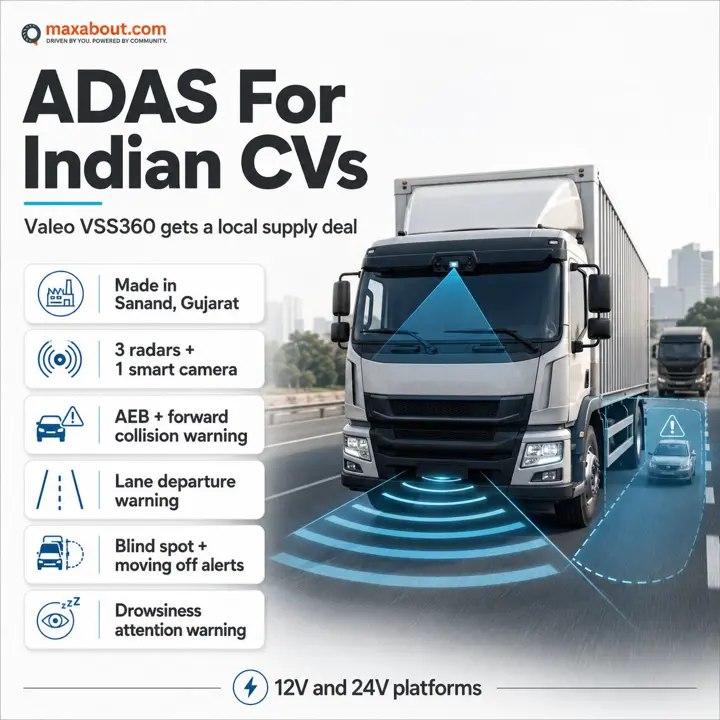 Their core strength in ADAS sits across four technology areas: radar sensors for detecting objects at distance, camera systems for lane and obstacle recognition, ultrasonic sensors for close-range detection, and driver monitoring systems that track fatigue and attention levels. These are not experimental technologies — they have been deployed in passenger vehicles across Europe and Asia for several years.
The India angle is specifically focused on commercial vehicles. Based on official announcements and industry reports, Valeo's engagement here targets trucks, intercity buses, and light commercial vehicles — segments that move the majority of India's freight and passenger load on highways.
What makes this noteworthy is the localization component. Rather than simply importing finished sensor modules, the partnership reportedly involves local integration and supply chain development, which directly affects cost viability for Indian fleet operators who are working with significantly tighter margins than European counterparts.
The State of Road Safety in India: A Problem That Demands This Solution
Here is a number that should stop you cold: India accounts for roughly 11% of global road accident fatalities despite having a fraction of the world's total vehicles. According to official government transport data, over 1.5 lakh people die on Indian roads every year. Of those, a disproportionate share involve trucks and buses — heavy commercial vehicles that dominate our national highways after dark.
Think about the Delhi-Mumbai corridor, or the Chennai-Bengaluru stretch late at night. Poorly lit roads, no lane markings, overloaded trucks pushing well beyond safe limits, and drivers who have been behind the wheel for 14 or 16 hours straight. Driver fatigue alone is cited in industry reports as a leading cause of highway crashes involving commercial vehicles. These are not freak accidents. They are predictable, repeatable failures — and that is precisely what makes them addressable with the right technology.
This is where forward collision warning, automatic emergency braking, and lane keep assist become genuinely life-saving tools rather than marketing features. A fatigued driver drifting across lanes on NH48 at 2 AM is not going to self-correct in time. But a system actively monitoring the vehicle's position and reacting in milliseconds can. The blind spots on a fully loaded 18-wheeler are enormous — another vehicle, a cyclist, a pedestrian can disappear entirely from a driver's view. ADAS does not get tired. It does not lose concentration.
The urgency is real. And the scale of India's commercial vehicle fleet makes this the right place to deploy it.
How ADAS for Commercial Vehicles Differs from What You See in Passenger Cars
When most people think about ADAS, they picture the lane-keep assist on a Hyundai Tucson or the automatic emergency braking on an MG Astor. Useful features, no question. But engineering those systems for a passenger car and engineering them for a 40-tonne truck are two completely different problems. The physics alone change everything.
Start with stopping distances. A loaded commercial vehicle travelling at highway speed needs significantly more distance to come to a halt than a passenger car does. The ADAS systems responding to a hazard cannot simply apply the brakes the same way — the braking logic, the warning thresholds, everything has to be recalibrated for mass, momentum, and load state. A truck running empty handles differently from one carrying full cargo. The system has to account for both conditions reliably.
Then there is the question of geometry. A long-haul truck has a dramatically higher center of gravity, a much longer wheelbase, and blind spots that passenger car engineers simply do not have to worry about. Sensor placement becomes genuinely complex — cameras, radar units, and ultrasonic sensors need to cover a vehicle that may stretch beyond 12 meters, with trailer articulation adding another layer of unpredictability.
Driver behavior patterns are different too. Long-haul truck drivers are managing fatigue over eight to twelve hour stretches, often on poorly lit state highways rather than well-marked expressways. The ADAS intervention logic has to be tuned for that reality — not triggering unnecessary alerts that drivers learn to ignore, but also not waiting too long when a genuine hazard develops. Getting that calibration right is far harder than it sounds.
Cost sensitivity adds another layer of difficulty. Fleet operators in India run on thin margins. Fuel, tyres, tolls, driver wages — every line item is watched carefully. An ADAS solution for commercial vehicles cannot be priced like a premium passenger car feature. It has to justify itself through measurable outcomes: fewer accidents, lower insurance costs, reduced vehicle downtime. That means the hardware needs to be robust and affordable, and the integration cannot require expensive dealership visits every time something needs updating.
This is precisely why commercial vehicle ADAS is a specialized engineering discipline, not simply a scaled-up version of what Hyundai or Maruti puts into their top-end variants.
What Fleet Operators and Transport Companies Stand to Gain
For a transport company running 200 trucks or a state transport undertaking managing hundreds of buses, the conversation around ADAS is not really about technology. It is about the bottom line.
The business case starts with insurance. Fleet operators in India pay significant premiums, and accident history directly drives those costs upward. Even a modest reduction in collision frequency can translate into meaningful savings at scale — across a large fleet, that arithmetic becomes compelling fairly quickly.
Then there is vehicle downtime. A truck off the road for repairs after a preventable collision is lost revenue. Logistics companies, particularly those serving e-commerce clients with strict delivery timelines, understand this pressure well. Fewer accidents mean fewer disruptions to operations.
Regulatory pressure is also building. India's evolving safety mandates, including the momentum behind Bharat NCAP and broader government safety initiatives, are nudging commercial vehicle standards in a more demanding direction. Fleet operators who adopt ADAS proactively are better positioned for compliance rather than scrambling to retrofit later.
That said, the adoption is not without friction. Driver training is a genuine challenge — many commercial drivers are unfamiliar with sensor-assisted systems and may distrust or override alerts. Maintenance complexity adds another layer of concern for smaller fleet owners without dedicated service infrastructure.
The opportunity is real. But so are the hurdles.
Regulatory Push and Government Policy: Is India Ready for Commercial Vehicle ADAS?
The timing of Valeo's commercial vehicle ADAS push in India is not accidental. It aligns with a regulatory environment that is, slowly but meaningfully, shifting toward mandating electronic safety systems. The Ministry of Road Transport and Highways has been increasingly assertive about road safety — and commercial vehicles sit at the center of that concern, given their outsized role in fatal accidents on Indian highways.
India's AIS (Automotive Industry Standard) framework has already laid groundwork here. Standards like AIS-140, which mandates vehicle tracking and emergency response systems for public transport, signal that the government is willing to push technology adoption through compliance requirements rather than leaving it purely to market forces. Industry observers expect similar momentum to build around advanced driver assistance features, particularly for heavy commercial vehicles operating on national highways.
MoRTH's broader Vision Zero-inspired road safety targets — aiming to halve road fatalities by 2030 — add urgency to this direction. From what policy analysts note, electronic stability control and automatic emergency braking are among the systems under active consideration for future mandates in the commercial segment.
But here is where honesty matters. Policy intent and ground reality in India often diverge significantly. Even well-intentioned mandates face implementation gaps. The real question is not just whether regulations will arrive — it is whether Indian roads can actually support ADAS systems performing reliably once they do.
The infrastructure challenge is genuine and should not be understated. Lane markings across large stretches of Indian highways are faded, inconsistent, or simply absent — a direct problem for lane departure warning systems that depend on clear visual inputs. Road signage quality varies enormously between a well-maintained expressway like the Delhi-Mumbai corridor and a state highway in a rural district. GPS mapping accuracy, while improving with platforms like HERE and Google Maps refining their India datasets, still struggles in semi-urban fringes and newly developed industrial zones where commercial traffic is heavy.
These are not minor inconveniences. They are fundamental inputs that determine whether an ADAS system delivers genuine safety value or generates enough false alerts to frustrate drivers into disabling it entirely.
The optimistic read is that regulation and infrastructure will co-evolve — that mandates create demand, demand drives investment in better road infrastructure, and the cycle feeds itself. That has happened in other markets. Whether India's execution machinery can move fast enough to make that cycle work before fleet operators grow disillusioned is the harder, less comfortable question worth asking.
Challenges Valeo and Its Partners Will Face in the Indian Market
None of this happens smoothly. The honest assessment is that Valeo and whatever fleet operators or OEM partners it works with are walking into a market that will push back — not out of stubbornness, but because the structural realities are genuinely difficult.
Cost is the first wall. Commercial vehicle operators in India, particularly the smaller fleet owners running two or three trucks, operate on margins that would make most logistics businesses in Europe unviable. Every additional component cost gets scrutinized hard. ADAS systems add meaningful expense to vehicle pricing, and the question of who absorbs that — manufacturer, fleet operator, or driver-owner — has no clean answer yet.
Then there is the fragmented nature of Indian trucking itself. A significant portion of the industry is unorganized — individual owner-operators, informal arrangements, older vehicles that will never see a factory-fitted sensor suite. Regulation can mandate ADAS on new commercial vehicles, but retrofitting or influencing purchasing decisions across this segment is a different challenge entirely.
Driver resistance is real and worth taking seriously. Fatigue monitoring and lane-departure alerts can feel intrusive, particularly to experienced drivers who have managed difficult routes for decades without electronic oversight. If the technology is not introduced carefully, with proper explanation and trust-building, pushback is predictable.
Similar friction appeared in Brazil and Southeast Asia during early telematics adoption — operators eventually came around, but it took time and better localization of the technology itself.
What This Deal Signals for the Future of Indian Commercial Vehicles and Road Safety
Despite those adoption challenges, the Valeo deal feels like something more than a press release moment. It points toward a broader, structural shift in how India's commercial vehicle ecosystem is being built — and who is building it.
Over the next five to ten years, I think we will see more global Tier-1 suppliers treating India not just as an export market, but as an active development ground. The cost pressures here are unlike anywhere else, and that forces genuine engineering innovation rather than simple technology transfer. Valeo entering this space sends a clear signal to competitors: India's commercial vehicle segment is ready for serious technology investment.
For fleet operators watching this unfold, the practical advice is straightforward — start asking questions now. What ADAS features are available on your next truck purchase? What does the service and calibration network look like? Technology that cannot be maintained locally is not really an asset. Individual truck owners should watch resale value trends closely, because ADAS-equipped vehicles may command meaningfully better prices within a few years as insurance and regulatory frameworks catch up.
Startups are worth watching too. The Valeo partnership creates an upstream anchor, but it also opens space for smaller Indian companies to build complementary solutions — driver coaching software, fleet dashboards, incident reporting tools — that plug into this emerging ADAS infrastructure.
Is this a genuine shift or early groundwork? Honestly, both. The foundations are being laid with real intent, but the building itself will take years. What concerns me is the familiar gap between technology deployment and everything that needs to surround it. India's highways have improved significantly, but secondary roads, poorly marked intersections, and unpredictable traffic patterns remain deeply challenging environments for sensor-based systems. ADAS is only as effective as the context it operates in.
Enforcement and driver training matter just as much — perhaps more. A forward-collision warning system cannot compensate for a driver who has been on the road for sixteen hours, or for a highway that lacks functional lane markings. Technology and infrastructure have to move together, and historically in India, that coordination has been uneven at best.
So yes, this deal matters. But whether India's roads actually become safer will depend on something harder than a supply agreement — it will depend on whether regulators, fleet owners, drivers, and technology providers all pull in the same direction, at the same time. That is a harder problem than any sensor array can solve on its own.
No comments yet
Be the first to share your thoughts!
Want to read more automotive news?
Stay updated with the latest car launches, reviews, and industry insights.
Browse All News