
Ultraviolette BaaS Model Drives 2026 Sales Surge
Something interesting happened in the Indian electric two-wheeler space in 2026. Ultraviolette — a brand that many buyers admired but hesitated over because of its steep price — started moving units at a pace that genuinely surprised the industry. The reason? A model called Battery-as-a-Service, or ...
Editorial Team
Something interesting happened in the Indian electric two-wheeler space in 2026. Ultraviolette — a brand that many buyers admired but hesitated over because of its steep price — started moving units at a pace that genuinely surprised the industry. The reason? A model called Battery-as-a-Service, or BaaS.
If you're unfamiliar, BaaS is straightforward. Instead of paying for the battery when you buy the motorcycle, you essentially lease it monthly. The upfront purchase price drops significantly, and you pay a subscription fee for battery usage. Simple in concept, but the impact on buyer psychology? Massive.
Here's the thing about Indian buyers — and I say this based on how conversations around EV purchases typically go. Before signing anything, most people run through a mental checklist. What's the EMI? What happens to resale value? What's the total cost over five years? High upfront pricing has historically stopped otherwise interested buyers cold, especially in the premium electric segment.
BaaS directly addressed that hesitation. It made Ultraviolette's F77 feel accessible in a way it never had before. And that shift matters beyond just one brand — it potentially signals a new commercial template for how premium electric two-wheelers get sold across India going forward.
What Is Battery-as-a-Service and How Does It Work for Ultraviolette Buyers
The concept is straightforward once you strip away the marketing language. Under BaaS, you buy the Ultraviolette F77 without the battery pack included. The motorcycle itself — the frame, motor, electronics, everything except the battery — is what you're purchasing outright. That immediately brings the upfront price down substantially, which is the whole point.
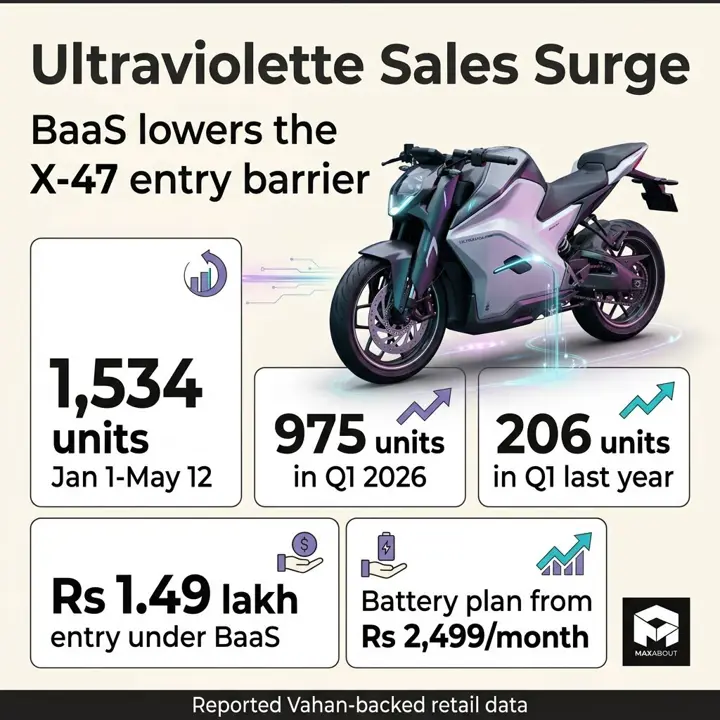 The battery then comes to you through a monthly subscription. Think of it loosely like leasing rather than owning. You pay a recurring fee to use the battery, and Ultraviolette retains ownership of it.
From what industry reports suggest, the subscription structure can work in a few different ways depending on the plan a buyer selects:
A fixed monthly fee regardless of how much you ride
A kilometre-based plan where your monthly cost scales with usage
A hybrid model combining a base fee with per-kilometre charges beyond a set limit
Now here's where buyers genuinely need to read the fine print. Battery degradation is real, and over time — especially through Indian summers and stop-start city traffic in places like Bengaluru or Hyderabad — cells lose capacity. Under the BaaS arrangement, Ultraviolette is responsible for replacing a degraded battery since they own it, not you. That's actually a meaningful protection that outright ownership doesn't give you.
Service centre availability is the practical question most riders should ask first. The BaaS model only works smoothly if authorised service points exist within reasonable distance. For metro riders, that's less of a concern. For someone in a smaller city, it's worth verifying before committing.
The Real Numbers: How Much Does Ultraviolette Actually Cost Under BaaS
Let's actually do the math here. The F77 without battery — the ex-battery price under BaaS — comes in roughly around ₹2.5 to ₹3 lakh depending on the variant. The full ownership price, battery included, sits closer to ₹3.8 to ₹4.5 lakh. That upfront gap is exactly what makes BaaS attractive on paper.
Your monthly outgo under BaaS would look something like this: a loan EMI on the base vehicle price, plus the battery subscription fee which is estimated around ₹2,500 to ₹3,500 per month based on usage tiers. So realistically, total monthly cost lands somewhere between ₹7,000 and ₹9,500 for most urban riders.
Now compare that against a 200cc petrol bike in Pune or Bengaluru. Fuel alone — given current prices and typical city commuting — runs ₹2,500 to ₹3,500 monthly. Add servicing, oil changes, and general wear. The gap narrows faster than the EV marketing suggests.
Here's the honest part though. Over five years, cumulative battery subscription payments could cross ₹1.5 to ₹2 lakh. That's real money. The BaaS model works best for riders who prioritise lower entry cost and predictable monthly expenses — not necessarily the lowest total cost over a long ownership period.
Why Indian Buyers Are Finally Warming Up to Ultraviolette in 2026
Something has shifted. Not dramatically overnight, but gradually — the kind of change you notice when you look back six months and realise conversations about Ultraviolette sound different now. Less sceptical. More curious. Sometimes genuinely enthusiastic.
A lot of that credit goes to Bengaluru. As Ultraviolette's home city, it became an organic testing ground where early adopters quietly built credibility for the brand. Riders in Koramangala, Whitefield, and Indiranagar have been seen on F77s long enough that the bike no longer feels like a bold experiment. It feels established. That street-level familiarity matters more than any advertisement.
Word-of-mouth from those early riders has done considerable work. From what has been widely reported, test ride experiences at Ultraviolette experience centres consistently leave strong impressions — the acceleration, the build quality, the overall premium feel. Riders who expected a glorified electric scooter reportedly leave surprised. That surprise travels.
Rising petrol prices have also done their part. With fuel costs climbing steadily, the running cost advantage of EVs becomes harder to ignore for younger urban professionals calculating monthly expenses seriously. Infrastructure anxiety — once a genuine barrier — has reduced meaningfully as charging networks expand across metro corridors.
Perhaps most importantly, the social perception of electric two-wheelers has matured. Choosing an EV no longer signals compromise. Among younger riders especially, it signals awareness. Ultraviolette, positioned firmly as a performance brand rather than an economy option, benefits directly from that evolving mindset.
Honest Pros and Cons of Choosing Ultraviolette Under the BaaS Model
The Battery-as-a-Service model genuinely solves some real problems. But it creates a few new ones too. Worth being clear-eyed about both before signing anything.
What actually works in your favour: The entry price drops significantly, making Ultraviolette accessible without a large upfront commitment. Battery degradation — something that quietly terrifies every EV buyer — becomes the company's problem, not yours. Monthly costs are predictable, which matters when you're budgeting seriously. And the performance itself? From what riders and reviewers consistently report, the F77 Mach 2 competes genuinely with petrol bikes in this segment. That combination is hard to dismiss.
Where it gets uncomfortable: If you're covering high kilometres — say, a daily 60-plus kilometre commute — the subscription costs accumulate. Over five or six years, there's a real possibility you've paid more than full ownership would have cost. That's not a hypothetical; it's straightforward arithmetic worth doing before committing.
There's also the question of dependency. You're not just buying a bike. You're entering an ongoing financial relationship with one company. What happens if Ultraviolette revises subscription terms two years from now? The fine print matters enormously here, and most buyers don't read it carefully enough.
For riders in cities like Nashik, Coimbatore, or Bhopal, the concerns become more practical. Service infrastructure outside metros remains thin. Highway trips still require careful planning — battery swap networks are nowhere near the coverage of home charging, and home charging itself assumes stable overnight access, which isn't universal.
The BaaS model is genuinely promising. It's just not yet frictionless for everyone.
How BaaS Compares to What Other Indian EV Brands Are Offering
Ultraviolette isn't operating in a vacuum here. The broader Indian electric two-wheeler market has been wrestling with the affordability problem for years, and different brands have taken very different approaches to solving it.
Some competitors leaned heavily on aggressive upfront discounts and FAME subsidy pass-throughs to make their vehicles appear accessible. Others built financing partnerships with NBFCs offering low down payments and stretched EMI tenures. A few experimented with their own subscription-style programs, though most of those remained limited in scope or quietly wound down when uptake was lower than expected.
What Ultraviolette has done with BaaS feels structurally different. Rather than discounting the vehicle or hiding costs inside a loan, the model separates ownership of the machine from ownership of the battery — the single most expensive component. That's a meaningful distinction, not just a marketing reframe.
Globally, battery subscription has gained traction in markets like Taiwan and parts of Europe, largely because it removes the anxiety around long-term battery degradation. India's adoption of this model has been slower, partly due to trust gaps and partly because the incumbent brands built their identity around outright ownership narratives.
In my view, competitors will follow. The unit economics are too compelling to ignore as battery costs remain high. Whether Ultraviolette holds a first-mover advantage long enough to matter is the real question.
Should You Buy an Ultraviolette Under BaaS in 2026? Practical Advice for Indian Riders
The honest answer is: it depends entirely on who you are and how you actually ride.
If you're a daily urban commuter in Bengaluru, Pune, or Hyderabad, BaaS makes genuine sense. Short, predictable distances, access to charging infrastructure, and the ability to offset subscription costs against saved fuel expenses — the numbers work in your favour. The performance headroom also means city traffic feels almost effortless.
For the performance enthusiast who wants weekend highway runs alongside weekday commuting, think carefully. Range anxiety on longer stretches remains real, and the subscription commitment adds a layer of financial obligation that outright ownership doesn't.
Cost-conscious buyers comparing against a 150cc-200cc petrol bike should run their own numbers honestly. If your annual mileage is low, the subscription model may not save you enough to justify the switch.
Tier-2 city buyers should probably wait. Without reliable charging infrastructure nearby, the entire value proposition weakens considerably.
As for what this sales surge actually means — I'd call it a genuinely promising data point rather than a definitive turning point. One brand's strong quarter doesn't reshape an industry. But it does prove something important: Indian riders will embrace EVs when the financial structure finally respects how they think about money.
No comments yet
Be the first to share your thoughts!
Want to read more automotive news?
Stay updated with the latest car launches, reviews, and industry insights.
Browse All News