
TVS FY27 Capacity Expansion Plan: What It Means for Buyers
Something significant is happening at TVS Motor Company, and it goes beyond quarterly sales numbers. The company is making a serious bet on the future — one that could reshape how millions of Indians buy, ride, and think about two-wheelers over the next few years.India's two-wheeler market is genuin...
Editorial Team
Something significant is happening at TVS Motor Company, and it goes beyond quarterly sales numbers. The company is making a serious bet on the future — one that could reshape how millions of Indians buy, ride, and think about two-wheelers over the next few years.
India's two-wheeler market is genuinely at an inflection point. Demand is recovering strongly, electric vehicles are creating entirely new buyer segments, and export opportunities — particularly in Southeast Asia, Africa, and Latin America — are opening faster than most analysts expected. TVS has been quietly capitalizing on all three trends simultaneously, and their FY27 capacity expansion plan appears to be the moment they stop being quiet about it.
According to industry reports and official announcements, TVS is committing substantial capital investment toward expanding manufacturing capacity, with production targets designed to support both domestic growth and accelerating export volumes. The scale of this expansion signals genuine confidence — not cautious optimism.
What makes this story interesting beyond investor circles is the downstream effect. More capacity means better dealer availability, potentially shorter waiting periods, and competitive pricing pressure across segments. For someone considering a new scooter or motorcycle purchase in the next twelve to eighteen months, this decision made in boardrooms today could meaningfully affect their buying experience tomorrow.
Why TVS Is Betting Big on FY27: The Demand Story Behind the Decision
Capacity expansion at this scale does not happen on instinct. There is a very specific demand story pushing TVS toward this decision — and it unfolds across several fronts simultaneously.
Start with the premium two-wheeler segment. Industry reports consistently show that buyers are moving upmarket. The ₹1 lakh to ₹1.5 lakh motorcycle bracket has seen disproportionate growth over the past two years. Riders who previously considered entry-level commuters are now stretching budgets for better features, performance, and aesthetics. TVS, with products like the Apache and Ronin series, sits well inside this sweet spot. But meeting rising demand requires more than good products — it requires the physical capacity to build them fast enough.
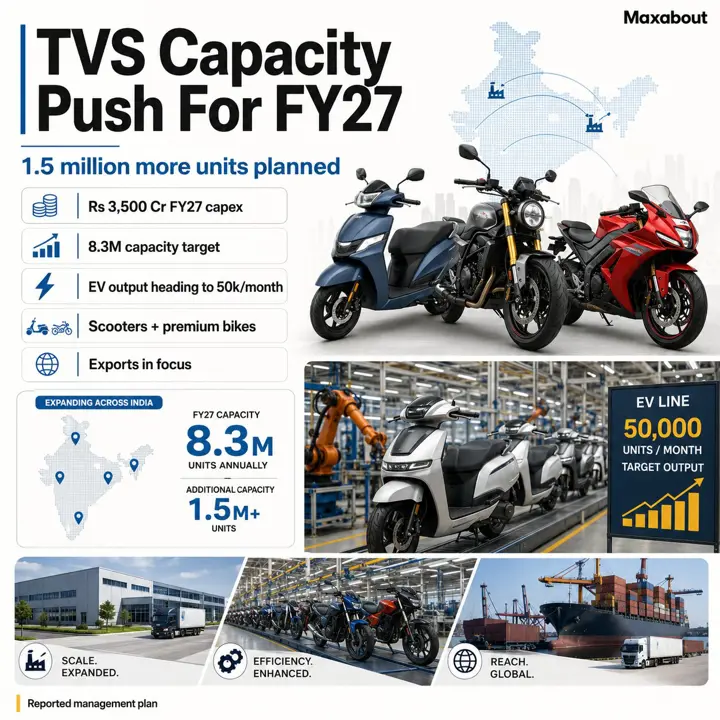 Then there is the EV pressure. Government policy tailwinds, FAME subsidies, and state-level incentives have accelerated electric two-wheeler adoption faster than most manufacturers anticipated. TVS iQube has been gaining real traction, particularly in cities like Bengaluru, Pune, and Chennai. Scaling EV production requires dedicated lines, battery assembly infrastructure, and quality controls that cannot simply be bolted onto existing setups.
Rural penetration adds another layer. Improving road connectivity and rising agricultural incomes across states like Madhya Pradesh, Rajasthan, and Uttar Pradesh are bringing first-time buyers into the market — buyers who want reliable, affordable mobility. This is not a niche opportunity. It is structurally significant volume.
Export ambitions complete the picture. TVS has been steadily building its presence in Africa, Southeast Asia, and Latin America — markets hungry for durable, fuel-efficient two-wheelers at accessible price points. FY27 timing aligns with post-pandemic logistics normalization and stronger trade frameworks, making it a credible window to scale international volumes meaningfully.
Competitors are moving too. Hero MotoCorp and Bajaj Auto have both announced manufacturing investments, essentially signaling that the entire industry sees the same demand curve approaching. Standing still is not an option when your rivals are adding headroom. FY27 is not an arbitrary deadline — it reflects where recovery cycles, policy momentum, and consumer confidence are expected to converge.
Inside the Expansion Plan: Facilities, Investment, and Production Targets
TVS Motor has been directing significant capital toward its existing manufacturing base rather than starting entirely from scratch. The Hosur facility in Tamil Nadu remains the operational core — it handles the bulk of two-wheeler production and is where most of the near-term capacity additions are being concentrated. Mysuru plays a supporting role, particularly for certain product lines, and industry reports suggest incremental upgrades there as well.
On the investment side, TVS has publicly committed to capital expenditure in the range of ₹1,000–1,200 crore annually over this expansion cycle, covering tooling, automation upgrades, and line additions. This is not a one-shot announcement — it follows a phased approach, with successive quarters seeing capacity unlocked rather than everything arriving at once. That kind of structured rollout reduces execution risk considerably.
What stands out is the dedicated push toward EV-specific production infrastructure. The iQube assembly lines are being treated separately from the internal combustion engine lines — different processes, different supplier dependencies, and different quality benchmarks. Keeping them distinct makes operational sense as EV volumes grow unpredictably.
From a jobs and supply chain perspective, expansions at this scale typically generate thousands of direct and indirect employment opportunities around Hosur's industrial corridor. Local component suppliers — particularly those producing battery packs, wiring harnesses, and lightweight frame components — stand to benefit meaningfully as TVS ramps sourcing to match higher output targets.
The EV Angle: How Much of This Expansion Is About Electric Vehicles
TVS has never been quiet about its electric ambitions. The iQube has quietly matured from a cautious experiment into a genuinely competitive product, and from what industry observers note, EV-oriented capacity is increasingly central to the FY27 expansion blueprint — not a side conversation.
The numbers support that reading. The iQube has seen consistent month-on-month volume growth, and TVS appears to be betting that this trajectory holds. Dedicated EV assembly lines, rather than shared infrastructure with combustion vehicles, seem to be part of the thinking here. That separation matters — EV production involves fundamentally different processes around battery integration and quality checks.
Government policy has clearly shaped these decisions. FAME II benefits and state-level EV subsidies have made the economics of scaling electric manufacturing more viable. TVS would be leaving real money on the table by not aligning capacity investments with these frameworks.
The competitive pressure is real too. Ola Electric, Ather Energy, and Bajaj's Chetak platform are all pushing hard. TVS cannot afford to be cautious here.
That said, battery supply chain reliability remains the honest challenge. Cell sourcing dependencies and charging ecosystem gaps in smaller cities could slow adoption regardless of how aggressively TVS builds capacity. Expanding assembly lines is the easier part. Ensuring the broader ecosystem keeps pace — that's where execution genuinely gets tested.
What This Means for TVS Buyers: Availability, Wait Times, and New Models
So what does all of this actually mean if you're someone standing at a TVS dealership, trying to decide whether to book a Jupiter or an iQube right now? Honestly, quite a bit.
Expanded capacity almost always translates into shorter waiting periods. The TVS Jupiter and the Apache series have both seen booking queues stretch uncomfortably long during peak demand periods — festive seasons especially. More production headroom means dealers can maintain better floor stock rather than running on backorder mode constantly.
The iQube, in particular, has struggled with availability in several cities. From what buyers in tier-2 markets have reported, wait times of six to ten weeks have not been uncommon. With additional capacity coming online, that experience should genuinely improve.
There's also the new model angle. When a manufacturer isn't scrambling to meet existing demand, it gets room to launch fresh products without disrupting current lines. Whether that means a more premium Apache variant, a longer-range iQube, or a refined commuter — the capacity expansion creates breathing room for TVS to execute those plans properly.
If you're weighing a TVS purchase right now, this expansion is a reasonable signal of confidence in the brand's near-term direction.
Export Ambitions: TVS's Global Growth Plans Riding on FY27 Capacity
TVS isn't just building for Indian roads. The brand has quietly become one of India's more serious two-wheeler exporters, and the FY27 capacity push has a clear international dimension to it.
Africa remains TVS's strongest export territory, where the Star City and Radeon have built genuine reputations for reliability on rough terrain. Bangladesh and Nepal are consistent volume contributors too. More recently, select Latin American markets have started showing traction. These aren't marginal numbers — export volumes have been climbing steadily, and the ambition appears to be scaling that further.
The Apache series carries significant weight here. It competes as a premium offering in several developing markets where it punches above its price point. From what industry reports suggest, TVS is looking to grow export volumes meaningfully through this expansion cycle rather than treating international demand as secondary.
Then there's Norton Motorcycles. TVS acquired the iconic British brand, and while Norton operates independently, the association gives TVS credibility in premium Western markets that raw volume numbers never could.
Crucially, expanded domestic production means TVS can fulfill export commitments without pulling supply away from Indian dealerships — which has historically been a real tension point for growing exporters.
Risks and Challenges: Can TVS Execute This Expansion Successfully?
Ambition is one thing. Execution is another. And honestly, this is where I think it's worth pausing and asking some harder questions.
Raw material costs remain unpredictable. Steel, aluminium, and copper — the backbone of two-wheeler manufacturing — have seen significant price swings over recent years. Any sustained inflation here directly compresses margins, especially on entry-level models where pricing pressure is already intense.
Semiconductor availability is another variable TVS cannot fully control. The industry learned that lesson painfully between 2021 and 2023. EV powertrains, in particular, carry greater chip dependency than conventional engines.
Then there's the EV adoption pace question. TVS is clearly betting on electric momentum continuing. But rural two-wheeler buyers remain cautious — charging infrastructure outside Tier-1 cities is still patchy, and financing penetration for EVs lags significantly behind conventional vehicles. If adoption stalls, newly built EV-dedicated capacity sits underutilized.
Large-scale capital projects in Indian manufacturing also carry inherent execution risk. Land acquisition, regulatory clearances, and construction timelines have historically stretched beyond original projections across the industry. TVS has a reasonably clean track record here, but the scale of FY27 commitments is meaningfully larger than previous cycles.
Finally, competitive dynamics could shift the demand math entirely. Hero MotoCorp and Bajaj are not standing still — aggressive pricing moves or compelling new launches could erode the volume assumptions underpinning this expansion. That's a real risk worth watching.
Final Thoughts: Confidence, Calculation, or Both?
After weighing everything, I think this expansion is best understood as a disciplined bet rather than a reckless one. TVS has consistently been one of the more careful capital allocators in the Indian two-wheeler space. They have not historically chased volume for its own sake, which gives me reasonable confidence that this FY27 commitment is grounded in something more than boardroom optimism.
That said, scale changes the equation. What worked at smaller expansion cycles does not automatically translate when the commitments grow meaningfully larger. Execution risk is real, and the external environment — rural demand patterns, competitive intensity, raw material costs — could make even well-planned targets difficult to hit cleanly.
My honest read is that TVS sees a structural window opening in India's premiumization story, and they want capacity ready before demand fully arrives. That logic is sound. Whether the timing lands perfectly is something only FY27 results will confirm.
For buyers and enthusiasts, watch for new product launches tied to this capacity. For industry watchers, the quarterly capacity utilization numbers will tell the real story long before any official announcement does.
No comments yet
Be the first to share your thoughts!
Want to read more automotive news?
Stay updated with the latest car launches, reviews, and industry insights.
Browse All News