

Toyota's ₹15,800 Cr Maharashtra Expansion: 3 New Plants By 2030
Toyota's Maharashtra Expansion: A Game-Changer for Indian Automotive IndustryToyota's recent announcement of a massive ₹15,800 crore (USD 1.9 billion) investment in Maharashtra marks one of the most significant automotive developments I've seen in recent years. Setting up three new manufacturing fac...
Toyota's Maharashtra Expansion: A Game-Changer for Indian Automotive Industry
Toyota's recent announcement of a massive ₹15,800 crore (USD 1.9 billion) investment in Maharashtra marks one of the most significant automotive developments I've seen in recent years. Setting up three new manufacturing facilities by 2030 signals Toyota's serious long-term commitment to the Indian market.
This expansion is particularly noteworthy considering Toyota's current relatively modest market share in India. With their existing manufacturing primarily centered in Karnataka, this Maharashtra move represents a strategic pivot that could dramatically alter their production capacity and market presence.
From my perspective, this investment will likely translate to several tangible benefits for Indian consumers. We might see more locally manufactured Toyota models (potentially at more competitive price points), shorter waiting periods, and possibly even India-specific vehicles designed for our unique road conditions.
The economic impact shouldn't be underestimated either. Beyond creating thousands of direct jobs, these plants will establish an extensive supplier ecosystem, boosting the broader manufacturing sector. I believe this move positions Maharashtra as an increasingly important automotive hub, potentially rivaling established centers like Chennai and Gurugram.
Breaking Down the Investment: What Does $1.9 Billion Mean?
Let's put this ₹15,800 crore ($1.9 billion) investment into perspective. From what I understand, this capital injection will likely create manufacturing capacity for approximately 200,000-250,000 vehicles annually across the three plants. This is substantial when you consider Toyota's current capacity in India stands at around 310,000 units at its Karnataka facility.
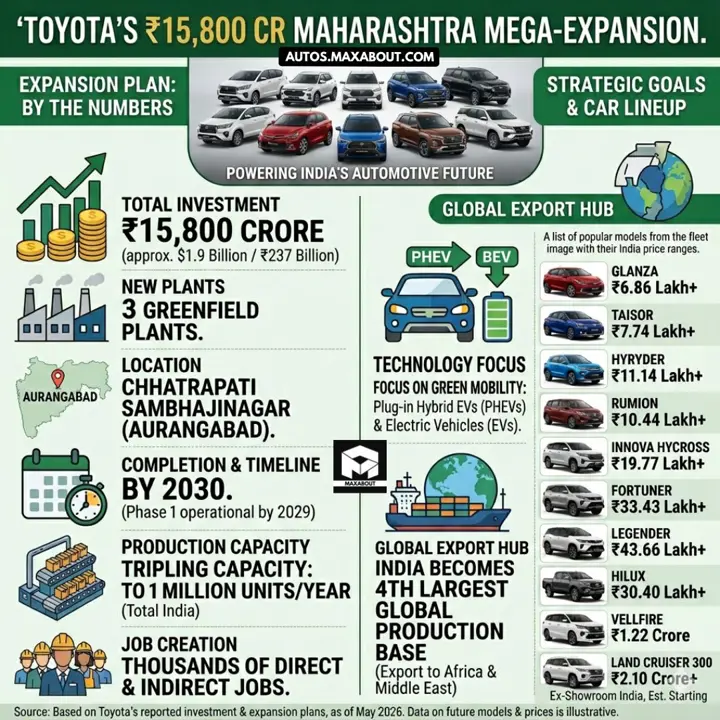 The investment appears strategically focused on diversified production capabilities. I expect we'll see these plants handling everything from mass-market models like the Urban Cruiser to hybrid and electric vehicles. The scale suggests at least one plant will likely be equipped with advanced automation and Industry 4.0 manufacturing technologies.
Compared to other recent automotive investments, this is significant - larger than Kia's initial ₹10,000 crore entry into India, though smaller than the Suzuki-Toyota combined ₹18,000 crore EV manufacturing plan announced earlier. The timing is particularly meaningful as several European manufacturers have scaled back Indian investments.
For Maharashtra, this could generate 4,000-5,000 direct jobs and potentially 15,000-20,000 indirect employment opportunities across the supplier ecosystem. The investment reveals Toyota's strong commitment to India as not just a market but as a manufacturing hub in their global production network.
The Maharashtra Advantage: Why Toyota Chose This Location
Toyota's selection of Maharashtra for this massive investment wasn't coincidental. The state offers several compelling advantages over other automotive manufacturing hubs in India.
I think Maharashtra's robust infrastructure is a major factor. The state boasts excellent connectivity with major ports like JNPT, well-maintained highways, and reliable power supply - critical requirements for automotive manufacturing at scale.
The existing automotive ecosystem in Maharashtra is equally impressive. The Chakan-Talegaon belt near Pune already hosts manufacturers like Volkswagen, Mercedes-Benz, and Bajaj Auto, creating a ready supplier network that Toyota can leverage. In my view, this established cluster offers significant cost efficiencies compared to building in isolation.
Government policies likely sealed the deal. Maharashtra's industrial policy offers substantial incentives including land at competitive rates, electricity duty exemptions, and SGST reimbursements. While Tamil Nadu, Gujarat, and Haryana offer similar packages, Maharashtra's combination of incentives with existing infrastructure gives it an edge.
The state's strategic location provides excellent access to both domestic and export markets. From a logistics perspective, this allows Toyota to optimize supply chains and reduce transportation costs significantly compared to inland locations in states like Haryana.
Expected Impact on Toyota's Product Portfolio in India
This massive investment will likely transform Toyota's product strategy in the Indian market. With three new plants, I expect Toyota to significantly diversify its portfolio beyond its current offerings like the Innova and Fortuner.
The expanded manufacturing capacity could finally address the painfully long waiting periods for popular models like the Urban Cruiser Hyryder. From what I've observed, Toyota might prioritize localizing more components for its hybrid vehicles, potentially bringing down prices of models like the Hyryder and Camry hybrid by ₹1-2 lakh.
I believe we'll see Toyota make a stronger push into the competitive sub-₹10 lakh segment where it currently has limited presence. This could include:
More affordable SUVs positioned below the Urban Cruiser
Mass-market hybrid options with better fuel efficiency for Indian driving conditions
Possibly entry-level EVs by 2026-27 as the market matures
The most exciting prospect is whether Toyota will finally bring its globally successful models like the RAV4 or Corolla Cross to India. With greater localization capabilities, these vehicles could be adapted for our roads and priced competitively against rivals like Hyundai Tucson and Volkswagen Tiguan.
Given the current focus on SUVs and rising fuel prices, I think Toyota's hybrid technology will feature prominently in their expanded lineup, offering a practical middle ground before full electrification takes hold in India.
Price Implications for Indian Consumers
With Toyota's ₹15,600 crore (USD 1.9 billion) investment in Maharashtra, I expect significant price benefits for Indian buyers in the coming years. Local manufacturing typically reduces production costs by 15-20% compared to completely built imports, which could translate to more competitive pricing across Toyota's lineup.
The current Fortuner and Innova models, despite being manufactured locally, still command premium prices (₹35-50 lakh range). With expanded production facilities, I believe Toyota might introduce more affordable variants with localized components while maintaining their renowned quality standards.
For premium vehicles like Camry and Vellfire that currently attract heavy import duties, localization could potentially bring their prices down by ₹3-5 lakh. This would position Toyota more competitively against Hyundai and Jeep in the ₹20-30 lakh segment where they currently struggle.
Unlike Maruti Suzuki's mass-market approach, Toyota will likely maintain their quality-first strategy but with more accessible price points. This investment might finally help them challenge Hyundai and Tata in the critical ₹10-20 lakh SUV segment where Indian consumers are increasingly spending.
Environmental and Sustainability Aspects
Toyota's massive investment in Maharashtra comes with significant green implications. Having followed Toyota's global sustainability practices, I think these new plants will likely incorporate their innovative eco-friendly manufacturing techniques. Their "Toyota Environmental Challenge 2050" commitment isn't just corporate talk - they've consistently reduced water usage and emissions in their factories worldwide.
What excites me most is how these facilities could accelerate Toyota's electrification plans for India. While they've been somewhat cautious with EVs here (compared to their hybrid push), these new plants provide the perfect opportunity to manufacture affordable electric and hybrid vehicles specifically designed for Indian conditions.
The Strong Hybrid technology that Toyota has perfected could be a perfect interim solution for India's challenging charging infrastructure situation. I expect these plants to produce more affordable hybrid versions of models like the Urban Cruiser and even introduce compact EVs in the ₹15-20 lakh range by 2026-27.
Maharashtra's relatively stable power supply and progressive environmental policies make it a strategic choice for green manufacturing. If Toyota implements their closed-loop water systems and renewable energy installations (as they've done in Thailand and Japan), these plants could become benchmarks for sustainable automotive manufacturing in India.
Challenges and Potential Roadblocks
Despite the promising outlook, Toyota's ambitious expansion plan faces several significant hurdles. The 2030 timeline seems aggressive considering India's often unpredictable land acquisition processes. I think bureaucratic delays and regulatory compliance issues could potentially push completion dates back by 12-18 months.
The competitive landscape is also rapidly evolving. Maruti Suzuki's dominance in the mass market and Tata's aggressive push into EVs might force Toyota to recalibrate their product strategy midway through this expansion. Maharashtra may have stable power, but consistent industrial water supply remains questionable for large-scale manufacturing operations.
Global supply chain vulnerabilities exposed during the pandemic haven't fully healed. Semiconductor shortages could resurface, and sourcing specialized components for hybrid powertrains might prove challenging at the scale Toyota envisions.
The shifting regulatory environment presents another variable. If India accelerates its EV timeline or introduces stricter emission norms before 2030, Toyota might need to adjust their production mix substantially. Their heavy investment in hybrid technology could become less advantageous if pure EV incentives grow dramatically.
Market uncertainties also loom large. Rising interest rates have already cooled automotive demand in segments where Toyota hopes to expand. If economic headwinds persist, the projected return on this $1.9 billion investment could take longer to materialize than Toyota anticipates.
What This Means for the Future of Automotive Manufacturing in India
This massive investment by Toyota positions India more firmly as a global manufacturing powerhouse. I think we're witnessing a significant shift in how international automakers view the Indian market – not just as a sales destination but as a strategic production hub with global export potential.
The ripple effects will likely transform the entire automotive ecosystem in Maharashtra. Local suppliers will need to upgrade their capabilities to meet Toyota's exacting standards, potentially creating thousands of additional jobs beyond direct employment. This creates a virtuous cycle where supplier expertise developed for Toyota benefits other manufacturers as well.
From a talent perspective, these plants will accelerate skill development in advanced manufacturing. Engineers and technicians will gain expertise in hybrid and possibly EV production techniques that simply don't exist at scale in India today. This knowledge transfer is perhaps even more valuable than the immediate economic impact.
Other manufacturers are surely taking notice. I expect we'll see competitive responses from Maruti Suzuki, Hyundai and Tata as they reconsider their own manufacturing footprints. For Indian consumers, this ultimately means more locally-produced vehicles with potentially better price points – particularly in the ₹10-15 lakh segment where manufacturing efficiencies matter tremendously.
The next decade looks promising for Indian automotive manufacturing, though success isn't guaranteed. The plants that balance automation with India's labor advantage while embracing sustainability will ultimately define this new chapter in India's industrial development.
Maxabout Team
Editorial Team
Specializes in: Automotive News, Reviews, Analysis
Want to read more automotive news?
Stay updated with the latest car launches, reviews, and industry insights.
Browse All News