
Tata Motors Flex-Fuel Car Coming to India by Year-End
Something is actually happening this time. After years of government nudges, policy announcements, and industry conferences where flex-fuel got discussed endlessly without much follow-through, Tata Motors is planning to put an actual flex-fuel car on Indian roads before the end of this year. That fe...
Something is actually happening this time. After years of government nudges, policy announcements, and industry conferences where flex-fuel got discussed endlessly without much follow-through, Tata Motors is planning to put an actual flex-fuel car on Indian roads before the end of this year. That feels worth paying attention to.
So what exactly is flex-fuel? In plain terms, it is an engine that can run on petrol, ethanol, or any blended mix of the two — without you needing to do anything differently. You pull up to a pump, fill up with whatever blend is available, and the engine figures the rest out on its own. No modifications, no separate tank, no drama. Countries like Brazil have been running on this technology for decades. India has been talking about it almost as long.
The context matters here. India has been pushing hard toward E20 compliance — a 20 percent ethanol blend in petrol — as part of a broader energy independence strategy. Flex-fuel takes that logic further, potentially allowing much higher ethanol concentrations. From what industry observers have noted, this is as much about reducing the country's fuel import bill as it is about cleaner emissions.
And now Tata Motors PV — the passenger vehicle division — is reportedly bringing a production-ready flex-fuel model by year-end. Which platform? That part remains genuinely interesting to watch.
What Exactly Is Flex-Fuel And Why Should Indian Drivers Care
So let's break this down simply. A flex-fuel engine is essentially a regular petrol engine with some meaningful upgrades — modified fuel injectors, sensors, and engine management software that can detect ethanol concentration in real time and adjust combustion accordingly. The driver does nothing special. You fill up whatever blend is available, and the engine figures out the rest.
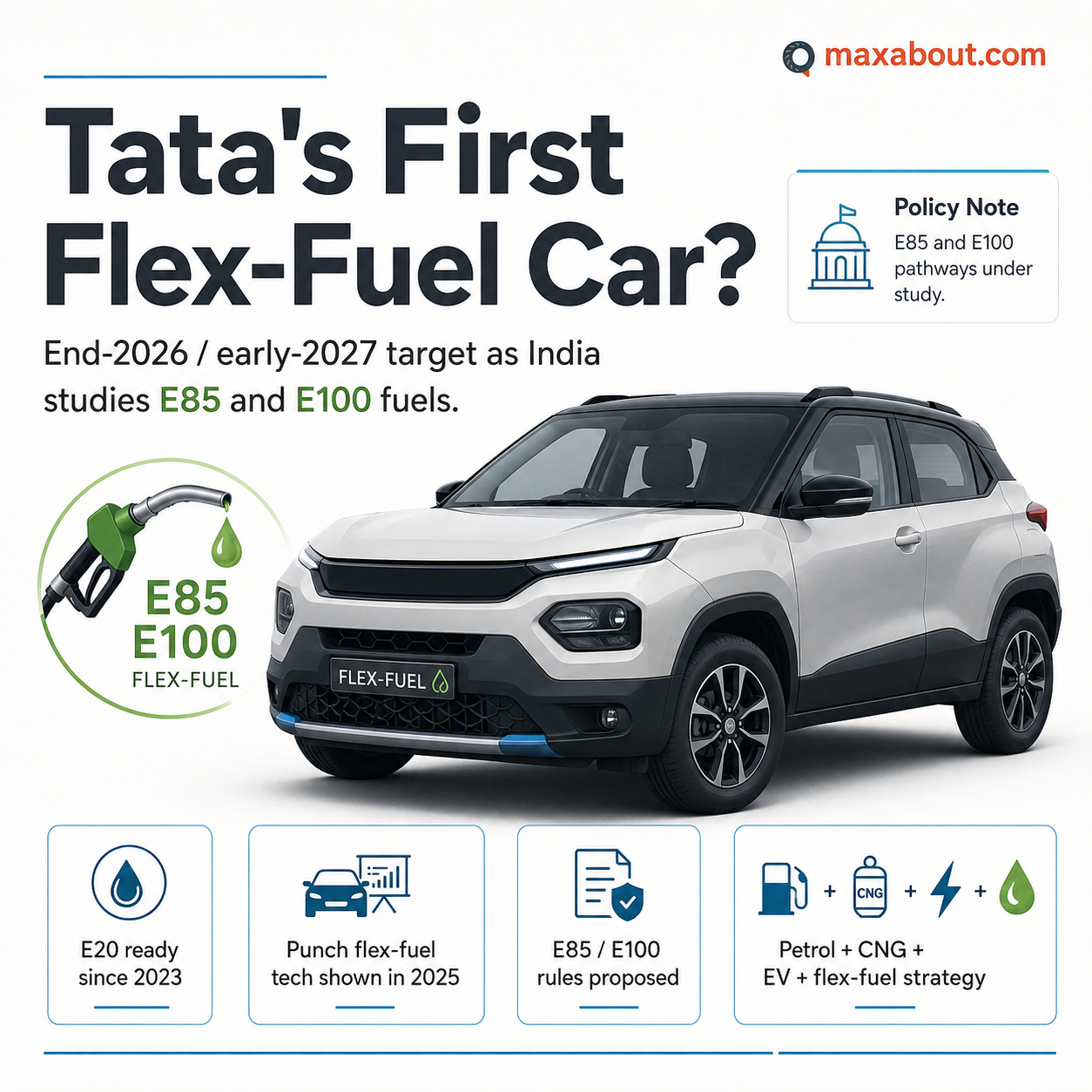 That last part matters. Because there's a genuine confusion floating around right now. The E20 fuel already appearing at pumps in Maharashtra, Uttar Pradesh, Karnataka, and several other states? That's a 20 percent ethanol blend mixed into regular petrol. Most modern cars can handle that without special modifications. But a true flex-fuel vehicle goes considerably further — running cleanly on E85 or even higher concentrations, where ethanol makes up the bulk of the fuel mixture.
From a practical standpoint, here's why this is worth paying attention to. Fuel prices at Indian pumps have been volatile for years, and a significant reason is crude oil import dependency. Ethanol, largely produced domestically from sugarcane and surplus grain, doesn't carry that same geopolitical weight. Higher ethanol availability in fuel theoretically means more price stability over time — something every driver stuck watching the price board at a fuel station can appreciate.
The government's 20 percent ethanol blending target by 2025 is part of this thinking. Flex-fuel vehicles would be the natural next step — making the infrastructure investment actually usable at meaningful scale.
Tata Motors PV Strategy: Where Does Flex-Fuel Fit In
Tata Motors has spent the last few years building one of the most compelling EV stories in India. The Nexon EV, the Punch EV, the Tiago EV — there's a clear pattern here. They have claimed India's electric passenger vehicle segment almost entirely. So when official announcements and industry reports began surfacing about Tata planning its first flex-fuel passenger vehicle by year-end, the obvious question was: why?
It actually makes more sense than it first appears. Their EV push is fundamentally an urban story. Charging infrastructure, range confidence, apartment-friendly ownership — these conditions exist reasonably well in metros and large cities. But step outside that bubble into Tier 2 or Tier 3 towns, and the picture changes considerably. Charging points are sparse. Range anxiety is very real. For a family in a smaller city, an EV still feels like a leap of faith.
Flex-fuel addresses a completely different buyer. Someone in a mid-sized town who wants fuel cost relief without abandoning familiar refueling habits. That's a massive segment Tata cannot afford to leave unaddressed while competitors move in.
From what industry observers suggest, the flex-fuel model will likely target the mass-market end — think compact hatchback or entry-level SUV territory rather than anything premium. That would align logically with Tata's existing platform strengths and their stated intent to broaden accessibility. It's not a retreat from electrification. It's simply filling the gaps that EVs cannot reach yet.
The Ethanol Infrastructure Question: Is India Actually Ready?
Here is where I think we need to slow down and be genuinely honest. The flex-fuel announcement sounds exciting on paper, but the real test is not the car — it is the fuel pump. And right now, India's ethanol infrastructure tells a very uneven story.
E20 blending is progressing reasonably well across the country. Most major fuel stations in metro cities have begun offering E20 blends, and that rollout deserves credit. But a flex-fuel vehicle's real advantages — the lower running costs, the reduced dependence on pure petrol — only materialize when you are running on E85 or higher concentrations. That is where availability becomes genuinely patchy.
States like Maharashtra and Uttar Pradesh, being major sugarcane producers, are far better positioned. You will find E85 pumps in Pune, Nashik, and parts of western UP without too much trouble. But travel toward eastern India, most of the southern states, or smaller tier-three towns anywhere, and the picture changes quickly. The infrastructure simply has not caught up yet.
Consider a practical scenario. Someone buys Tata's flex-fuel car in Pune, enjoys the ethanol benefits daily, then drives toward a smaller district town on the weekend. Chances are they will default back to regular petrol. That is not catastrophic — flex-fuel vehicles are designed to handle exactly that transition smoothly. But the cost savings essentially disappear on those stretches.
This is the honest reality check worth keeping in mind before assuming flex-fuel immediately transforms your fuel bills.
Potential Benefits For Indian Car Buyers: Cost, Environment, And Beyond
That said, the genuine upsides here are worth taking seriously — especially if ethanol infrastructure keeps expanding at its current pace.
The most immediate draw is running cost. Ethanol typically prices lower than petrol at the pump, and if E85 becomes widely accessible, the per-kilometre savings could be meaningful for buyers watching every rupee. For someone commuting daily in a city like Bangalore or Hyderabad, that difference compounds quickly over months.
There is also an environmental dimension — and I will keep this practical rather than preachy. Ethanol derived from sugarcane is a domestic, renewable source. It burns cleaner than fossil petrol, which directly matters for cities like Delhi and Mumbai where air quality is a genuine daily health concern, not just a headline statistic.
Reduced import dependency is another real advantage. India spends enormously on crude oil imports, and global price shocks hit Indian buyers hard. Homegrown ethanol buffers against that volatility to some degree.
Driving behaviour requires virtually no adjustment — flex-fuel engines handle the transition between fuel blends transparently. You simply fill up and drive normally.
Finally, government policy signals suggest possible incentives — reduced road tax or registration benefits on flex-fuel vehicles have been discussed in official circles, though nothing is confirmed yet. Worth watching.
Concerns And Honest Drawbacks Worth Considering
That said, let's not get carried away. There are genuine questions worth asking before assuming flex-fuel is a straightforward win.
The most immediate concern is fuel efficiency drop. Ethanol contains less energy per litre than petrol — roughly 30% lower energy density. So when running on high ethanol blends like E85, your kilometres per litre figure will fall noticeably. The per-litre cost might be cheaper, but you'll be refuelling more frequently. Whether the arithmetic actually favours you depends on local ethanol pricing, your annual mileage, and driving patterns. Smart buyers should run the numbers for their specific situation rather than assuming savings are automatic.
Then there's cold start performance. High ethanol blends struggle in genuinely cold conditions — hill stations like Manali, Shimla, or Mussoorie during winter mornings could expose this weakness. Ethanol's volatility characteristics make cold ignition harder. Purpose-built flex-fuel systems include compensating mechanisms, but how effectively Tata's implementation handles Indian hill terrain remains to be seen in real-world conditions.
Pricing is the critical unknown. If this variant carries a significant premium over the standard petrol model, the payback period through running cost savings could stretch uncomfortably long. A ₹1-1.5 lakh price gap could undermine the entire value proposition for moderate-mileage users.
Material compatibility is less worrying here — a purpose-engineered flex-fuel system shouldn't have corrosion issues. But these other questions genuinely deserve answers before committing.
How Tata's Flex-Fuel Move Compares To What Other Automakers Are Doing
This isn't a Tata story in isolation. That's actually what makes it worth paying attention to.
Toyota has been the most visible player here. Under government-led demonstrations, Toyota showcased flex-fuel versions of popular models, working closely with the Ministry of Road Transport and Highways to prove that E85-capable vehicles aren't just theoretical. Those weren't quiet, back-room exercises — they were deliberate, public signals that Toyota was positioning itself ahead of any formal mandate.
Maruti Suzuki has also indicated interest in alternative fuel technologies, though with characteristic caution. Given their volume dominance and cost-sensitive buyer base, any serious move from Maruti typically confirms a technology is approaching mass-market viability.
The Ministry of Road Transport and Highways has been pushing this direction firmly, with directives encouraging automakers to prepare flex-fuel compatible lineups. When government pressure meets multi-manufacturer intent, concept demonstrations tend to become production realities faster than most expect.
Tata entering this space now suggests the industry has quietly crossed a threshold. What was once limited to demonstration events is clearly moving toward actual showroom intent. For buyers, that broader participation matters — it signals improving infrastructure investment, wider E85 availability, and long-term manufacturer commitment rather than a one-brand experiment.
Should You Wait For Tata's Flex-Fuel Model Or Buy Petrol Now?
This is the question most practical buyers will land on eventually. And honestly, the answer depends almost entirely on your personal timeline.
If you are not under immediate pressure to buy, waiting a few months actually makes sense here. Year-end is not far away. Once the flex-fuel model launches, you will have real pricing to evaluate, actual variant breakdowns, and early ownership reviews filtering in from buyers who have run it on E85. That information is genuinely valuable before committing.
However, if you need a car right now, you are not really losing much either. Tata's existing petrol variants are already E20 compatible, which aligns with the current national fuel mandate. You are not buying something that will feel outdated the moment flex-fuel arrives.
From what I can see, the smarter play for most buyers is this — give it until the actual launch. See the price. Read the first real-world reviews. Check whether E85 pumps exist in your city before making flex-fuel the deciding factor.
Flex-fuel is genuinely exciting for India's automotive future. But as always, the proof will be in everyday performance, long-term service costs, and whether fuel infrastructure actually keeps pace. The intent is promising. The execution is what we are all waiting to see.
Maxabout Team
Editorial Team
Specializes in: Automotive News, Reviews, Analysis
Want to read more automotive news?
Stay updated with the latest car launches, reviews, and industry insights.
Browse All News