
Supreme Court Orders Panic Buttons in Public Transport
Supreme Court's Landmark Directive: What It Means for Public Transport Safety in IndiaThe Supreme Court of India has once again stepped in where state governments have largely dragged their feet. A recent directive ordering all states to mandatorily install panic buttons and GPS tracking devices in ...
Editorial Team
Supreme Court's Landmark Directive: What It Means for Public Transport Safety in India
The Supreme Court of India has once again stepped in where state governments have largely dragged their feet. A recent directive ordering all states to mandatorily install panic buttons and GPS tracking devices in public transport vehicles is significant — not because it is entirely new thinking, but because it underscores just how little progress has been made on passenger safety despite years of conversations about it.
The order covers a broad range of vehicles — city buses, auto-rickshaws, taxis, and app-based cab services. Essentially, if you are a commuter paying to get from one point to another, this ruling is meant to protect you. And frankly, that matters to a huge number of people navigating daily travel across cities like Mumbai, Delhi, Bengaluru, and Chennai.
From what has emerged through official announcements and industry reports, this directive was prompted by persistent concerns around passenger safety incidents — particularly affecting women travelling alone. The court's patience, it seems, has worn thin.
What makes this moment worth paying attention to is the pattern. This is not the first such directive. Similar orders have been issued before, only to stall somewhere between policy and actual implementation. Whether this time will be different is the real question worth asking.
What Exactly Does the Supreme Court Order Require?
At its core, the directive breaks down into two distinct technical requirements — panic buttons and vehicle tracking systems — and both carry specific functional expectations, not just symbolic ones.
A panic button, when pressed by a passenger in distress, is expected to trigger an immediate alert to a central control room or the nearest police station. The response has to be real-time. A button that logs a complaint for review the next morning defeats the entire purpose.
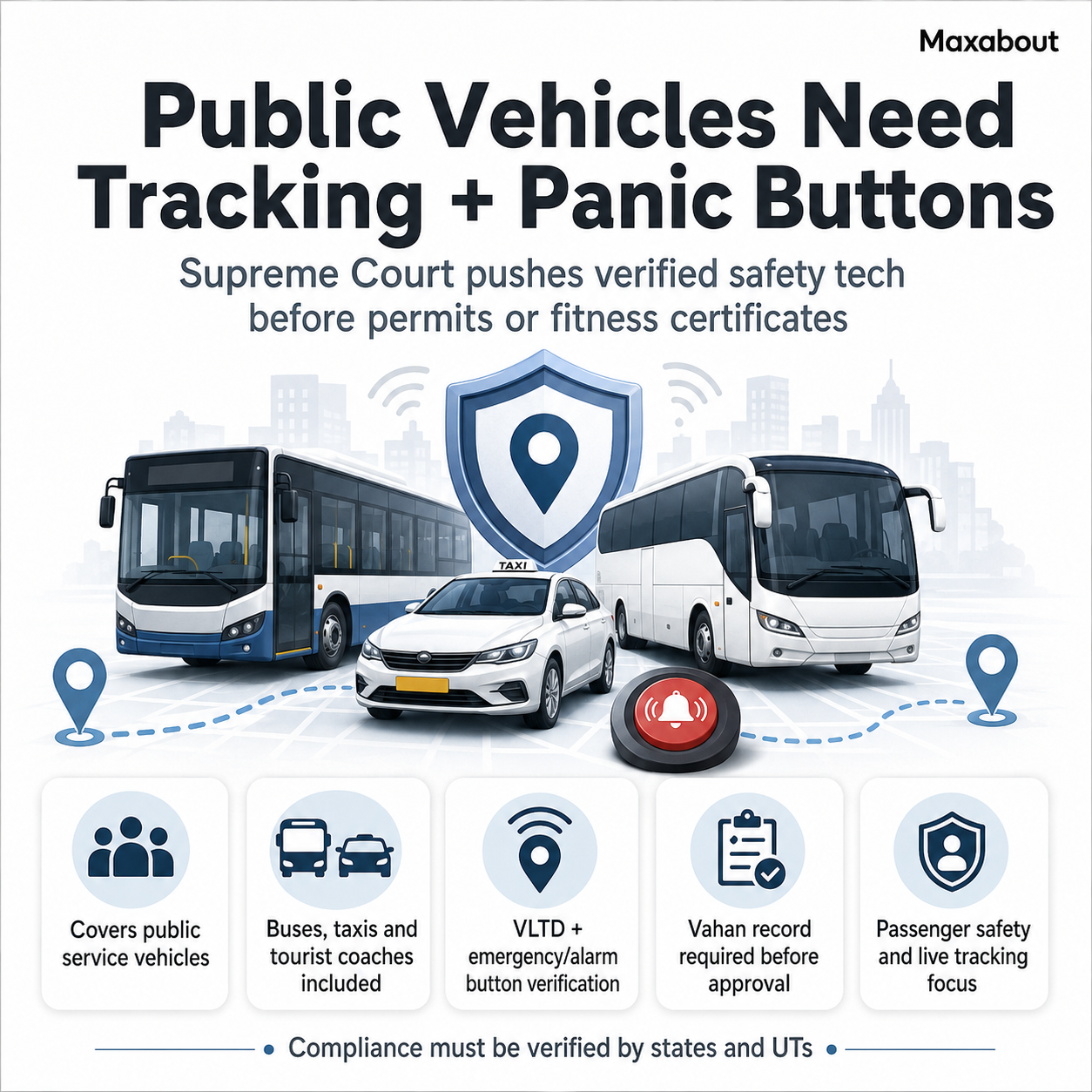 Vehicle tracking systems are meant to do more than just show a dot moving on a map. The court's intent covers real-time GPS monitoring, route compliance verification, and speed tracking — essentially ensuring that a vehicle is where it is supposed to be, moving how it is supposed to move.
The categories covered are fairly broad. State-run buses, contract carriages, school buses, and app-based aggregator vehicles operating under the Motor Vehicles Act framework all fall within scope. That last category is significant, given how many daily commuters now rely on ride-hailing platforms.
States are expected to submit compliance reports demonstrating actual installation — not just policy circulars or budget allocations. Timelines have been pressed firmly, with the court signalling it will monitor follow-through directly.
A Long-Pending Safety Need: The Ground Reality of Public Transport in India
The Supreme Court's directive doesn't exist in a vacuum. It comes after years of incidents that have shaken public confidence in shared transport — incidents that many commuters, particularly women, have lived through or know someone who has.
Ask anyone who regularly uses public buses in Delhi or Bengaluru, and the discomfort is real. Overcrowded state-run buses with no visible driver identification. Routes that change without notice. Stops that feel isolated after dark. The absence of anyone to call if something goes wrong. For elderly passengers and solo travelers, this isn't abstract — it shapes daily decisions about when to travel and whether to travel at all.
Cities like Chennai and Mumbai have relatively better-organized bus networks, yet even there, accountability gaps persist. In smaller towns and tier-2 cities, the situation is often significantly worse. Shared tempos, private minibuses, and poorly regulated contract carriages operate with almost no passenger-facing safety infrastructure.
What makes this particularly troubling is the absence of basic traceability. When incidents of harassment or assault occur, investigations frequently stall because there is no tracking data, no verified driver record, and sometimes no clear operator on record either.
Technology alone cannot fix culture or enforcement. But a functioning panic button and a live-tracked vehicle are at least a start — a signal to both drivers and passengers that someone is watching.
Panic Buttons and GPS Trackers: How the Technology Actually Works
So what does this technology actually look like in practice? It is worth understanding before assuming it is either a magic fix or an impossible ask.
A panic button system is fairly straightforward in concept. A physical button — typically installed near the driver's seat or at accessible points inside the cabin — is hardwired to a communication module in the vehicle. When pressed, it sends an immediate alert signal to a designated command center or police control room, transmitting the vehicle's live location, registration details, and a timestamp. The response protocol, ideally, should trigger the nearest patrol unit to intercept the vehicle within minutes. That last part — the actual response — is where execution matters far more than the hardware itself.
GPS tracking adds a continuous layer of monitoring. Beyond just live location, a properly configured system can flag route deviations in real time, alert operators when a vehicle exceeds a set speed threshold, and maintain a full trip log that investigators can access after an incident. Some systems also support geofencing — triggering alerts if a vehicle strays into restricted or unusual zones.
States like Rajasthan and Himachal Pradesh have made partial attempts at equipping certain bus fleets with these systems, with mixed results in actual deployment and monitoring consistency. App-based aggregators are somewhat ahead here — their platforms already embed live tracking and emergency contact features directly into the passenger-facing interface.
The harder challenge is retrofitting older vehicles. Standalone hardware units need stable power connections, SIM-based data connectivity, and backend integration with a control room that is actually staffed and responsive. In many state-run fleets running ageing vehicles, that integration is far from plug-and-play.
State-Level Implementation: Where Things Have Stalled Before
Here is the uncomfortable truth: India has been through this cycle before. A court directive arrives, states issue acknowledgment, deadlines get set, and then the actual rollout quietly fades into bureaucratic inertia. The panic button mandate is not a new idea — earlier versions of this requirement existed under the Nirbhaya Fund framework and various MoRTH guidelines. The compliance record, to put it plainly, was poor.
The reasons are fairly predictable once you look closely. Budget allocation is the first casualty. State transport departments are chronically underfunded. Procuring hardware across thousands of buses, autorickshaws, and taxis is not a small line item. Tenders get delayed, vendors under-deliver, and accountability is diffuse enough that nobody is clearly responsible when deadlines slip.
Then there is the maintenance problem. Installing a device is only the beginning. A panic button connected to an unstaffed control room is essentially decorative. Several states that did install tracking hardware in earlier drives reported that a significant portion of units became non-functional within months — dead SIM cards, loose wiring, drained backup batteries. Nobody followed up.
The scale involved is genuinely staggering. India's registered public transport fleet runs into millions of vehicles across state borders, languages, and wildly different administrative capacities. What works in a relatively organised urban fleet in one state may be completely unworkable in a semi-rural district transport setup elsewhere.
Good intentions, without funded monitoring mechanisms and genuine accountability, tend to produce paperwork rather than change.
What This Means for Private Cab Aggregators and App-Based Mobility
If state transport departments face an uphill climb here, the situation for app-based aggregators is somewhat more nuanced. Platforms operating under aggregator licenses — governed by the Motor Vehicles (Amendment) Act, 2019 — already carry certain baseline obligations around driver verification, trip tracking, and emergency response features. The question worth asking is whether this Supreme Court directive adds meaningful new requirements, or largely overlaps with what compliant platforms have already built.
In practice, most major ride platforms already embed GPS tracking into every trip. Passengers can share live location links. Emergency buttons exist within the app. On paper, that sounds like alignment with the court's intent. But hardware-level panic buttons installed in the physical vehicle are a different requirement from a software feature inside a passenger's smartphone. The directive appears to target the vehicle itself — which shifts accountability squarely onto the driver and operator, regardless of which app dispatched the ride.
That distinction matters more than it might initially appear. Driver accountability becomes harder to sidestep when the emergency mechanism is built into the cab rather than dependent on a passenger's ability to unlock their phone and navigate an app under stress.
The data privacy angle, however, raises genuinely uncomfortable questions. Continuous vehicle tracking generates significant location data — and it is not always clear who monitors it, how long it is retained, or whether passengers have any meaningful visibility into how their commute information is stored and used.
The Bigger Picture: Can Technology Alone Make Public Transport Safer?
Panic buttons and GPS trackers are genuinely useful. But let us be honest — they are one piece of a much larger, more complicated puzzle. Technology responds to a crisis. What we actually need are systems that prevent the crisis from happening in the first place.
Driver background verification is the obvious starting point. From what industry observers consistently report, screening standards for public transport drivers vary wildly across states. A panic button cannot tell you whether the person behind the wheel has a history of reckless behaviour or worse. That requires institutional diligence — and right now, that diligence is uneven at best.
Then there is the physical environment. Poorly lit bus stops, isolated terminals, and unmanned boarding points create vulnerability long before a passenger even boards a vehicle. No amount of in-vehicle technology addresses that reality. Adequate lighting, visible security presence, and basic infrastructure upgrades matter enormously — especially for women travelling late at night in cities like Bengaluru, Lucknow, or Bhopal.
Police response time is the other critical variable. A panic alert is only as effective as the speed and seriousness with which it is acted upon. If response infrastructure remains stretched or indifferent, the button becomes symbolic rather than functional.
In my view, what will ultimately determine whether this directive creates real change is not the hardware — it is the accountability layer built around it. Grievance redressal mechanisms, transparent monitoring, and genuine consequences for operators who ignore compliance will matter far more than the devices themselves. Realistic optimism feels right here. This is a meaningful step forward. But execution quality will tell the real story.
What Should Commuters and Passengers Do in the Meantime?
While courts direct and governments deliberate, people still need to get from one place to another — every single day. So until implementation actually catches up with this ruling, a few practical habits are worth building.
Share your trip details before you travel. A quick message to a trusted contact — vehicle registration number, route, expected arrival time — takes thirty seconds and genuinely matters. Most of us skip this step until something goes wrong.
Note the driver's ID card in app-based cabs. It is displayed for a reason.
Use apps that have built-in emergency sharing or SOS features — several ride-hailing platforms already offer this.
Save your local police helpline and transport authority contact. The number 112 works nationally for emergencies.
None of this should be necessary as a substitute for systemic safety. It is genuinely frustrating that individual vigilance still has to fill gaps that regulation should cover. But being informed and prepared is not paranoia — it is just being realistic.
This Supreme Court ruling deserves continued public attention. Directives without follow-through are unfortunately common. Keeping pressure on state governments and transport authorities to show actual compliance progress — not just paperwork — is where citizen scrutiny becomes genuinely valuable.
No comments yet
Be the first to share your thoughts!
Want to read more automotive news?
Stay updated with the latest car launches, reviews, and industry insights.
Browse All News