

Royal Enfield: World's 3rd Strongest Auto Brand
Let that sink in for a moment. Royal Enfield — the brand behind those iconic, thumping motorcycles you see crawling through Bangalore traffic and conquering Ladakh passes — has been ranked the world's third strongest automotive brand. Ahead of Audi. Ahead of Ferrari. Yes, you read that correctly.Thi...
Let that sink in for a moment. Royal Enfield — the brand behind those iconic, thumping motorcycles you see crawling through Bangalore traffic and conquering Ladakh passes — has been ranked the world's third strongest automotive brand. Ahead of Audi. Ahead of Ferrari. Yes, you read that correctly.
This isn't about sales numbers or revenue. Brand strength rankings measure something far more interesting — emotional connection, consumer loyalty, and the kind of recognition that money simply cannot manufacture overnight. It's about how deeply a brand lives in people's minds and hearts, not just their garages.
And somehow, a company rooted in Chennai, selling motorcycles that many once dismissed as old-fashioned, has outscored two of Europe's most celebrated automotive names. Ferrari, which carries decades of Formula 1 glory. Audi, which practically invented the premium German driving experience. Both sitting behind a brand whose signature sound you can identify from three streets away.
From what industry analysts have observed, this ranking reflects something genuinely rare — a cult following that transcends demographics, geography, and income levels. Royal Enfield riders aren't just customers. They're a community.
This is, without question, a remarkable moment for Indian automotive history. And it deserves a proper, honest look at why it happened.
Understanding the Brand Strength Index: How These Rankings Actually Work
Before getting into what this ranking means for Royal Enfield, it's worth understanding what's actually being measured here. Because a lot of people will assume this is about sales numbers or revenue — and it isn't. Not even close.
The Brand Strength Index (BSI) is a scoring framework that measures the depth of a brand's connection with its audience. Think of it as the difference between someone who buys a product and someone who genuinely believes in it. The BSI captures the latter.
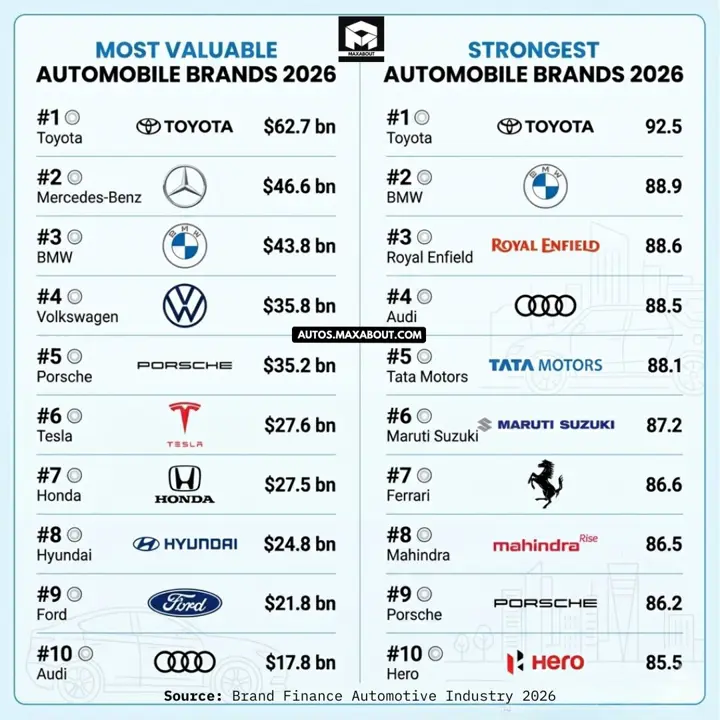 The key pillars typically evaluated include brand equity (perceived value beyond the product itself), consumer loyalty (how likely people are to stay with the brand and recommend it), emotional resonance (how strongly the brand connects on a personal level), and global recognition (awareness and reputation across markets).
Here's the analogy that makes this clearest. Ferrari sells relatively few vehicles annually — deliberately so. Yet it commands almost unmatched prestige worldwide. By that logic, Ferrari should rank near the top of any brand strength list. And it does rank impressively. But Royal Enfield still placed higher. That single fact tells you everything about what the BSI is genuinely capturing — not exclusivity, not price, but the raw strength of human connection a brand creates.
It measures passion, not profit.
Royal Enfield's Journey: From a British Relic to a Global Cult Brand
The story starts somewhere most people don't expect. Royal Enfield isn't an Indian original. The brand was born in Redditch, England, in the late 1800s. It supplied motorcycles to the British military, earned a reputation for reliability, and then — like many post-war British manufacturers — slowly faded from relevance in its home country.
What saved it was India. Specifically, a factory in Chennai that kept building these machines long after the world had moved on. Madras Motors acquired the license in the 1950s, and what followed was one of the most remarkable brand resurrection stories in automotive history. While the British operation collapsed entirely, the Indian side survived, adapted, and eventually thrived.
For decades, the Bullet was a working motorcycle. Traffic police rode them. Army officers swore by them. They weren't aspirational in any fashionable sense — they were just deeply trusted. That trust, built over generations, became the foundation for everything that came later.
Then came the reinvention. The Classic 350 arrived and changed the conversation completely. Suddenly, Royal Enfield wasn't just reliable — it was desirable. Young riders across Indian cities began choosing it not purely for commuting, but for identity. A Classic 350 parked outside a cafe said something about its rider. So did a Himalayan loaded up for a solo trip through Spiti Valley or Ladakh.
That emotional layer is exactly what brand strength scores measure. And Royal Enfield built it organically, one mountain road at a time.
Why Royal Enfield Beats Audi and Ferrari on Brand Strength — A Closer Look
At first glance, this ranking feels almost absurd. Ferrari builds machines that cost more than most Indian apartments. Audi's engineering reputation spans decades. So how does a mid-displacement motorcycle brand from Chennai outrank both? The answer becomes obvious once you understand what brand strength actually measures — and what it doesn't.
It isn't about price tags or horsepower. It's about how deeply a brand lives inside its audience.
Consider accessibility first. A Ferrari is something you admire through a showroom window or a YouTube video. It exists in a world most people will never touch. That generates awe, certainly — but awe from a distance is passive. Royal Enfield sits in a completely different position. At ₹1.9 lakh to ₹4.5 lakh, it is genuinely aspirational yet genuinely attainable for a middle-class buyer saving up for their first real motorcycle. That combination — wanting it and actually getting it — creates a far more powerful emotional bond than admiration alone ever could.
Audi faces a different problem. It occupies a crowded premium space where BMW and Mercedes-Benz constantly challenge its identity. Ask someone what makes Audi distinctly Audi, and the answer gets complicated fast. The brand competes hard but lacks a singular emotional story that separates it clearly from its rivals.
Royal Enfield has no such identity crisis. Its community does the heavy lifting. Ride groups organize weekend runs from Pune to Mahabaleshwar. Strangers on Himalayan trails wave at each other simply because they're both on Enfields. Official events like Rider Mania draw thousands who aren't just customers — they're believers. That grassroots, participatory loyalty is something Ferrari's admiring fanbase simply cannot replicate.
Owning a Royal Enfield signals a personality. It says something specific about how you spend your weekends, what you value, where you want to go. Very few brands — at any price point — achieve that kind of identity fusion with their owners.
The India Factor: How a Chennai Factory Built a World-Class Brand
There's something genuinely remarkable about this ranking when you place it in the context of where Royal Enfield actually comes from. A manufacturing plant in Chennai. Indian workers. Indian engineers. An Indian supply chain. And yet, the brand that emerges from that factory now sits above Audi and Ferrari in global brand strength. That's not a small thing.
For decades, there's been an unspoken assumption in global automotive circles — that cult status, prestige, and emotional brand power belong exclusively to European heritage names or Japanese engineering giants. Royal Enfield, quietly and without much fanfare, has dismantled that assumption piece by piece.
From what industry reports and export data consistently show, Royal Enfield's international footprint has expanded significantly across Europe, Southeast Asia, Latin America, and North America. Riders in Colombia, Thailand, France, and the United States aren't buying these motorcycles out of curiosity. They're buying into an identity — one that was shaped entirely on Indian soil.
That's the part worth sitting with. The character, the aesthetic, the unhurried mechanical personality of every Royal Enfield — all of it originates in Chennai. India didn't just produce a competitive motorcycle brand. It produced a globally desirable one.
For an industry that has long watched European and Japanese names dominate prestige rankings, this achievement signals something larger. Indian automotive manufacturing is clearly capable of building more than practical, affordable vehicles. It can build icons.
Strengths and Challenges: The Honest Picture Behind the Ranking
A brand ranking this strong deserves genuine celebration. But it also deserves honest scrutiny. Royal Enfield has earned its position — and yet, the work of holding it is arguably harder than the work of reaching it.
The strengths are real and difficult to replicate. Brand loyalty here borders on devotion. The riding community Royal Enfield has cultivated — through Himalayan expeditions, owner meetups, and a shared cultural identity — is something Audi and Ferrari cannot simply manufacture overnight. Add an iconic design language that has remained emotionally consistent across decades, plus pricing that makes the dream genuinely accessible in markets like India and Southeast Asia, and you have a brand with rare structural advantages.
But the challenges are equally real. Reliability concerns surface persistently across owner forums and review communities. Quality control inconsistencies — finish issues, electrical gremlins, vibration complaints — remain recurring conversations. Service availability in smaller Indian towns and in newer international markets still has noticeable gaps.
Then there is the competitive pressure. Bajaj's Triumph partnership and the Honda Highness CB350 are directly targeting Royal Enfield's most loyal customer segment. These are not distant threats.
The ranking is deserved. But complacency at this altitude would be costly. Iconic status, once questioned, takes a long time to rebuild.
What This Ranking Means for Indian Buyers and the Broader Auto Industry
For anyone who owns a Royal Enfield — or is considering one — this ranking is more than a headline. It is genuine validation. Resale value matters, and strong brand equity directly protects it. A Bullet 350 or a Classic holds its price remarkably well compared to most motorcycles in its segment. That is not coincidence. That is brand strength doing its quiet work.
There is also something harder to measure: pride of ownership. Knowing your motorcycle sits in the same brand-strength conversation as Audi and Ferrari changes how you feel about that machine in your garage. From what buyers consistently share, Royal Enfield ownership was always emotional. Now it carries global credibility too.
For the broader Indian auto industry, the signal is significant. Tata, Mahindra, and Royal Enfield are no longer brands that younger Indian consumers feel they need to graduate away from. That old instinct — to reach for a foreign badge as a status marker — is visibly weakening. This ranking accelerates that shift.
But momentum requires maintenance. Homegrown brands must invest consistently in quality, customer experience, and global service infrastructure — not just marketing. Ranking third once is an achievement. Staying there demands discipline.
Final Thoughts: A Ranking That Deserves More Than a Moment of Pride
Third strongest auto brand in the world. Ahead of Audi. Ahead of Ferrari. That is not a small thing, and it would be dishonest to treat it as routine. Royal Enfield has genuinely earned something significant here.
But brand strength measured today is not a guarantee of tomorrow. Rankings like these reflect accumulated perception — years of emotional connection, cultural relevance, and word-of-mouth trust. That reservoir can be drained surprisingly fast if quality slips, if service experiences disappoint, or if the next generation of products feels uninspired.
Royal Enfield still has real gaps to address. Reliability complaints have not fully disappeared. The ownership experience varies widely depending on which city you live in. These are not small footnotes — they matter deeply to the everyday rider.
So yes, celebrate this ranking. It reflects something real about how the brand has grown. But hold it lightly.
I would genuinely like to know — does this ranking match your personal experience with Royal Enfield? Has the brand delivered on the loyalty it clearly inspires, or do you feel there are still meaningful gaps between the reputation and the reality? That conversation, honestly, feels more important than the ranking itself.
Maxabout Team
Editorial Team
Specializes in: Automotive News, Reviews, Analysis
Want to read more automotive news?
Stay updated with the latest car launches, reviews, and industry insights.
Browse All News