
Royal Enfield Andhra Pradesh Factory: Capacity Watch
Royal Enfield's Andhra Pradesh Factory: Why This Expansion MattersRoyal Enfield is not a small story anymore. What started as a brand largely associated with retired police officers and highway romantics has quietly transformed into something far more serious — a genuine global force in mid-size mot...
Editorial Team
Royal Enfield's Andhra Pradesh Factory: Why This Expansion Matters
Royal Enfield is not a small story anymore. What started as a brand largely associated with retired police officers and highway romantics has quietly transformed into something far more serious — a genuine global force in mid-size motorcycles. And the new manufacturing facility coming up in Andhra Pradesh is perhaps the clearest signal yet of just how ambitious this company has become.
The plant, announced as part of Royal Enfield's long-term capacity expansion strategy, is expected to significantly add to production volumes beyond the existing facilities in Chennai. For a brand that has struggled with waiting periods stretching weeks or even months on models like the Classic 350, Himalayan, and Bullet, this is not just corporate news — it directly affects real buyers sitting at dealerships across Pune, Hyderabad, and Bengaluru.
From what industry reports suggest, domestic demand has consistently outpaced production capacity in recent years. Add export ambitions into the mix — Royal Enfield is aggressively pushing into Southeast Asia, Europe, and Latin America — and the capacity pressure becomes even clearer.
This expansion, in many ways, marks a pivotal moment. It signals that Royal Enfield is done playing catch-up and is now building infrastructure to lead.
Current Production Capacity and Why It Has Been Stretched
Royal Enfield currently operates two manufacturing facilities in Chennai — one at Thiruvottiyur and the larger, more modern plant at Oragadam. Together, these plants have a combined annual capacity of approximately 9.5 to 10 lakh units, based on figures referenced in official communications and industry reports over recent years.
On paper, that sounds substantial. In practice, it has not been enough.
 Post-pandemic demand rebounded faster than most analysts expected. The Classic 350 alone has consistently ranked among the top-selling motorcycles in India. The Hunter 350 added an entirely new wave of younger buyers. And the Himalayan 450, despite being a more specialized product, generated waiting periods stretching beyond two to three months in several cities shortly after launch.
Dealer feedback from markets like Bengaluru, Pune, and Delhi has pointed to a recurring pattern — customers walking in ready to buy, but leaving with a booking slip rather than a motorcycle. That gap between demand and delivery is a real business cost.
Export volumes have compounded the pressure further. With Royal Enfield scaling shipments to Europe and Southeast Asia, domestic allocation has at times felt the squeeze. The Andhra Pradesh facility, when fully operational, is expected to directly address this bottleneck.
The Andhra Pradesh Plant: Location, Scale, and What We Know So Far
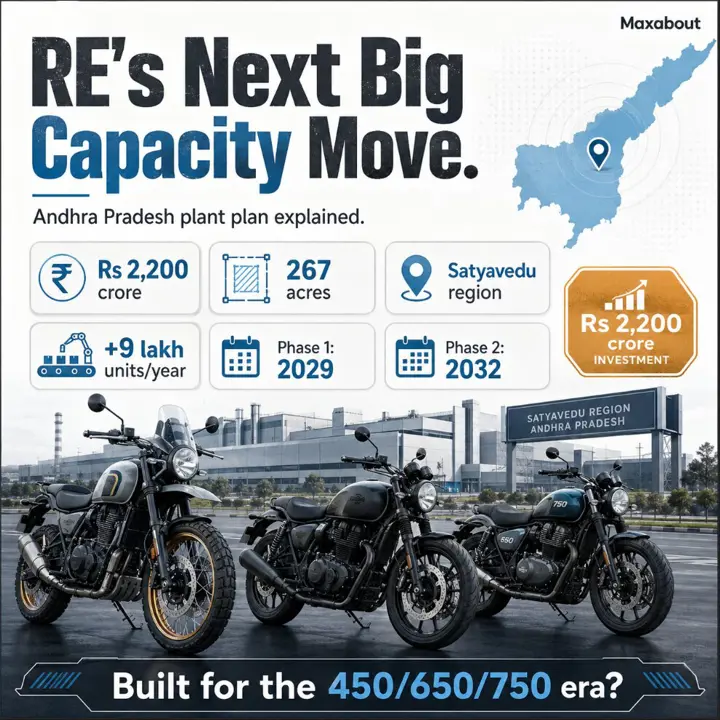
The facility is coming up in Sri City, Chittoor district — a well-established industrial corridor in Andhra Pradesh that already hosts several major manufacturers. The location makes practical sense. It sits reasonably close to Chennai's supplier ecosystem while offering the infrastructure and land availability that Tamil Nadu's saturated industrial zones simply cannot match anymore.
Officially, Royal Enfield has confirmed an investment commitment in the range of ₹1,000 crore for this facility, a figure backed by state government announcements following the initial MoU signing. The Andhra Pradesh government has cited this as a significant employment-generating project for the region.
On capacity, the projected target that has emerged through investor communications and official statements points toward approximately 4.5 lakh units annually at full ramp-up. That number, if achieved, would meaningfully expand Royal Enfield's total production ceiling beyond its current Tamil Nadu operations.
Phased commissioning is the confirmed approach — meaning the plant will not go from zero to full capacity overnight. Early phases are expected to prioritise current volume platforms, likely the Classic and Meteor families, before potentially accommodating next-generation models as production matures.
What remains genuinely unconfirmed is the precise commercial launch timeline. Dates have shifted in industry discussions, and until Royal Enfield makes a formal operational announcement, treating any specific commissioning date as certain would be premature.
How Increased Capacity Could Affect Waiting Periods and Pricing
For anyone currently sitting on a waiting list for a Himalayan 450 or eyeing the Guerrilla 450, this is probably the most practical question of all. Factory capacity is not an abstract number — it translates directly into how long your dealer tells you to wait, and whether the bike you want is actually available at sticker price.
Right now, supply tightness on popular 450-platform models has given certain dealers informal leverage. From what buyers have reported, some markets have seen small premiums or priority charges — nothing dramatic, but enough to be frustrating. That is a classic symptom of constrained allocation.
If the Andhra Pradesh facility ramps up meaningfully over the next 18 to 24 months, the realistic expectation is that waiting periods compress first. Pricing rarely drops as a direct result of added capacity, but what scale does allow is resistance to price increases. Royal Enfield can absorb input cost pressures more comfortably when per-unit overhead falls.
For someone ordering today versus two years from now, the difference may simply be peace of mind — less dealer dependence, more stock availability, and fewer grey-market markups. That alone is meaningful.
Still, increased production does not guarantee lower prices. Cost efficiencies often get reinvested into features or compliance upgrades rather than passed to buyers directly.
Export Ambitions and the AP Plant's Strategic Role
Royal Enfield's international footprint has grown quietly but consistently. Europe, Australia, and several Southeast Asian markets have seen steady volume increases over recent years. Industry reports suggest export numbers have roughly doubled within a five-year window — a trajectory the brand clearly wants to sustain.
The Andhra Pradesh plant fits neatly into that ambition. Separating domestic supply from export-bound production makes logistical sense. When one facility is perpetually chasing local demand, export commitments often get deprioritized. A partially dedicated export line changes that equation entirely.
Indian manufacturing also gives Royal Enfield a genuine cost advantage globally. Producing motorcycles at Indian labour and input costs, then positioning them as premium heritage products in European or Australian showrooms, creates a healthy margin structure. That positioning — affordable heritage, accessible character — is genuinely difficult for competitors to replicate at the same price points.
Faster delivery timelines to international dealers matter more than people realize. Inventory delays erode dealer confidence and push buyers toward alternatives. A dedicated or ring-fenced export capacity at the AP plant could sharpen those timelines meaningfully.
Models like the Himalayan and the Classic range have found real traction abroad. This global pull is quietly shaping product development too — refined refinement, better fit and finish, tighter quality controls. In a way, export ambition is making Royal Enfield a better manufacturer overall.
Jobs, Local Economy, and Royal Enfield's Commitment to Andhra Pradesh
Beyond the production numbers and export ambitions, there is a quieter story unfolding in Andhra Pradesh — one measured in livelihoods rather than unit volumes.
Royal Enfield's new plant is projected to generate thousands of direct manufacturing jobs in the region. But the more significant multiplier effect comes from the supplier ecosystem. In Indian automotive manufacturing, the pattern is well established — once an anchor plant commits to a location, tier-one and tier-two vendors typically follow, setting up ancillary units within a reasonable radius to reduce logistics friction and meet just-in-time supply requirements.
Andhra Pradesh has been actively positioning itself as a destination for exactly this kind of industrial investment. Official announcements and industry reports suggest the state government has offered competitive land acquisition terms, infrastructure support, and streamlined clearances to attract manufacturers. Royal Enfield choosing this location reflects both the policy environment and the geographic advantage — proximity to southern ports matters when export volumes are part of the long-term plan.
For local communities near the plant site, this represents something more concrete than corporate announcements. Indirect employment across logistics, tooling, component fabrication, and facility services can realistically outpace direct headcount by a significant margin. That ripple effect is what transforms a single factory into a regional economic anchor.
Risks and Challenges: Capacity Expansion Is Never a Straight Road
All of that regional optimism is worth holding alongside a more grounded question: how often do large manufacturing announcements in India land exactly on schedule, at full capacity, without friction? The honest answer is — not very often.
Greenfield plant commissioning carries its own category of risks. Construction timelines slip. Equipment procurement faces delays. Getting a brand-new workforce trained to Royal Enfield's quality standards takes considerably longer than the commissioning date on paper suggests. When you're scaling fast, consistency becomes the hardest thing to protect. A second plant means a second quality chain — and that's not a minor operational footnote.
From what industry observers have noted, Royal Enfield's Vallam Vadagal facility in Tamil Nadu also faced its own ramp-up learning curve. That experience likely informs how the Andhra Pradesh project is being approached, which is reassuring. But past navigation of challenges doesn't guarantee smoother sailing this time.
On the market side, the mid-size motorcycle segment is no longer Royal Enfield's quiet territory. Competitive pressure is building, and if economic headwinds soften discretionary spending, a plant ramping up into weakening demand is a difficult position to manage.
Announced capacity and operational reality are genuinely two different things. Worth remembering before the celebrations begin.
What Enthusiasts and Prospective Buyers Should Watch For
Given all of this, the smart move is to track specifics rather than headlines. A plant announcement is not the same as a plant producing motorcycles at scale.
The milestones that actually matter:
Official inauguration date and whether phased production timelines are made public
Model-specific allocation updates — which platforms benefit first
Any capacity-linked product launches tied directly to AP output
If you are currently waiting on a Royal Enfield, ask your dealer directly: when are waiting periods expected to ease, and is that linked to new supply coming online? A good dealer will tell you honestly. A vague answer is itself useful information.
Broadly, this expansion signals that Royal Enfield genuinely believes demand is structural, not cyclical. That confidence is worth noting.
But the AP plant is ultimately a long bet — on sustained volumes, on holding competitive ground, and on executing an expansion without the missteps that have occasionally complicated the brand's past. How that bet plays out will quietly determine Royal Enfield's position through the rest of this decade. Worth watching closely.
No comments yet
Be the first to share your thoughts!
Want to read more automotive news?
Stay updated with the latest car launches, reviews, and industry insights.
Browse All News