
PM E-DRIVE Approves 4,874 EV Chargers Across India
Something significant just happened for anyone sitting on the fence about buying an electric vehicle in India. The PM E-DRIVE scheme has approved 4,874 EV charging stations across the country — and this is not another policy announcement that quietly fades away. This is actual, sanctioned infrastruc...
Something significant just happened for anyone sitting on the fence about buying an electric vehicle in India. The PM E-DRIVE scheme has approved 4,874 EV charging stations across the country — and this is not another policy announcement that quietly fades away. This is actual, sanctioned infrastructure moving toward the ground.
Range anxiety has been the single biggest reason I hear from people holding back on EVs. Not the price. Not the technology. The simple, practical fear of getting stuck somewhere between Pune and Mumbai with a dead battery and no charger in sight. That fear is completely legitimate, and honestly, it has slowed EV adoption far more than most people acknowledge.
What makes this approval different is the concrete scale of commitment. Nearly 5,000 charging points is not a pilot program. Cities like Bengaluru, Delhi, and Pune — where EV sales have been climbing steadily — have been screaming for this kind of backbone support.
EV sales in India are growing fast, but infrastructure has lagged behind. This approval signals that the gap is finally being taken seriously at a policy level. For buyers who have been waiting to see real action before committing, this might just be the moment worth paying attention to.
What Exactly Is the PM E-DRIVE Scheme and How Does It Work
The full name — Electric Drive Revolution in Innovative Vehicle Enhancement — is quite a mouthful, but the idea behind it is straightforward. PM E-DRIVE is the central government's structured push to accelerate EV adoption across India, not just by subsidising vehicles but by building the ecosystem around them. Charging infrastructure, demand incentives, and execution accountability — it attempts to address all three together.
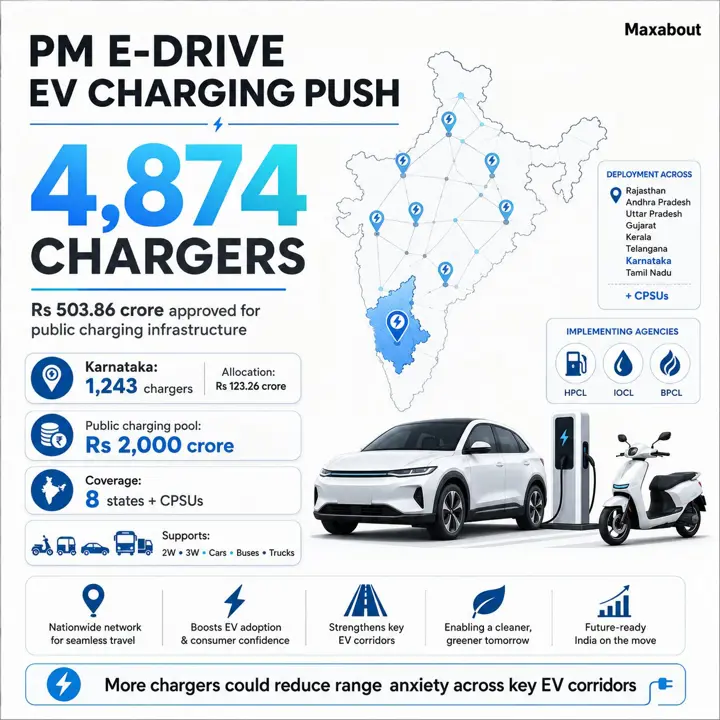 The scheme carries a budget allocation of approximately ₹10,900 crore, according to official announcements. That is a serious number. And the 4,874 charger approval we have been discussing? That is just one piece of a much larger framework operating under this umbrella.
On the execution side, the rollout is not being left to state governments alone. Public Sector Undertakings — including BHEL and Energy Efficiency Services Limited (EESL) — are central to the deployment process. Think of them as the agencies responsible for actually getting chargers installed and operational, rather than just planned on paper.
From what industry observers have noted, this structure matters. Previous EV initiatives in India often stalled because responsibility was unclear. PM E-DRIVE attempts to fix that by assigning specific agencies to specific outcomes — which, in theory, improves accountability significantly.
Where Will These 4,874 EV Chargers Actually Be Installed?
This is the question most EV owners — and potential EV buyers — genuinely want answered. Approved numbers look impressive on paper. But where these chargers land will determine whether this scheme actually changes daily EV ownership in India.
From what official announcements and industry reports suggest, the distribution strategy prioritizes national highways and key expressway corridors first. Routes like the Delhi-Mumbai Expressway, the Pune-Mumbai Expressway, and the Bengaluru-Chennai highway are obvious candidates. These are high-traffic corridors where charging infrastructure would make long-distance EV travel genuinely practical rather than anxiety-inducing.
Urban centers will also receive significant attention. But here is where past experience raises a fair concern — previous infrastructure pushes heavily favored metro cities like Delhi, Mumbai, and Bengaluru, while tier-2 cities such as Nashik, Coimbatore, or Lucknow were largely ignored. Whether PM E-DRIVE corrects that imbalance remains to be seen.
On the charger type mix, fast chargers are expected to dominate highway locations — which makes sense for travel use cases. Slower AC chargers will likely fill urban and residential gaps. Getting this mix right matters enormously. A slow charger on a busy highway is practically useless.
How This Changes the Game for Indian EV Buyers Right Now
Let me put this in plain terms. If you are sitting in Hyderabad today, seriously considering a Tata Nexon EV or an MG ZS EV, one question is probably stopping you cold — what happens when you need to drive to Vijayawada? That is roughly 275 kilometres. Doable on paper. Nerve-wracking in reality, because right now you are gambling on finding a working, fast charger somewhere along NH-65 when you actually need one.
That specific anxiety is what nearly 5,000 approved chargers could begin to dissolve. Not eliminate. Begin to dissolve. There is a meaningful difference.
The honest truth about existing public charging infrastructure is that it is unreliable in ways that go beyond just being sparse. Chargers sit broken for weeks. Payment systems fail. Connectors do not match. Someone driving from Jaipur to Udaipur — about 240 kilometres through stretches where charging options are genuinely thin — cannot afford to discover a non-functional unit halfway through. That is not range anxiety. That is a legitimate logistical problem.
If this approval translates into properly maintained, fast, accessible chargers along those corridors, the mental calculation for fence-sitting buyers shifts noticeably. The petrol car stops looking like the obviously sensible choice.
But approval is not installation. And installation is not operation. India has seen sanctioned infrastructure projects stall before. Execution is everything here, and buyers would be wise to watch actual commissioning numbers before making their decision around this announcement alone.
The Real Challenges: Will These Chargers Actually Get Built on Time?
Honest answer? Nobody knows. And that uncertainty deserves serious attention.
Start with land acquisition. Highway charging stations need physical space — ideally with shade, security, and grid access. Getting that combination right on busy national highway stretches, where land ownership is fragmented and local permissions move slowly, is genuinely complicated. It has tripped up infrastructure rollouts before.
Then there's grid connectivity in smaller cities. Tier-2 and tier-3 locations sound great on paper, but reliable high-voltage supply in towns like Nandurbar or Chitradurga is not guaranteed. A fast charger drawing significant load from an already stressed local grid creates real operational problems.
Maintenance is perhaps the most underappreciated concern. Existing public chargers across Indian cities have a patchy reliability record — units that show available on apps but are physically non-functional, displays that don't work, cables left damaged. Vandalism is a genuine factor too. Without dedicated service contracts and accountability, new installations can deteriorate quickly.
Connector compatibility also remains unresolved. Not every EV accepts every charger type. Unless the deployed units are genuinely universal — covering CCS2, CHAdeMO, and AC Type 2 — certain vehicle owners will still find themselves stranded.
None of this makes the scheme a failure. But these are real friction points that need watching closely.
Which EV Models Benefit the Most From This Infrastructure Push
When I think through who this announcement actually helps, the answer isn't every EV owner equally. The real winners here are buyers of longer-range, larger-battery vehicles — the ones genuinely attempting intercity travel.
A Tata Nexon EV owner driving from Pune to Nashik, or an MG ZS EV user planning a Mumbai to Surat run, faces genuine range anxiety today. A denser fast-charging corridor changes that calculation meaningfully. Same logic applies to premium options like the Hyundai Ioniq 5 and BYD Atto 3 — vehicles with the battery capacity to handle highways but nowhere reliable to top up midway.
Entry-level EVs are a different story. Vehicles like the Tata Tiago EV are fundamentally urban tools. Most owners charge overnight at home and rarely push beyond city limits. This infrastructure expansion matters far less to them.
Two-wheeler EV owners face a separate question altogether. From what official announcements indicate, this scheme appears oriented primarily toward four-wheeler charging infrastructure. Whether dedicated two-wheeler charging points are part of the deployment mix remains unclear — and that's a gap worth flagging, given how large India's electric scooter segment has become.
What Indian EV Buyers Should Watch for in the Coming Months
Approval is one thing. Actual installation is another. If you are currently evaluating an EV purchase, this development deserves attention — but it should not be the deciding factor just yet.
The milestones worth tracking are straightforward. Which highway corridors go live first? The real test of this scheme's ambition will be whether high-traffic routes — think Delhi-Jaipur, Mumbai-Pune, Bengaluru-Mysuru — get functional chargers within a credible timeframe. Watch also for whether these are fast DC units or slower AC points. That distinction matters enormously for long-distance confidence.
A unified payment experience is another marker. Fragmented apps and incompatible access cards have frustrated early adopters for years. If this rollout comes with a standardised interface, that signals genuine ecosystem thinking rather than just numbers on paper.
Realistically, expect meaningful ground-level progress somewhere between 12 and 24 months from now. Procurement, tendering, and installation at scale take time in India.
That said, India's EV story is genuinely accelerating. This approval is one of the more credible signals that the ecosystem is maturing — government intent is becoming infrastructure reality. Just monitor progress before making it the cornerstone of your buying decision.
Maxabout Team
Editorial Team
Specializes in: Automotive News, Reviews, Analysis
Want to read more automotive news?
Stay updated with the latest car launches, reviews, and industry insights.
Browse All News