
Petrol, Diesel Up ₹3, CNG Up ₹2 Amid Iran War
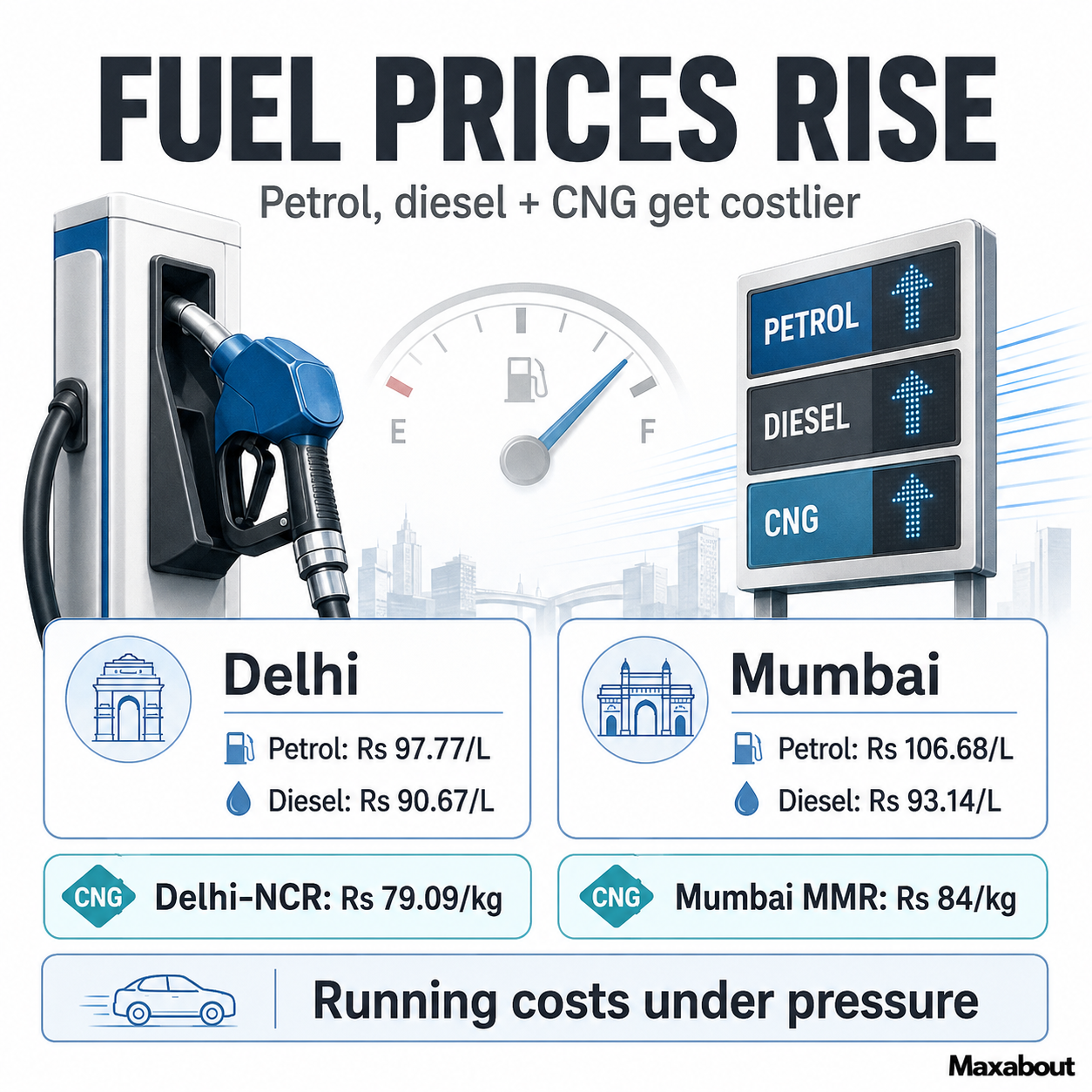
It has happened again. Petrol and diesel prices have gone up by ₹3 per litre, and CNG has followed with a ₹2 per litre increase — and honestly, for most people filling up at the pump right now, this one stings.The trigger this time is the escalating conflict involving Iran, which has rattled global ...
Editorial Team
It has happened again. Petrol and diesel prices have gone up by ₹3 per litre, and CNG has followed with a ₹2 per litre increase — and honestly, for most people filling up at the pump right now, this one stings.
The trigger this time is the escalating conflict involving Iran, which has rattled global crude oil markets almost instantly. When tensions rise in that part of the world, oil supply fears spike, crude prices jump, and within days, that pressure travels all the way to fuel stations in Mumbai, Lucknow, Coimbatore, and everywhere in between. That connection between a geopolitical flashpoint and your monthly fuel budget is very real — and very frustrating.
Think about what ₹3 extra per litre actually means for someone driving daily in a city like Bengaluru or Delhi. For a car with a 40-litre tank, that is ₹120 more every single fill-up. Multiply that across a month, and it is a number that quietly but firmly hits household budgets.
What makes this hike harder to absorb is the timing. Many buyers were already sitting on the fence about their next vehicle purchase — weighing petrol against electric, reconsidering whether a diesel still makes financial sense. This announcement adds another layer of anxiety to those decisions. The road ahead, quite literally, just got more expensive.
Why the Iran Conflict Is Sending Fuel Prices Higher in India
To understand why your fuel bill just went up, you need to follow a chain that starts thousands of kilometres away in the Middle East. India imports roughly 85 percent of its crude oil needs, and a significant portion of that comes from the Gulf region. When tensions flare around Iran — one of the world's major oil producers sitting right at the mouth of the Strait of Hormuz — global markets react immediately.
 The Strait of Hormuz is critical. Nearly a fifth of the world's oil supply passes through that narrow waterway. Any credible threat to that route pushes Brent crude prices higher almost overnight, simply because traders price in the risk of supply disruption before it even happens.
From there, the chain reaction moves quickly. Global crude rises. Indian oil marketing companies — think the major public sector refiners — absorb that cost for a while to avoid immediate public backlash. But that buffer has limits. Eventually, the revised rates reach the pump.
What compounds the pain is India's layered tax structure. The base fuel price is just the starting point. Central excise duty sits on top of that, and then each state adds its own VAT, which varies considerably. So even a modest rise in crude translates into a noticeably larger jump at the petrol station counter.
It is not complicated economics. It is simply an expensive domino effect — and right now, Indian consumers are the last domino standing.
How Much More Will You Actually Pay Every Month
Abstract numbers rarely hit home. So let me break this down into something tangible — actual rupees leaving your pocket every single month.
Take a petrol hatchback — a Maruti Swift or Hyundai Grand i10 type — delivering around 18 km per litre in real-world city driving. At 1,000 km monthly, you need roughly 56 litres. With petrol up by ₹3 per litre, that is ₹168 extra every month. Over a full year? You are quietly paying ₹2,016 more for absolutely no additional benefit.
Now consider a diesel SUV owner — someone driving a Creta or Scorpio-N around 1,500 km monthly, averaging 14 km per litre. That works out to approximately 107 litres consumed. At ₹3 extra per litre, the monthly damage is ₹321, which compounds to roughly ₹3,852 annually.
The CNG sedan story is slightly gentler but still noticeable. At 1,200 km monthly with an efficiency of around 28 km per kg, you consume about 43 kg of CNG. The ₹2 hike adds ₹86 per month — around ₹1,032 yearly.
But spare a thought for auto-rickshaw commuters. Daily office-goers taking two rides a day will likely see fares creep up as drivers pass on the increased running costs. That quiet ₹5 or ₹10 fare adjustment adds up faster than most people realise.
Petrol vs Diesel vs CNG vs Electric: Does This Hike Change the Math?
Every fuel price hike forces the same uncomfortable question: am I running the right vehicle for my situation? With petrol, diesel, and CNG all moving up simultaneously, it is worth revisiting the numbers honestly rather than defaulting to assumptions that may no longer hold.
The Diesel Premium — Still Worth It?
Diesel vehicles typically cost ₹1 lakh to ₹1.5 lakh more than their petrol equivalents. The traditional justification was simple — diesel was significantly cheaper per litre, and higher efficiency meant the breakeven point arrived within two to three years for moderate urban users covering around 1,500 km monthly.
That math is getting harder to defend now. The price gap between petrol and diesel has narrowed considerably in many cities. If you are covering under 1,200 km monthly through stop-and-go city traffic, the breakeven calculation stretches well beyond four years. Add higher servicing costs for diesel engines and the case weakens further. For genuinely moderate urban mileage, petrol increasingly makes more practical sense.
CNG's Advantage — Dented But Not Broken
The ₹2 CNG hike stings less than the petrol and diesel increases in absolute rupee terms. CNG still delivers a meaningful cost-per-kilometre advantage over petrol — roughly 40 to 50 percent cheaper depending on your city and vehicle efficiency. That gap does not disappear with a ₹2 revision.
The honest caveat, though, is boot space sacrifice, the occasional range anxiety between stations, and the fact that CNG infrastructure outside major metros remains patchy. If you drive primarily within Mumbai, Delhi, Pune, or Ahmedabad, CNG remains a genuinely strong choice. Beyond those corridors, the practical inconvenience starts outweighing the savings.
Electric Vehicles — The Hike Widens the Gap Further
Every petrol and diesel price revision quietly strengthens the EV argument. Home charging on a standard connection costs roughly ₹1 to ₹1.5 per kilometre in most Indian cities, compared to ₹6 to ₹8 per kilometre for petrol vehicles post-hike. That difference is now impossible to ignore for high-mileage urban commuters.
From what consistent EV user feedback suggests, the monthly running cost advantage is real and meaningful — particularly for those covering 1,500 km or more monthly within city limits. Each fuel hike makes that conversation easier to have.
But balance matters here. EVs carry their own set of challenges. Public charging infrastructure outside Bengaluru, Delhi, Mumbai, and a handful of other cities remains genuinely unreliable. Apartment dwellers without dedicated parking struggle with home charging access. Highway travel still demands careful planning around charging stops. These are not minor inconveniences — for many buyers, they are genuine dealbreakers that no fuel price calculation can override.
The honest takeaway is this: if you live in a metro, have home charging access, and drive predictable urban routes, this hike pushes the EV value proposition meaningfully ahead. If your life involves frequent highway runs or you depend on public charging, the equation remains more complicated than the headline numbers suggest.
City by City Reality: How the Hike Hits Differently Across India
A ₹3 hike sounds uniform on paper, but India's fuel pricing doesn't work that way. State VAT and local levies mean the same central revision lands with very different weight depending on where you fill your tank. Mumbai and Chennai already sit among the most expensive fuel markets in the country. Adding ₹3 on top of an already elevated base price stings noticeably harder there than in a lower-tax state.
Metro city drivers arguably feel this the most acutely. Stop-and-go traffic in Bengaluru or Delhi already punishes fuel efficiency — your car is barely moving for stretches of the commute, burning fuel while covering almost no ground. When your effective mileage drops because of congestion, every rupee added to the per-litre price multiplies faster against your monthly budget.
Contrast that with a truck operator or private diesel vehicle owner running long highway stretches across Rajasthan or Punjab. The distances are large, yes, but highway driving is far more fuel-efficient. The hit is real, but the per-kilometre impact is somewhat cushioned compared to an urban commuter stuck in city traffic daily.
The CNG hike is its own separate concern. Auto-rickshaw and taxi operators in Delhi, Mumbai, and Pune built their entire business model around CNG being the affordable alternative. A ₹2 increase sounds small, but these drivers run high daily mileage. From what operators in these cities have consistently said, even modest CNG revisions push them toward reconsidering fare structures. Higher cab fares for daily commuters are a very real possibility in the coming weeks.
Should You Reconsider Your Next Car Purchase After This Hike?
If you are currently sitting on a purchase decision — test drives done, loan pre-approved, just waiting for the right moment — this hike is worth pausing over. Not panicking over. Pausing.
The honest answer is that one price revision should not completely derail a well-thought-out buying plan. But here is the uncomfortable truth: this is not really one hike. It follows a broader pattern of fuel prices drifting upward whenever global supply chains face pressure. The Iran situation may stabilize. Prices may not immediately reverse.
For someone eyeing a petrol compact SUV in the ₹12–16 lakh range, strong hybrid options suddenly deserve a harder look. Vehicles with self-charging hybrid technology — which have largely been mid-size sedan territory — are now creeping into SUV segments too. The fuel savings over three to four years of Delhi or Bengaluru traffic genuinely start adding up against the higher sticker price.
CNG variants are worth considering if your city has reliable dispensing infrastructure. Mumbai and Ahmedabad buyers have reasonable access. But factor in the ₹2 hike and ask whether that advantage gap has narrowed slightly.
Used car buyers might actually be in the most interesting position right now. A well-maintained, fuel-efficient older model with lower running costs could make more practical sense than stretching a budget toward a brand-new petrol vehicle with uncertain fuel costs ahead.
Buy smart. Not reactively — but not blindly either.
Tips to Reduce Your Fuel Costs Right Now Without Buying a New Car
Before you spiral into spreadsheets about switching fuels or trading in your car, take a breath. There are real savings available to you right now, with the vehicle you already own. They are not dramatic. They will not cut your fuel bill in half. But in a month where every litre costs more than it did last week, marginal gains add up.
How you drive matters more than most people admit. In stop-and-go Bangalore traffic or the perpetual crawl through Mumbai's Western Express Highway during peak hours, aggressive acceleration followed by hard braking is genuinely expensive behaviour. You are burning fuel to gain ten metres, then throwing away that momentum entirely. Smooth, anticipatory driving — reading traffic ahead, easing off early — can meaningfully reduce consumption without adding a single minute to your commute time.
Tyre pressure is the most quietly neglected factor. Underinflated tyres increase rolling resistance, and your engine works harder to compensate. Most people check pressure occasionally, if at all. Checking monthly and keeping tyres at manufacturer-recommended levels costs nothing and consistently delivers small but real efficiency improvements.
A clogged air filter forces your engine to work harder on every combustion cycle. If your service is overdue, that ₹3 hike is hitting a less efficient engine than necessary. Fix that first.
Route planning sounds obvious, but genuinely reconsidering departure times — even by thirty minutes — can dramatically reduce idling time in cities like Delhi or Chennai during peak congestion. And if you have a regular office commute, carpooling with even one colleague effectively halves your fuel expenditure on those days. Simple, unsexy, effective.
Be honest with yourself about fuel station timing myths though. Filling up in the morning for "denser fuel" makes negligible real-world difference with modern underground storage. Focus on the things that actually move the needle.
The Bigger Picture: Are Frequent Fuel Hikes Accelerating India's EV Shift?
Step back from the immediate pinch at the pump and look at the longer pattern. Every significant fuel price hike in India has historically pushed a measurable share of buyers toward more efficient alternatives. This one, tied to Middle East conflict, feels no different — except that now, the alternatives are actually credible.
Mainstream manufacturers have clearly read the room. CNG variants from Maruti, Hyundai, and Tata now sit comfortably in showrooms that once offered only petrol and diesel. Hybrid lineups are expanding. And EV infrastructure, while still imperfect, is no longer a metro-only conversation — Pune, Jaipur, Coimbatore, and Lucknow are seeing real charging network growth.
There's a structural argument forming here. India's fuel prices are increasingly hostage to geopolitics thousands of miles away. That's not a comfortable position for any economy, and buyers are quietly doing the math themselves.
Realistically though, the transition will take time. Charging infrastructure outside major cities still needs serious, sustained investment. Range anxiety on highways between smaller towns remains a genuine concern, not just a perception problem.
But here's what's interesting — economic pressure is proving more persuasive than any government mandate. Each hike builds the case for alternatives faster than policy alone ever could. The shift is happening. It's just not happening uniformly yet.
No comments yet
Be the first to share your thoughts!
Want to read more automotive news?
Stay updated with the latest car launches, reviews, and industry insights.
Browse All News