

New Hyundai Creta Interior Spied With Pleos Connect & SDV
The Hyundai Creta does not really need an introduction in India. Month after month, it sits near the top of the mid-size SUV sales charts, and for good reason. Families in Chennai, Pune, Jaipur, and practically every other Indian city have made it their default choice when stepping up from a hatchba...
The Hyundai Creta does not really need an introduction in India. Month after month, it sits near the top of the mid-size SUV sales charts, and for good reason. Families in Chennai, Pune, Jaipur, and practically every other Indian city have made it their default choice when stepping up from a hatchback. It is comfortable enough for long highway runs, manageable enough for daily city commuting, and backed by a service network that stretches into smaller towns where some rivals simply do not reach.
That kind of consistent trust is hard to earn. And it makes any significant update to the Creta genuinely worth paying attention to.
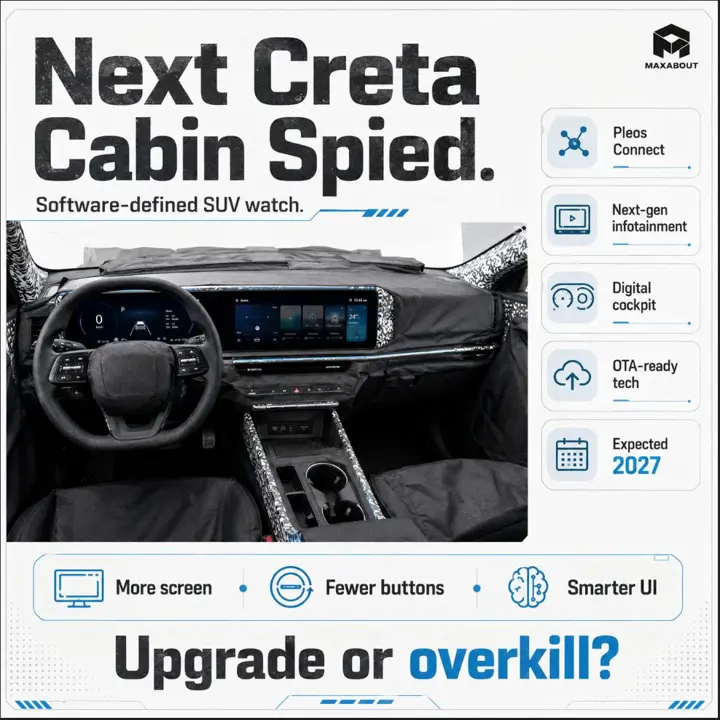
Recent spy shots of what appears to be a next-generation Creta interior have started circulating, and they reveal something more than a cosmetic refresh. The cabin shows clear signs of Pleos Connect, Hyundai's next-generation infotainment platform, alongside what looks like an SDV (Software Defined Vehicle) architecture underneath. For a car that many buyers already consider the benchmark in its segment, this could be a meaningful leap forward.
From what industry sources suggest, this is not just about a larger screen or prettier graphics. It points toward a fundamentally different relationship between the vehicle and its software — one that can evolve over time. That is a curious and genuinely interesting direction for a car that millions of Indian families already rely on every single day.
What Is Pleos Connect and Why Should Indian Buyers Care?
Let's start with the basics. Pleos Connect is Hyundai's next-generation infotainment and connected vehicle platform — essentially the software brain that manages everything from your touchscreen interface to how the car communicates with the outside world. Think of it as a significant step up from the current system, built with faster processors, smarter connectivity, and a genuine capacity to improve over time through over-the-air updates.
 That last part matters more than it might sound. Right now, the current Creta's infotainment works — but only just. Anyone who has used it in stop-and-go traffic in Bengaluru or Mumbai knows the occasional frustration. Inputs lag. The connected car features, while present, can feel inconsistent. Smartphone mirroring sometimes takes its time, and the app ecosystem feels limited compared to what buyers in this price range increasingly expect.
And those expectations have genuinely shifted. In the ₹15–20 lakh segment, buyers today walk into showrooms asking about screen size, voice command accuracy, and whether the system supports wireless Android Auto. In-cabin technology has moved from a bonus feature to a serious purchase consideration — almost as important as fuel efficiency or ride quality for a certain type of urban buyer.
Pleos Connect appears designed to address exactly this gap — with more responsive touch inputs, a broader app ecosystem, and seamless smartphone integration that actually works reliably.
Understanding SDV – What a Software Defined Vehicle Means for Your Creta
If you've been following the Creta buzz and stumbled across the term Software Defined Vehicle, you're not alone in finding it slightly confusing. It sounds like something from a tech conference, not a car showroom. But the concept is actually quite straightforward once you break it down.
Think of it this way. Your current car is essentially fixed at the moment it leaves the factory. Whatever features it shipped with, that's largely what you get for the next ten years. An SDV flips that idea entirely. The car's features, driving behavior, and core systems are governed by software — which means they can be updated, improved, or expanded after you've already driven it home. Exactly like how your smartphone gets better with every OS update.
Practically speaking, this could mean Hyundai pushes an over-the-air update six months after purchase that improves the voice recognition accuracy, adds a new connected app, or even refines the throttle response mapping. You wake up, and your car is genuinely better than it was yesterday. That's a meaningful shift from how we've always thought about vehicle ownership in India.
But it's worth being honest about the concerns too. This creates a real dependency on Hyundai's long-term software support commitment. What happens five years from now if update cycles slow down? Cybersecurity is another genuine consideration — a connected car is also a car with potential vulnerabilities.
And then there's India's infrastructure reality. Tier-2 and tier-3 cities still deal with inconsistent 4G coverage, let alone 5G. For a buyer in Coimbatore or Nagpur, seamless over-the-air updates may not be as effortless as Hyundai's marketing suggests.
Interior Design Changes Spotted in the Spy Shots – A Closer Look
Beyond the infotainment buzz, the spy shots reveal something more interesting — the overall dashboard architecture appears noticeably different from the current generation. The layout looks more horizontal and layered, moving away from the slightly busy, center-heavy design that the existing Creta carries.
The screen itself appears larger, possibly stretching toward a widescreen or panoramic format. There are also hints of a fully digital instrument cluster replacing the current semi-digital setup — which, frankly, feels dated compared to rivals already offering full-digital dials.
Steering wheel controls look revised too. The current model's button placement has drawn mild criticism for feel and tactile response, so any improvement there would be welcome. Some shots suggest touch-sensitive or capacitive controls, though that remains speculative at this stage.
Ambient lighting traces are visible along the dashboard trim — a feature the current Creta reserves largely for higher variants. If this cascades further down the trim lineup, that would genuinely address a common complaint.
Speaking of complaints — the current Creta's lower trims have hard, scratchy plastics on the door panels and lower dashboard sections, something owners consistently mention. From what these images show, surface textures look more refined, but spy shots cannot confirm material quality with certainty.
Rear legroom remains unclear from available angles. That has historically been a genuine pain point, and no interior redesign fully resolves it without changing the wheelbase itself.
How Does This Stack Up Against Rivals Like the Seltos, Grand Vitara, and Hector?
This is where things get genuinely interesting. The Creta has not always held the interior technology lead in this segment — and its rivals have been busy.
The Kia Seltos already runs a capable connected infotainment setup with over-the-air updates and a reasonably mature software experience. Ownership communities generally rate its tech reliability higher than its screen size suggests. The Maruti Suzuki Grand Vitara brought a heads-up display into this price bracket — something that genuinely impressed buyers who expected that feature to sit much higher up the price ladder. And the MG Hector has made its enormous touchscreen and voice command system a centrepiece of its identity for years now.
So does the Pleos Connect system and SDV architecture genuinely leapfrog these competitors, or does it simply bring the Creta back to parity? Honestly, from what is currently known, it looks more like a strong catch-up move with some forward-looking additions. The SDV foundation matters more long-term than any single feature — it means the vehicle can evolve through software rather than becoming dated within two years.
What Indian buyers in this segment consistently ask about, based on forum discussions and long-term review feedback, is not the spec sheet. Reliability of the technology is the real concern. A system that freezes on the Mumbai-Pune expressway or loses connected features after a software update frustrates owners far more than a slightly smaller screen ever would.
That is where Hyundai will need to prove itself with this generation.
Real-World Concerns: Will This Tech Hold Up on Indian Roads and Networks?
Specs on paper mean very little when you are crawling through Bengaluru's Outer Ring Road at 6 PM with your connected services dropping in and out. That is the honest reality of deploying sophisticated software-heavy systems in Indian conditions.
Network consistency is the first problem. Connected features depend entirely on reliable data connectivity, and Indian urban corridors — despite impressive 4G and 5G rollouts — still have significant dead zones inside dense city pockets, underpasses, and suburban stretches outside Mumbai or Delhi. Features like over-the-air updates, remote commands, and live traffic integration become unreliable precisely where you need them most.
Then there is the heat factor. Touchscreen panels in vehicles parked under direct sun in Rajasthan or interior Maharashtra regularly reach temperatures that affect responsiveness and long-term display health. A large, software-driven screen is only as good as its thermal management.
Dusty highway conditions on routes like Delhi-Jaipur add another layer of concern for sensor-dependent SDV systems.
Perhaps the most genuine concern is service readiness. Hyundai's network is broad and generally dependable for mechanical issues. But software diagnostics require trained technicians and updated tools — something tier-2 centers are still developing across most brands. If a Pleos Connect module malfunctions in a smaller city, the turnaround experience could be frustrating.
Expected Launch Timeline, Variants, and Pricing Outlook
So when does all of this actually arrive in showrooms? Nothing official has been confirmed yet, but industry chatter points toward a 2025-2026 window for a more significant Creta update or generation change. Hyundai typically refreshes the Creta every four to five years, and the current generation launched in early 2024 — so a full overhaul seems unlikely immediately. A mid-cycle facelift carrying these interior upgrades, including Pleos Connect, feels like the more realistic near-term possibility.
On variants, Hyundai's approach has been fairly consistent. Expect the base and mid trims to get the hardware shell without the full software capability unlocked. Pleos Connect and SDV features will almost certainly be top-trim territory first — think the SX and SX(O) equivalents. From what industry observers have noted, premium connectivity tech tends to trickle down only after one full product cycle, if at all.
Pricing is where things get interesting. The current Creta runs from roughly ₹11 lakh to ₹20 lakh ex-showroom. A meaningful tech upgrade of this scale could push the top variants closer to ₹22-23 lakh — informed speculation, not a firm figure. Whether that price shift feels justified will depend entirely on how polished the actual experience is at launch.
Final Thoughts – Is the Next-Gen Creta Interior Worth the Wait?
Honestly? The Pleos Connect direction looks genuinely promising. If Hyundai delivers on what these spy shots suggest — a cleaner layout, smarter software integration, and real over-the-air capability — this could be one of the more meaningful mid-cycle interior upgrades we have seen in the segment.
For tech-forward buyers and young professionals who care about the connected experience as much as the drive itself, this update matters. A lot. These are buyers who already live inside their smartphones and expect their car to keep up. The current Creta is good, but its tech layer is starting to show its age against newer rivals.
For families upgrading from a 2018-2020 Creta, the gap will feel enormous — and that is probably Hyundai's most important audience here.
That said, software quality at launch is still an open question. Promises on paper rarely survive first contact with real traffic on a Bengaluru ring road or a patchy network connection on a highway stretch outside Nagpur.
If you are not in a rush, waiting makes sense. The current Creta still offers strong value and a proven ownership experience. But if the next generation arrives with a polished, reliable software layer rather than a laggy demo experience, it could genuinely reset expectations.
India's car buyers are ready for truly connected vehicles. The real question is whether the technology is ready for India.
Maxabout Team
Editorial Team
Specializes in: Automotive News, Reviews, Analysis
Want to read more automotive news?
Stay updated with the latest car launches, reviews, and industry insights.
Browse All News