
New Bajaj Pulsar 125 and Pulsar 150 Launched: Prices and Key Changes
The new Bajaj Pulsar 125 and Pulsar 150 have launched in India with starting ex-showroom prices of ₹92,990 and ₹1,15,233, respectively. The update is more substantial than a routine colour refresh: both motorcycles adopt a monoshock rear suspension, revised chassis hardware, LED lighting and Bajaj's...
Editorial Team
The new Bajaj Pulsar 125 and Pulsar 150 have launched in India with starting ex-showroom prices of ₹92,990 and ₹1,15,233, respectively. The update is more substantial than a routine colour refresh: both motorcycles adopt a monoshock rear suspension, revised chassis hardware, LED lighting and Bajaj's low-speed Crawl Tech, while higher variants add a connected 5-inch TFT. Buyers should still compare variants carefully because the display, braking and seat configurations are not identical across the range.
What you need to know
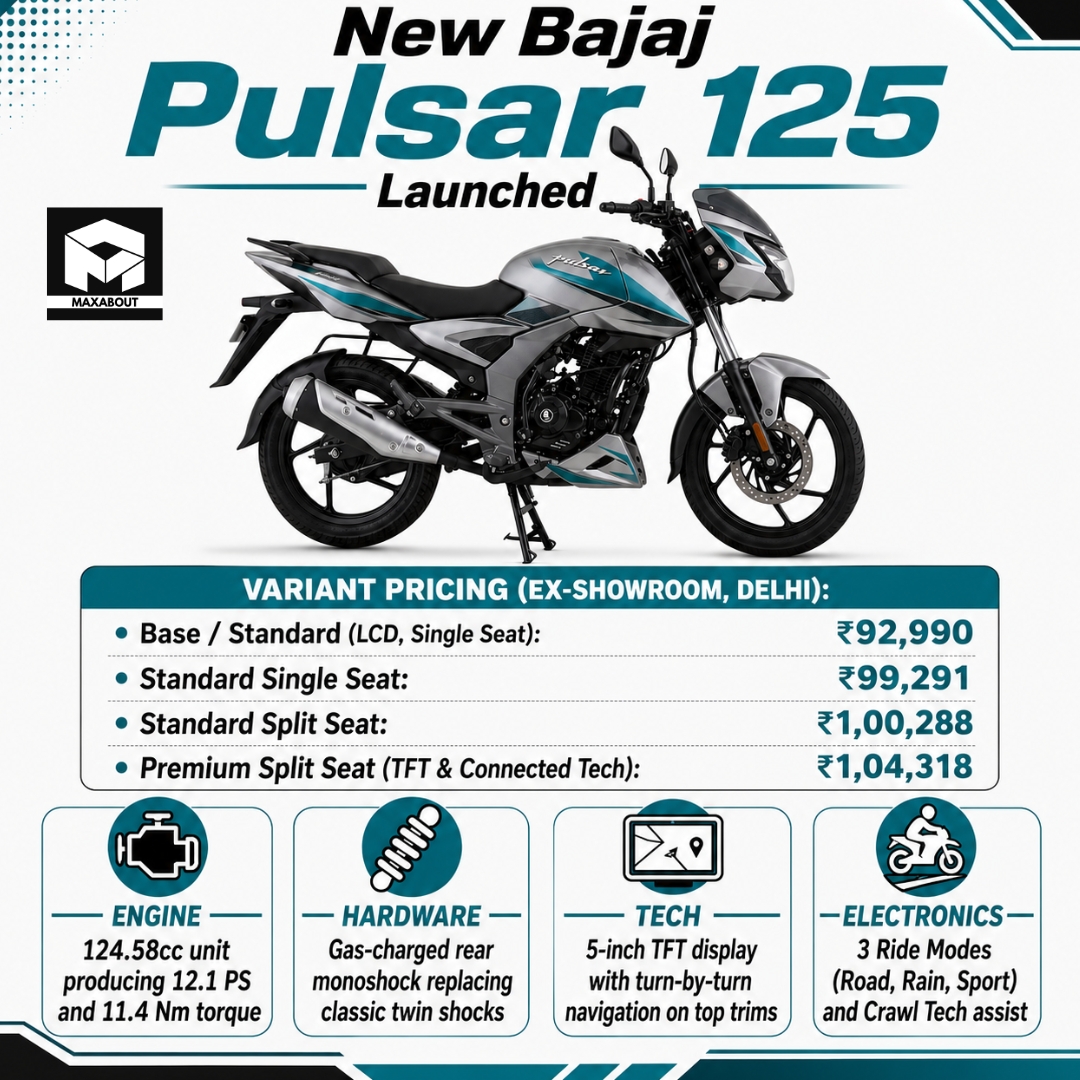
Pulsar 125 price: ₹92,990 to ₹1,04,318, ex-showroom.
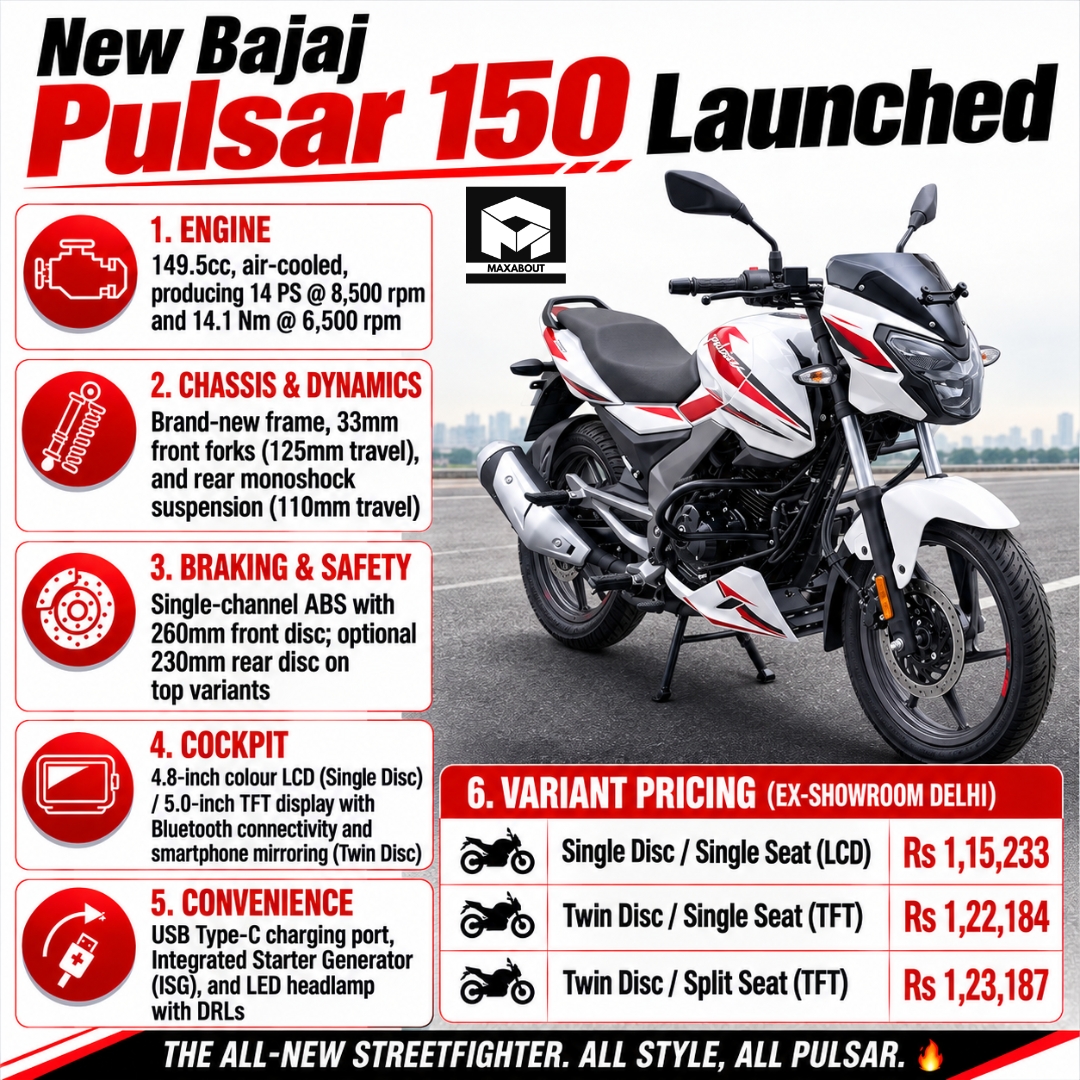
Pulsar 150 price: ₹1,15,233 to ₹1,23,187, ex-showroom.
Shared headline upgrades: monoshock rear suspension, LED headlamp, new chassis/gearbox hardware and Crawl Tech.
Connected display: a 5-inch TFT with navigation and connected functions is offered on higher variants; lower trims use a colour LCD.
Availability caution: on-road prices, dealer stock and delivery timing can vary, and dispatch dates were not confirmed at the time of writing.
New Bajaj Pulsar 125 and Pulsar 150 price list
| Model / variant | Ex-showroom price |
|---|---|
| Pulsar 125 entry variant | ₹92,990 |
| Pulsar 125 standard, single seat | ₹99,291 |
| Pulsar 125 standard, split seat | ₹1,00,288 |
| Pulsar 125 premium, split seat | ₹1,04,318 |
| Pulsar 150 single disc, single seat | ₹1,15,233 |
| Pulsar 150 twin disc, single seat | ₹1,22,184 |
| Pulsar 150 twin disc, split seat | ₹1,23,187 |
These are launch ex-showroom figures, not final on-road prices. Registration, insurance, accessories and state-level charges will change the amount a buyer pays.
What has changed on the new Pulsars?
The most visible shift is the move from the older twin-shock layout to a rear monoshock. The motorcycles also use a diamond-type frame with the engine functioning as a stressed member, along with a revised exhaust and LED headlamp. Reported outputs are approximately 12 PS for the Pulsar 125 and 14 PS for the Pulsar 150, with both paired to a 5-speed gearbox.
Contemporary launch reports differ on whether the engines should be described as entirely new or heavily revised. The safe buyer takeaway is that Bajaj has changed the engine/gearbox package and low-speed calibration, but a detailed official brochure comparison is still the best way to verify every internal change.
What is Crawl Tech?
Crawl Tech is a low-speed assist designed for stop-go traffic. It lets the motorcycle move at a controlled low pace without constant throttle input, reducing the small throttle-and-clutch corrections riders typically make in congestion. It is a convenience feature, not autonomous riding, and users should confirm its operating instructions during the dealer handover.
LCD, TFT and variant equipment explained
The headline 5-inch TFT is not a reason to assume every variant has identical equipment. Higher trims add the TFT with Google navigation and connected functions, while entry versions use a colour LCD. Depending on the variant, buyers can also choose between single and split seats and different braking packages. Some reports additionally list three ride modes, USB Type-C charging, silent starting and idle start-stop on better-equipped versions.
Before booking, ask the dealer to show the exact variant physically and confirm the display, front/rear brake hardware, seat configuration, USB port and connected features on the invoice.
Pulsar 125 or Pulsar 150: which one fits you?
The Pulsar 125 is the value-led choice for city commuters who want the classic Pulsar identity, a lower starting price and the new chassis features. The Pulsar 150 costs roughly ₹22,000 more at the entry level but offers more displacement and stronger output, which should suit riders who regularly carry a pillion or spend more time on faster roads.
The most useful comparison is not only 125 versus 150. Buyers should first set a budget, then compare the precise variants within that model. A top Pulsar 125 and base Pulsar 150 sit relatively close in price, so engine performance, braking hardware and desired display features may matter more than cosmetic preferences.
FAQs
What is the new Bajaj Pulsar 125 price?
The 2026 Pulsar 125 starts at ₹92,990 and goes up to ₹1,04,318, ex-showroom, depending on the variant.
What is the new Bajaj Pulsar 150 price?
The 2026 Pulsar 150 starts at ₹1,15,233 and reaches ₹1,23,187, ex-showroom, depending on the seat and braking configuration.
Do all Pulsar 125 and Pulsar 150 variants get a TFT?
No. Higher variants get the 5-inch TFT, while lower versions use a colour LCD. Confirm the exact equipment before booking.
Are deliveries open?
The motorcycles have been launched, but a uniform national dispatch or delivery date was not confirmed at retrieval. Dealer stock can differ by city.
The new Bajaj Pulsar 125 and Pulsar 150 price positioning keeps both bikes in the mass-market commuter-sport space while adding meaningful chassis and traffic-friendly technology. The best next step is to compare the exact on-road quote and variant equipment rather than choosing from the starting price alone.
No comments yet
Be the first to share your thoughts!
Want to read more automotive news?
Stay updated with the latest car launches, reviews, and industry insights.
Browse All News