
MG Majestor Pulls 406-Tonne Train, Sets Guinness Record
A production SUV pulling a 406-tonne train. Let that sink in for a moment. That is not a modified drag racer or some purpose-built engineering prototype. That is the MG Majestor — a vehicle you could theoretically drive to a shopping mall in Pune on a Tuesday — hauling the equivalent weight of rough...
Editorial Team
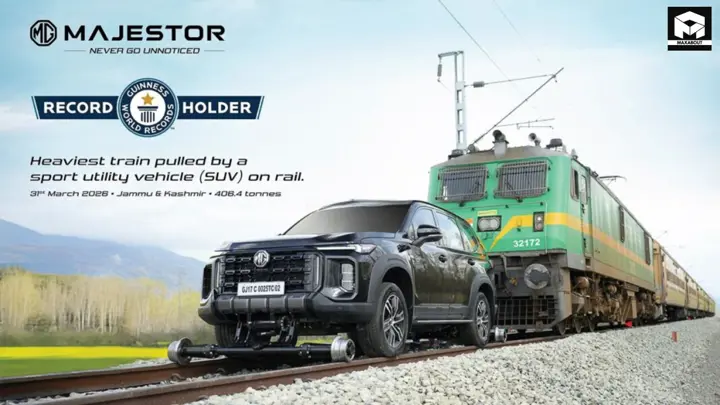
A production SUV pulling a 406-tonne train. Let that sink in for a moment. That is not a modified drag racer or some purpose-built engineering prototype. That is the MG Majestor — a vehicle you could theoretically drive to a shopping mall in Pune on a Tuesday — hauling the equivalent weight of roughly 270 full-grown elephants down a railway track.
The Guinness World Record attempt took place under official, controlled conditions, with proper verification and documentation. MG did not just post a dramatic video and call it a day. This was a legitimate, independently verified achievement, and the numbers are genuinely staggering.
For those not yet familiar with the Majestor — it is MG's flagship full-size SUV, positioned at the premium end of their lineup. Think commanding road presence, serious powertrain hardware, and a design that is clearly aimed at buyers who want something that stands out in a sea of similarly sized rivals.
But here is why this matters beyond the spectacle. In a market as competitive and skeptical as India's, engineering credibility is hard to earn. From what I have observed, Indian buyers are increasingly asking sharper questions about build quality and real-world capability. A Guinness record does not answer every question — but it absolutely starts a conversation.
Breaking Down the Record: The Numbers Behind the 406-Tonne Pull
So what does 406 tonnes actually feel like as a number? Think of it this way — a standard sedan weighs roughly 1.2 to 1.4 tonnes. That means the MG Majestor effectively dragged the equivalent of nearly 300 fully loaded family cars in a single controlled pull. That is not a small achievement, and the scale of it deserves a proper look.
According to official announcements, the attempt was conducted on a level surface under controlled conditions, with Guinness adjudicators present to verify the attempt. The distance pulled, the gradient of the surface, and the load configuration were all documented as part of the verification process. This matters because Guinness does not simply take the manufacturer's word for it — there are independent observers, calibrated measuring equipment, and strict protocol involved.
From an engineering standpoint, what makes this possible is peak torque delivery at low RPM — something electric drivetrains do exceptionally well. The Majestor's motor architecture is designed to push maximum torque almost instantly, which is precisely what you need to break static friction and get a massive stationary load moving.
That said, being honest here is important. A controlled record attempt is not the same as real-world towing. Surface conditions, ambient temperature, load distribution, and drivetrain stress over sustained distances all tell a different story than a single documented pull.
Meet the MG Majestor: What Kind of Vehicle Is This Anyway?
So before we get carried away with the spectacle of a car pulling a train, it helps to understand exactly what the MG Majestor is. Because context matters here.
The Majestor sits at the top of MG's Indian lineup — a large, three-row SUV aimed squarely at buyers who want something more substantial than a Hector Plus or an Alcazar. Think of it as MG's answer to the premium family hauler segment, competing broadly against vehicles like the Toyota Fortuner, Skoda Kodiaq, and the Jeep Meridian. It is not a hardcore off-roader, but it is engineered with enough muscle to handle serious real-world demands.
On the powertrain front, the Majestor is positioned around an electric drivetrain — which, interestingly, is exactly why this record attempt makes sense. Electric motors deliver peak torque from a standstill, something internal combustion engines simply cannot replicate without significant rev buildup.
In terms of size, this is a genuinely large vehicle — seven seats, a commanding road presence, and dimensions that put it firmly in full-size SUV territory. Expected pricing, based on official announcements, is likely to sit north of ₹30 lakh, targeting buyers upgrading from mid-size SUVs or considering German and Japanese alternatives.
MG choosing the Majestor for this record was no accident. It was a deliberate statement about where the brand believes its engineering credibility now stands.
What This Record Actually Tells Us About the MG Majestor's Engineering
Pulling a 406-tonne train is dramatic. But once the spectacle fades, the more interesting question is: what does this actually reveal about the Majestor's hardware?
The short answer — low-end torque delivery and drivetrain robustness. Moving something that heavy from a dead stop requires enormous pulling force at near-zero speeds. That means the engine, transmission, and cooling systems all had to perform under sustained, brutal load without flinching. That is not a straightforward engineering achievement.
The transmission specifically deserves attention here. Controlled towing attempts regularly expose weak points in torque converters and clutch packs. The fact that the Majestor held together under that kind of stress suggests its drivetrain has genuine structural integrity — not just on paper, but under real physical demand.
Now, the honest caveat. A Guinness attempt is a controlled environment — flat surface, measured conditions, a single defined task. Everyday driving in Himachal Pradesh or Uttarakhand is an entirely different story. Sustained climbs, unpredictable gradients, and variable loads introduce complexity that no record attempt fully replicates.
That said, for Indian buyers who actually tow — think caravan owners, equipment haulers, or those running goods through hilly terrain — this kind of reserve power is genuinely reassuring. And even if you never attach a trailer, there is real value in knowing your vehicle has serious headroom beyond what daily driving demands.
MG's Journey in India: Building Credibility One Bold Move at a Time
MG Motor did not quietly slip into the Indian market. From day one, they arrived with intention — launching the Hector with a technology-first pitch at a time when connected car features were still a novelty here. It was a smart read of the room. Indian buyers, particularly in metros, were hungry for something that felt genuinely modern.
Since then, the brand has followed a consistent playbook: do something bold, make headlines, repeat. The ZS EV helped position MG as an early serious player in India's electric space. The Comet tried something almost experimental — a micro EV for city commuters. Not every bet landed perfectly, but the ambition was always visible.
This Guinness record attempt fits that same pattern. Other manufacturers have used engineering stunts effectively — think Volvo's live test campaigns or various towing demonstrations from American truck brands. The idea is simple: a dramatic real-world demonstration says more than a specification sheet ever could.
The honest question, though, is whether MG's after-sales experience matches this marketing energy. From what customers in cities like Pune, Hyderabad, and Chennai have reported, the picture is mixed. Service network coverage has improved, but it still trails the depth that Maruti or Hyundai offers across smaller towns. That gap matters enormously in India.
Record attempts build excitement. Reliable service networks build loyalty. MG needs both.
Pros and Cons of the MG Majestor as an Indian Buyer's Choice
Let me be straightforward here. The Guinness record is genuinely impressive, but a 406-tonne train pull does not tell you how the Majestor handles a waterlogged stretch on the Bengaluru-Mysuru highway or whether it fits cleanly into a Mumbai apartment complex's parking bay. Those are the questions that actually matter.
Starting with what works in its favour: The engineering confidence shown by this record is not nothing. It signals serious powertrain capability, and MG vehicles have historically arrived with feature lists that punch well above their price bracket. If the Majestor follows that pattern, buyers can reasonably expect strong technology integration — ADAS features, connected car systems, and cabin quality that rivals more expensive options.
Against competitors in its segment, MG typically offers more equipment per rupee. That value proposition has real appeal.
But the concerns are equally real. Resale value remains a legitimate worry. Established brands like Toyota or Hyundai hold value more predictably, and for many Indian buyers, resale is practically part of the purchase calculation. Long-term reliability data simply does not exist yet for a vehicle this new.
Ground clearance on rough village roads, fuel efficiency crawling through Delhi traffic, and whether its footprint suits tight urban parking — these remain open questions worth investigating before signing anything.
Approach this one with cautious optimism, not blind excitement.
Should Indian Buyers Get Excited About the MG Majestor? My Take
Here is where I land on this. The 406-tonne train pull is genuinely impressive — not a gimmick, not hollow marketing theater. It reflects real engineering conviction, and MG deserves credit for putting that on record, literally.
But buying a car because it pulled a train? That would be missing the point entirely.
The ideal Majestor buyer is someone who wants a feature-rich flagship SUV, appreciates MG's value-for-money positioning at the premium end, and is not losing sleep over resale numbers or service network gaps in smaller cities. Someone in Pune, Bengaluru, or Delhi who wants presence, comfort, and technology — and understands they are early adopters.
Before committing, watch for official launch pricing, variant breakdowns, and crucially, real ownership experiences from the first six months on Indian roads.
In a broader sense, this record signals something meaningful — MG is pushing harder, thinking bigger, and competing more seriously in India's crowded SUV space. That ambition benefits every buyer, even those who ultimately choose a rival brand.
Optimistic? Yes. But go in with open eyes.
No comments yet
Be the first to share your thoughts!
Want to read more automotive news?
Stay updated with the latest car launches, reviews, and industry insights.
Browse All News