
MG India Opens Nepal Dealership: Export Push Begins
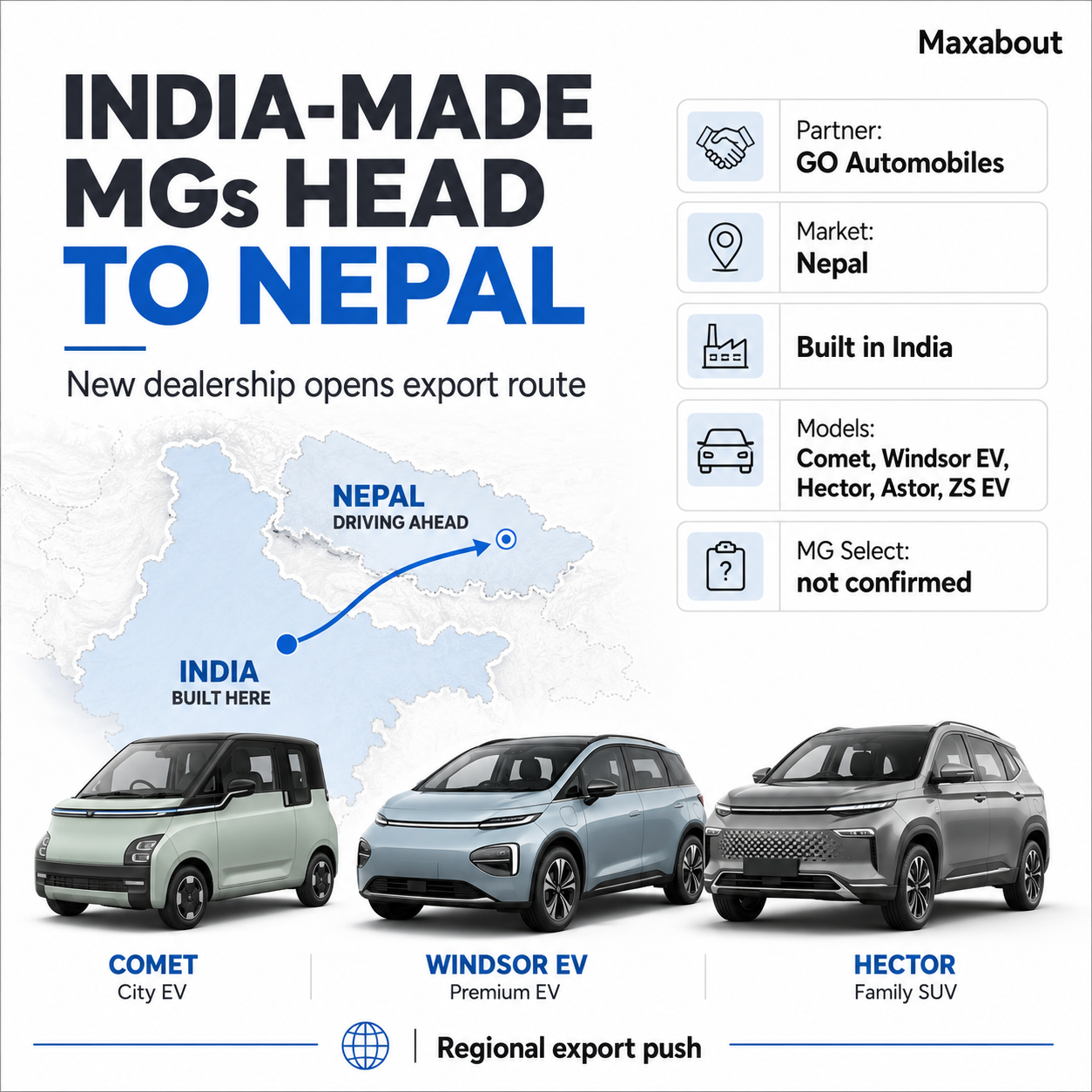
MG India just opened a dealership in Nepal, and honestly, it's worth paying attention to. This isn't just a routine business expansion — it signals something larger about where JSW MG Motor India sees itself heading across South Asia.For context, an Indian automotive operation exporting cars to a ne...
Editorial Team
MG India just opened a dealership in Nepal, and honestly, it's worth paying attention to. This isn't just a routine business expansion — it signals something larger about where JSW MG Motor India sees itself heading across South Asia.
For context, an Indian automotive operation exporting cars to a neighbouring market is still a relatively rare story. We're used to hearing about global brands setting up shop in India. Watching the direction reverse, even partially, feels like a meaningful shift.
MG India has been building quietly on the domestic front — the Hector, the Comet, the Windsor EV have all carved out distinct spaces in an increasingly competitive market. Now, with this Nepal move, the brand appears ready to test whether that momentum can travel beyond Indian borders.
The bigger question, though, is straightforward: is this a genuinely strategic push into South Asian markets, or is it largely symbolic? A single dealership in Nepal doesn't build an export empire. But it does plant a flag. It sends a signal to competitors, to investors, and to the region that MG India is thinking beyond its home turf.
From what industry observers are noting, this could be the first step in a more deliberate regional playbook.
Understanding MG India's Current Position in the Indian Market
Before exploring what Nepal means for MG's ambitions, it helps to understand where the brand actually stands in India right now. And honestly, the story is more interesting than many people give it credit for.
MG Motor India has carved out a distinct identity in a crowded market by doing one thing consistently well: loading vehicles with features that rivals charge significantly more for. The Hector, arguably the vehicle that put MG on the Indian map, still turns heads with its large touchscreen, connected car technology, and spacious interior. It sits in a competitive segment but manages to hold its ground.
 The ZS EV was among the earlier serious electric offerings in the Indian market at a time when most buyers were still skeptical about range and charging infrastructure. The Comet EV took a completely different approach — compact, urban-focused, and priced accessibly. Then there is the Gloster, MG's full-size SUV that quietly appeals to buyers wanting premium space without the steeper luxury price tags.
Perhaps the most significant development in recent times has been the JSW Group partnership, following a reduction in SAIC Motor's stake. That shift genuinely changed how many Indian consumers and dealers perceived the brand — moving it closer to a domestically grounded identity rather than a purely foreign-owned entity.
Dealership presence has expanded steadily across Mumbai, Delhi, Bengaluru, and Hyderabad, giving MG a credible service and sales footprint. That domestic foundation matters enormously when a brand starts thinking about regional exports.
Why Nepal Makes Sense as MG India's First Export Destination
When you think about it, Nepal is almost an obvious choice. The geography alone makes a compelling argument — landlocked, sharing an open border with India, and historically dependent on Indian imports across everything from consumer goods to automobiles. Starting close to home is simply smart business.
Urban centres like Kathmandu and Pokhara have shown consistent appetite for feature-rich, well-equipped SUVs. Nepali buyers in these cities aren't looking for stripped-down budget options — they want technology, space, and road presence. That description fits MG's lineup rather well.
Road conditions in Nepal also mirror many Indian realities. Uneven surfaces, altitude variations, and mixed urban-rural driving demand vehicles with capable suspension and reasonable ground clearance. The Hector and Astor aren't strangers to those demands.
There's also growing EV curiosity among Nepali consumers, partly driven by fuel import costs. MG's electric portfolio gives it a conversation starter that few rivals currently have at scale.
That said, MG isn't walking into empty territory. Hyundai, Kia, and Maruti already have established footholds in Nepal, with loyal customer bases and functioning service networks. The competitive landscape is real. Cultural familiarity with Indian vehicles certainly helps MG, but familiarity alone won't win market share — product quality and after-sales reliability will ultimately decide that.
What Models Could MG Offer in Nepal and Why That Matters
If MG is serious about Nepal, the product lineup it brings will matter enormously. Not every vehicle in its Indian portfolio makes equal sense for Nepali roads and buyers.
The Hector is arguably the strongest candidate. Nepal has historically shown a preference for larger, commanding SUVs — partly practical, given the varied terrain, and partly aspirational. The Hector's generous dimensions, feature-rich interior, and established reputation in India give it a credible pitch for Nepali buyers looking at that segment.
The ZS EV is an interesting case. Nepal's push toward electric mobility, backed by its substantial hydropower surplus, creates a genuinely favourable environment for EVs. From what industry observers note, charging infrastructure is gradually expanding in urban Nepal. The ZS EV could find real traction there, not just as a novelty but as a practical proposition.
The Comet EV is more of a question mark. It is inherently urban-specific, and Nepal's primary EV demand likely skews toward more versatile options. Worth watching, but probably not the priority launch.
One structural advantage worth noting — MG India already produces right-hand drive vehicles, which Nepal requires. There is no costly conversion needed, making the transition logistically clean.
Pricing, however, will be a genuine hurdle. Nepal's import duties typically push vehicle costs noticeably higher than Indian retail prices, so MG will need to position its value proposition carefully against that premium.
The Bigger Picture: India as a Regional Automotive Export Hub
MG's Nepal move doesn't exist in isolation. It's actually part of a much larger story that's been quietly building for several years — India's steady rise as a serious automotive export base for the wider region.
Maruti Suzuki, Hyundai India, Tata Motors, and Mahindra have all been exporting vehicles to neighbouring countries and African markets for some time now. Industry reports suggest India's automotive exports have grown significantly, with official announcements from the government positioning the sector as a key pillar of the broader manufacturing push.
The PLI scheme for automobiles and the ongoing Make in India initiative have both played a real role here. These aren't just policy documents — they've translated into actual investment decisions, production expansions, and now, export ambitions reaching deeper into South Asia.
From an industry standpoint, every additional vehicle sold abroad from an Indian plant strengthens domestic manufacturing volumes. Higher volumes typically mean better supplier ecosystems, improved cost efficiencies, and stronger justification for investing in localised component development. It creates a positive cycle.
For MG specifically, joining this export conversation signals genuine confidence in its Indian manufacturing setup. And for India's automotive industry overall, having one more brand — even a relatively young player — contributing to regional exports is a meaningful addition to a trend that's clearly gaining momentum.
Challenges MG India Will Face in the Nepali Market
That confidence is understandable, but the Nepali market comes with some genuinely tough hurdles that MG cannot afford to underestimate.
The most immediate concern is pricing. Nepal imposes heavy import duties on vehicles, and these aren't modest additions — they can push the final retail price to nearly double what the same model costs in India. For a brand like MG, which already sits in the mid-to-premium segment, that duty burden could place its vehicles well beyond what average Nepali buyers can realistically consider. Purchasing power there is considerably lower than in Indian metros, and the local currency dynamics add another layer of complexity to affordability.
Then there's the after-sales reality. A dealership opening is just the starting point. Nepal will need trained service technicians, a reliable spare parts supply chain, and eventually more service centres beyond the initial location. Building that infrastructure takes time, sustained investment, and genuine commitment — not just enthusiasm at launch.
Competition is fierce too. Japanese brands like Toyota and Suzuki, along with Korean players, have built deep loyalty over decades in Nepal. Buyers there trust these names precisely because service support is proven and parts are widely available. MG is walking into that trust deficit with no shortcuts available.
From what industry observers note, the Nepal push is promising — but realistic expectations matter here.
What Indian MG Owners and Buyers Should Take Away From This
So what does a Nepal dealership actually mean for someone sitting in Pune or Hyderabad, debating whether to book an MG Hector or Astor? Honestly, not much in the immediate term. Your waiting period is not about to shrink next month because of this announcement.
But look slightly beyond the short term, and there are some quietly encouraging signals worth noting.
When manufacturers scale production to meet export demand, supply chains tend to tighten up in a good way. Parts availability improves, logistics become more organised, and production lines run more efficiently. Indian buyers have occasionally complained about spare parts delays for certain MG models — that kind of friction tends to reduce naturally as overall volumes climb.
There is also the resale value angle. MG's perception in India still trails behind established Japanese and Korean brands. A growing regional footprint — Nepal today, potentially other South Asian markets tomorrow — gradually builds the brand's credibility. Stronger brand recognition across the region does, over time, influence how confidently a used-car buyer in Delhi or Bengaluru views an MG on the lot.
Most importantly, this move signals that MG views this geography as a long-term business commitment, not a short-lived experiment. For anyone currently considering an MG purchase, that is a genuinely reassuring backdrop to have.
Final Thoughts: A Cautious But Encouraging Step Forward
Let's be clear about what this actually is. One dealership in Nepal is not a sweeping international expansion. It is a single, deliberate step — modest in scale, but meaningful in intent. From what I can see, MG India is testing the ground carefully before committing further, which frankly seems like the right approach.
What makes this encouraging is the underlying confidence it reflects. You do not push into export markets unless you believe your domestic product quality and after-sales infrastructure can hold up under scrutiny beyond your home borders. That is not a trivial signal.
If MG follows through consistently over the next three to five years — building service support, maintaining parts availability, and expanding thoughtfully — this looks like a smart first move in a genuinely underserved regional market.
The bigger question worth sitting with, though, is this: why aren't more Indian automakers pursuing South Asian markets with this kind of intent? The geography is close, the brand familiarity exists, and the opportunity is real. Perhaps MG's cautious push will prompt others to finally take that seriously.
No comments yet
Be the first to share your thoughts!
Want to read more automotive news?
Stay updated with the latest car launches, reviews, and industry insights.
Browse All News