

Maruti Suzuki YMC Electric MPV Spotted Testing in India
Something interesting is happening on Indian roads. Maruti Suzuki's upcoming electric MPV, internally called the YMC, has been spotted testing — and if you follow the Indian auto space even casually, you know why that matters.Let's be honest here. Maruti has been notably late to the electric vehicle...
Something interesting is happening on Indian roads. Maruti Suzuki's upcoming electric MPV, internally called the YMC, has been spotted testing — and if you follow the Indian auto space even casually, you know why that matters.
Let's be honest here. Maruti has been notably late to the electric vehicle party. While Tata, MG, and Hyundai have been building their EV portfolios for years now, India's largest carmaker stayed on the sidelines, betting heavily on CNG and hybrids instead. So seeing a Maruti electric MPV actually running on Indian roads — in testing camouflage — feels like a genuine shift in strategy.
According to recent industry reports and automotive sources, spy shots of the YMC have surfaced, showing a heavily disguised people-carrier undergoing real-world evaluation. That kind of on-road testing signals serious development intent, not just early-stage concept work.
In this piece, I want to break down everything we currently know — the design direction, likely specifications, expected positioning, and what Maruti entering this segment could actually mean for buyers considering an electric family vehicle. There's a fair bit to unpack, so let's get into it.
What the Spy Shots Reveal About the YMC's Design and Size
The camouflage wrapping does its job well — there's no denying that. But spy shots rarely hide everything, and the YMC's silhouette tells a reasonably clear story. What stands out immediately is the near-monobox profile — a tall, upright body with a flat roofline that runs almost horizontally from front to rear. That's classic MPV geometry, and it suggests Maruti isn't trying to disguise this as a crossover or SUV-MPV hybrid.
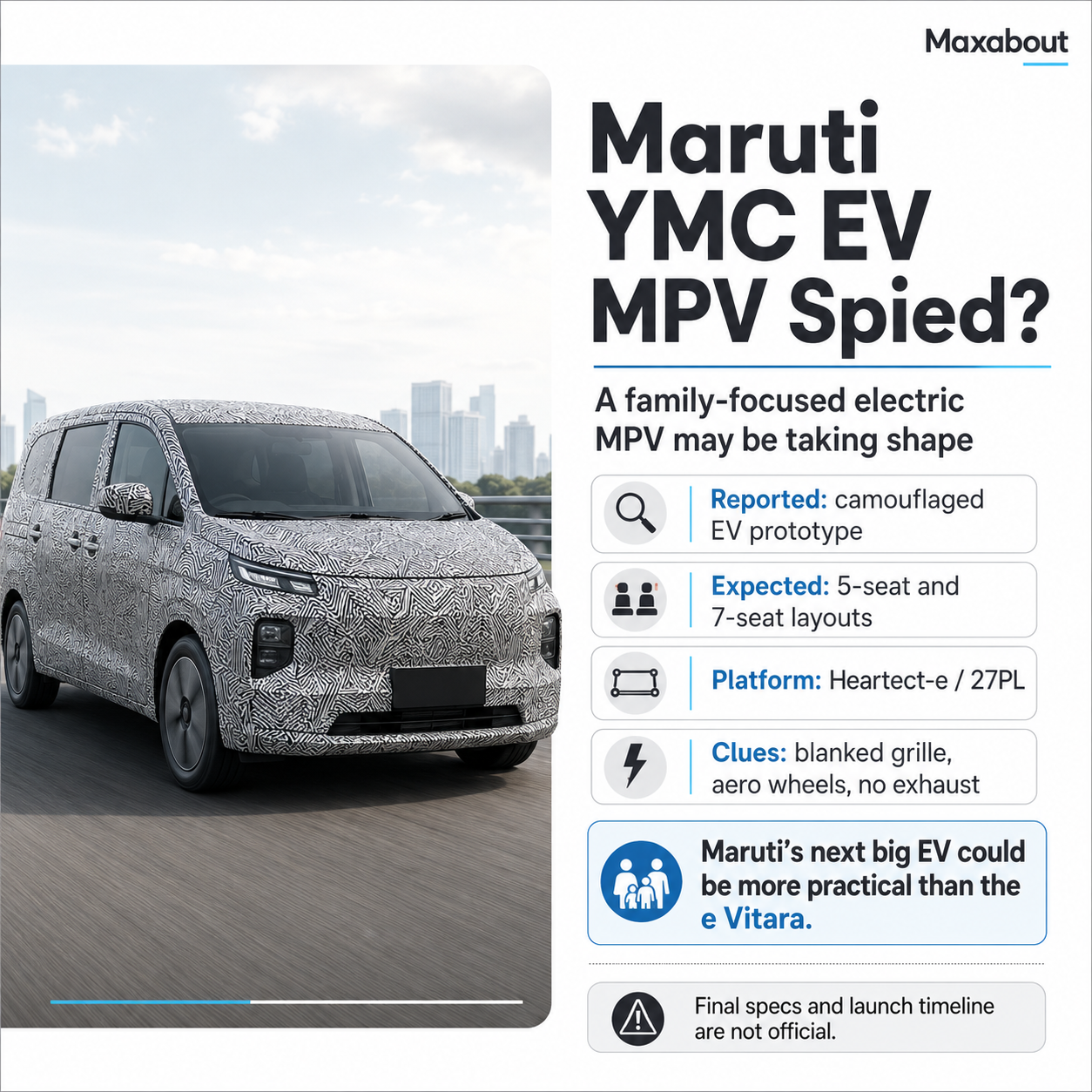 In terms of sheer footprint, this looks noticeably larger than the Ertiga. From what observers have noted, the proportions sit closer to Innova Crysta territory — long wheelbase, generous overhangs, and a body height that hints at a proper three-row interior. For Indian families running airport trips or longer highway drives, that scale matters enormously.
A few specific details have caught attention. The side profile shows flush door handles — a strong indicator of an EV-native design rather than a retrofitted petrol platform. The front end, though heavily wrapped, appears to feature a closed-off grille, which is almost standard practice for electric vehicles where active airflow cooling works differently.
Whether this rides on a global Suzuki platform adapted for India or represents a more India-specific development remains genuinely unclear from spy shots alone. But the sheer size and design language suggest Maruti is thinking seriously about this one.
Expected Powertrain and Range: Will It Suit Indian Driving Conditions?
This is where things get genuinely interesting — and honestly, uncertain. From what Maruti has publicly shared, nothing concrete about battery capacity or motor output has been confirmed. But based on their existing partnership with Toyota and Suzuki's global EV development direction, there are reasonable assumptions worth exploring.
The most likely scenario involves a platform shared with Toyota's EV ecosystem, similar to how the Grand Vitara and Urban Cruiser Hyryder share underpinnings. If that collaboration extends here, expect a reasonably modern battery setup — possibly somewhere in the 50-70 kWh range — though that remains speculative at this point.
For Indian buyers, claimed range figures mean very little in isolation. Real-world performance in Bengaluru's crawling traffic, Delhi's summer heat pushing 45°C, or Mumbai's humidity can easily shave 20-25% off manufacturer claims. An MPV carrying six or seven passengers with air conditioning running constantly will stress any battery pack harder than European test cycles ever account for.
Fast charging support would be non-negotiable for this segment. But here's the honest concern — Tier 2 cities like Jaipur, Indore, or Coimbatore still have patchy public charging infrastructure, and an MPV buyer typically travels further than a compact car owner. Whether Maruti's charging network can genuinely support intercity family trips remains an open question worth watching closely.
Who Is Maruti Really Building This For?
Think about the typical Indian family that currently shortlists the Toyota Innova HyCross or Kia Carens. They want space, reliability, and the confidence that a service center exists within reasonable distance of wherever they live. That buyer profile is exactly who Maruti appears to be courting here.
The Maruti badge carries a specific kind of trust in India. Not just brand loyalty — genuine, earned confidence in after-sales support and long-term ownership costs. Plenty of buyers have wanted an electric vehicle but held back precisely because Maruti hadn't offered one worth considering. The YMC could be the vehicle that finally converts that waiting audience.
Beyond private buyers, the fleet and cab aggregator segment deserves serious attention. Operators running Ola and Uber-affiliated vehicles are actively electrifying, and an MPV format with lower running costs could make compelling financial sense for high-mileage commercial use.
There's also the joint family dimension. In cities like Lucknow, Surat, or Pune, weekend outstation trips with six or seven passengers are completely normal. An electric MPV that handles that reality comfortably would genuinely fill a gap nothing else currently addresses at an accessible price point.
Premium positioning seems likely — probably above ₹20 lakh — but still undercutting the Innova HyCross meaningfully.
Maruti's EV Track Record and Why the YMC Needs to Get It Right
Let's be honest about something. Maruti Suzuki, the company that essentially taught India how to drive, has been remarkably slow to embrace electric vehicles. While Tata Motors was busy building a dominant EV ecosystem — from the Nexon EV to the Tiago EV — Maruti was watching from the sidelines. That absence has cost them credibility in a segment that younger, environmentally conscious buyers increasingly care about.
The e Vitara is their first genuine EV attempt, and it hasn't even launched yet. That tells you everything about how far behind they are. The criticism is fair and Maruti knows it.
Which is precisely why the YMC matters so much. Electric MPVs are essentially uncontested territory right now. No serious, affordable option exists. If Maruti can execute this well, they aren't just catching up — they're actually leading in a specific segment. That's a real opportunity.
But concerns remain. Will they price it aggressively, or play it safe and overshoot? Will the battery range realistically handle a Mumbai to Pune run fully loaded? These are legitimate questions from buyers who've watched other manufacturers overpromise.
Here's where Maruti's strength genuinely matters though. Their after-sales network across smaller cities is unmatched. For EV-specific servicing to reach Nagpur or Coimbatore reliably, that infrastructure advantage could be decisive — if they invest in training it properly.
Expected Price Range and How It Stacks Up Against Rivals
Pricing will make or break this one. Based on where the segment sits and how Maruti typically positions itself, a realistic estimate lands somewhere between ₹20 lakh and ₹30 lakh — with base variants possibly undercutting that ceiling and well-equipped trims pushing beyond it. These are educated guesses, not confirmed figures. The actual number only becomes real closer to launch.
For context, the Innova HyCross hybrid starts around ₹19 lakh and climbs comfortably past ₹28 lakh in top spec. Buyers are already writing those cheques for a premium family hauler. A Kia Carens petrol sits more affordably, but it's a different product emotionally. Maruti would need to position the YMC Electric as genuinely aspirational without scaring off its core audience.
Government FAME subsidies and state-level EV incentives could meaningfully shift the effective price depending on policies active at launch time. States like Maharashtra and Gujarat have offered attractive rebates before — that matters for buyers doing the actual math.
From what industry observers suggest, if Maruti prices this aggressively near the ₹22–24 lakh mark for a well-featured mid-variant, the value conversation becomes very interesting very quickly.
Launch Timeline and What to Expect Before the YMC Hits Showrooms
Camouflaged road testing in India typically signals a 12 to 24 month window before a production launch. The YMC appears to be in active real-world validation right now, which puts a realistic launch somewhere between late 2025 and 2026 — though that estimate could shift depending on how testing progresses.
Before the showroom date, watch for a few key milestones. Maruti will almost certainly use a major platform — possibly Bharat Mobility Expo — for either a concept reveal or a near-production showcase. That usually comes several months ahead of the actual launch.
On the regulatory side, homologation clearances and a final decision on charging standards matter significantly. Whether Maruti commits to CCS2 or Bharat AC001 will shape the charging infrastructure conversation for buyers outside metro areas.
From what industry observers are tracking, the testing phase looks reasonably advanced. But rushing an electric MPV into a price-sensitive market carries real risk — Maruti will likely take the time to get this right rather than launch prematurely.
For now, the most reliable approach is following official Maruti Suzuki announcements directly. Speculation moves fast, but confirmed details always tell a cleaner story.
Final Thoughts: Should Indian MPV Buyers Be Excited?
Honestly? Yes — but with measured expectations. Maruti entering the electric space with a family-focused MPV feels like a genuinely significant moment. This is not a niche luxury product or a small urban runabout. It is a practical, space-first vehicle aimed at real Indian families, and that matters.
But excitement alone does not close a deal. For the YMC Electric to truly win over buyers, three things need to land correctly:
Pricing that sits comfortably within reach — ideally under ₹20 lakh for the base variant
Honest real-world range above 400 km, not just ideal-condition figures
A fast-charging network that actually works outside major cities
Get those right, and Maruti has a genuine winner. Fall short on even one, and the competition will be unforgiving.
In my view, the brand trust Maruti carries is its biggest asset here — but also its biggest responsibility. Buyers will expect reliability above everything else.
Would you consider an electric MPV from Maruti over established rivals? Drop your thoughts below — this conversation is worth having.
Maxabout Team
Editorial Team
Specializes in: Automotive News, Reviews, Analysis
Want to read more automotive news?
Stay updated with the latest car launches, reviews, and industry insights.
Browse All News