
Maruti Suzuki 3 Million Rail Dispatch Milestone Explained
Maruti Suzuki recently crossed a significant logistics milestone — 3 million cars dispatched via rail. That's a big number, but let me explain why it actually matters to someone waiting for their new Swift or Brezza at a dealership in Lucknow or Coimbatore.So what exactly is a rail dispatch? When a ...
Editorial Team
Maruti Suzuki recently crossed a significant logistics milestone — 3 million cars dispatched via rail. That's a big number, but let me explain why it actually matters to someone waiting for their new Swift or Brezza at a dealership in Lucknow or Coimbatore.
So what exactly is a rail dispatch? When a car rolls off the assembly line at Maruti's plants in Manesar, Haryana or Hansalpur, Gujarat, it doesn't always get loaded onto a truck and driven to your city. Maruti uses dedicated freight trains called Auto Carrier Rakes — specially designed wagons that carry finished vehicles securely across long distances. Think of it as a moving parking lot on rails, carrying dozens of cars at once, heading to distribution hubs across the country.
From what industry reports suggest, this shift toward rail logistics isn't just an operational choice — it has real downstream effects. Faster, more predictable transit times mean shorter waiting periods at dealerships. Vehicles arrive with significantly less wear compared to long road hauls. And moving bulk inventory by train costs less than trucking, which quietly helps keep logistics overheads — and potentially showroom pricing — in check.
Three million units is not just a corporate achievement. It's a quiet revolution in how India's largest carmaker gets vehicles to your nearest showroom.
How Maruti Suzuki's Rail Logistics Network Actually Works
So how does a car actually get from the factory floor onto a train? It's a more coordinated operation than most people realise, and the engineering behind it is genuinely interesting.
The backbone of the system is something called an Auto Carrier Rake — essentially a specially designed flatbed rail wagon built to carry multiple cars simultaneously. These aren't standard freight wagons with cars awkwardly strapped on top. They are purpose-built, multi-deck structures that can carry anywhere between 150 to 300 vehicles per rake, depending on the configuration and vehicle sizes being loaded. Cars are driven on, secured carefully, and stacked across levels to maximise space without damaging bodywork.
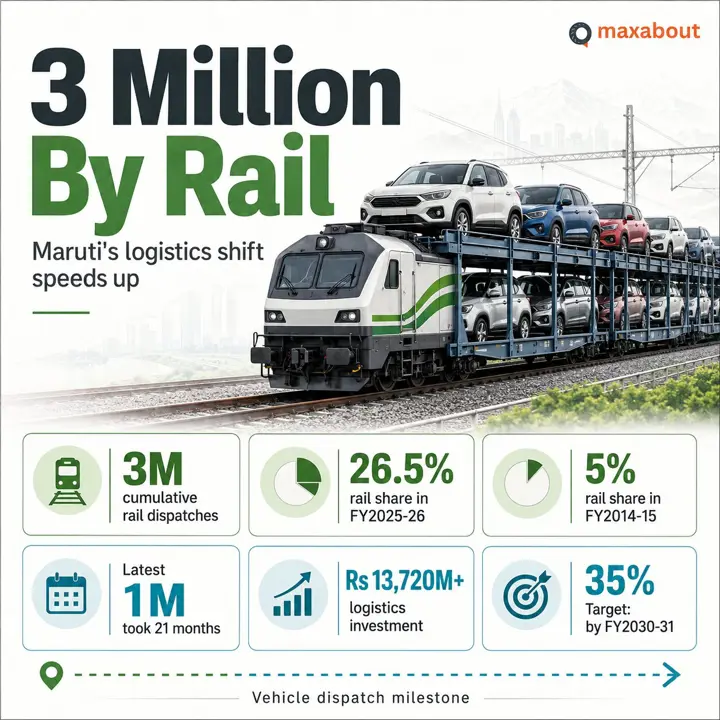 Maruti operates primarily out of two major manufacturing hubs — Manesar in Haryana and Hansalpur in Gujarat. From these plants, loaded rakes fan out across Indian Railways' network, heading toward rail yards situated near major consumption centres — cities like Chennai, Bengaluru, Kolkata, and Hyderabad. The partnership with Indian Railways has been critical here, providing dedicated rake availability and scheduling that keeps dispatches consistent rather than opportunistic.
From those destination rail yards, last-mile delivery still happens by road — smaller car carrier trucks handle the shorter trip to regional dealerships. It's a hybrid model, and honestly, that's what makes it practical across India's varied geography.
Why Rail Over Road: The Environmental and Cost Logic
So why does this hybrid model actually make sense beyond just the operational convenience? The honest answer comes down to three things: money, emissions, and how well your car arrives at the dealership.
On costs, rail freight moves vehicles at a significantly lower per-unit rate over long distances compared to road carriers. When you're dispatching hundreds of thousands of vehicles annually, those savings accumulate fast. Whether that directly translates to more stable showroom prices is hard to pin down exactly, but it does reduce pressure on Maruti's logistics budget — and that matters in a market where every thousand rupees in the ex-factory cost gets scrutinised.
The environmental angle is more straightforward. Rail transport produces considerably lower carbon emissions per vehicle moved compared to diesel-powered car carrier trucks covering the same distance. Maruti has publicly acknowledged sustainability targets as part of its broader corporate commitments, and scaling rail dispatch clearly supports that direction in a measurable way.
Then there's vehicle condition. Long-distance road transport exposes cars to vibration, dust, and weather across hundreds of kilometres. Rail transit is generally smoother, which means fewer transit-related quality complaints reaching dealerships.
India's National Logistics Policy actively encourages shifting freight from road to rail, so Maruti's approach here aligns with that national push — even if road still handles the final stretch.
So what does this actually mean if you're someone who just booked a new Swift or Fronx and you're waiting for delivery?
For buyers in well-connected metros — think Chennai, Bengaluru, Delhi, or Pune — rail dispatch often translates to more predictable delivery windows. A vehicle moving from a Gujarat plant to Tamil Nadu via rail follows a relatively fixed schedule. Compare that to road transport, where a driver's rest stops, traffic on NH48, or a breakdown somewhere in Andhra Pradesh can quietly push your delivery by days without anyone notifying you.
Rail is not always faster on paper, but it's more consistent. That consistency is genuinely useful when you've planned insurance, registration, or a delivery date around a specific week.
Tier-2 cities with active rail yards — places like Coimbatore, Nagpur, or Lucknow — also benefit directly from this. Dealerships in these locations receive stock in better condition and can plan their lot more efficiently.
The honest limitation, though, is that remote or semi-urban areas still rely on road transport for the final leg. If your dealer is 80 kilometres from the nearest rail yard, that last stretch still carries the usual risks. Rail gets the car close; it doesn't always get it to your doorstep.
Maruti's Market Dominance and How Logistics Is Part of the Formula
Here's something worth thinking about. When you're moving roughly 1.8 to 2 million vehicles every year, logistics isn't a background function — it becomes central to how the entire business holds together. At that scale, even a minor inefficiency per vehicle doesn't stay minor for long. It compounds, fast.
Maruti's pricing in the hatchback and entry SUV segments has always been a talking point. From what industry analysts consistently point out, a big part of that competitive pricing comes from relentlessly controlled operational costs. Rail dispatch is one piece of that puzzle. Moving vehicles by train costs significantly less per unit than road transport over long distances. Multiply those savings across millions of dispatches, and suddenly you're looking at a number that genuinely influences what the customer pays at the showroom.
Other manufacturers — many of whom still depend more heavily on road transport — don't have this kind of infrastructure advantage. Building it takes time, volume, and long-term coordination with Indian Railways. Maruti has had decades to develop that relationship.
The 3 million milestone isn't just a logistics achievement. It reflects how deeply supply chain discipline is embedded in Maruti's broader market strategy. That's not accidental. It's the kind of operational thinking that keeps them difficult to unseat, even as competitors arrive with flashier products.
Challenges and Limitations: Rail Dispatch Is Not a Perfect Solution
That said, let's be honest. Rail-based dispatch is not some flawless system that solves every logistics problem. It has real limitations, and glossing over them would be doing readers a disservice.
The most obvious issue is last-mile connectivity. Not every dealership sits conveniently near a rail yard. Once vehicles arrive at the destination terminal, they still need road transport to reach the showroom floor. That final stretch carries its own risks — road damage, delays, handling issues. The rail leg may be efficient, but it doesn't eliminate road vulnerability entirely.
There are also loading and unloading concerns at rail yards. Occasional vehicle damage during these handling stages is a reported issue. It's not rampant, but it happens, and any scratched panel or dented bumper arriving at a dealership creates real headaches.
Festive season demand spikes are another pressure point. When October rolls around and bookings surge, Indian Railways capacity on key corridors gets genuinely stretched. Rail schedules don't flex easily to accommodate sudden volume jumps, which can complicate dealer inventory planning significantly.
Infrastructure gaps on certain routes remain a constraint too. Not every corridor has the rake availability or terminal facilities that high-volume dispatch demands.
The Bigger Picture: Can Other Indian Automakers Follow This Model?
Three million units is a number that forces you to ask an obvious question: why isn't everyone doing this? The honest answer is that scale is the entire foundation on which Maruti's rail model rests.
Hyundai and Tata Motors have experimented with rail dispatch to varying degrees, according to industry reports. But replicating Maruti's consistency requires negotiating dedicated rake availability, building terminal partnerships, and maintaining volumes high enough to justify that infrastructure investment year after year. For manufacturers moving significantly fewer units, the economics simply don't work the same way.
Mahindra and Kia face a different reality. Their production volumes, while growing, don't yet create the kind of predictable, high-frequency dispatch cycles that make dedicated rail corridors financially sensible. Road transport remains more flexible at smaller scales, even with its cost and damage drawbacks.
What could change this picture is the government's ongoing push to modernize freight logistics. Dedicated freight corridors and upgraded terminal infrastructure could lower the entry barrier considerably, making rail viable for mid-volume manufacturers.
In my view, as Indian automakers collectively grow production volumes over the next decade, rail dispatch will shift from a Maruti-specific advantage to a broader industry standard. The milestone Maruti just crossed may well be the benchmark others are quietly working toward.
Final Thoughts: A Quiet Achievement With Real Consequences for Car Buyers
Three million vehicles dispatched by rail. Most buyers will never think about that number — and honestly, why would they? You walk into a showroom, sign the papers, and drive away. How the car got there feels like someone else's problem.
But milestones like this one matter precisely because of that invisibility. They reflect years of operational discipline, infrastructure investment, and supply chain thinking that quietly keeps the industry functional. Maruti didn't stumble into this. It was built, refined, and scaled deliberately.
What does that mean for you, the individual buyer? Potentially quite a bit. Vehicles arriving in better condition. Faster delivery timelines. And perhaps most meaningfully, a logistics model that helps absorb cost pressures that would otherwise find their way into the sticker price.
Looking ahead, I think efficient freight logistics will become one of those underappreciated forces shaping how car buying evolves in India. Faster deliveries, more predictable availability, and greater pricing stability — none of it glamorous, all of it genuinely useful.
So while this milestone won't trend on social media, it represents something worth acknowledging — a company building seriously for the long run.
No comments yet
Be the first to share your thoughts!
Want to read more automotive news?
Stay updated with the latest car launches, reviews, and industry insights.
Browse All News