

Maruti Hansalpur Hits 10 Lakh Capacity: Why Plant D and e Vitara Production Matter
Maruti Suzuki's Hansalpur plant in Gujarat has reached 10 lakh vehicles of annual production capacity after commercial production began at the new Plant D in July 2026. The fourth plant adds 2.5 lakh units a year to the site and initially produces the e Vitara. That makes Hansalpur India's largest p...
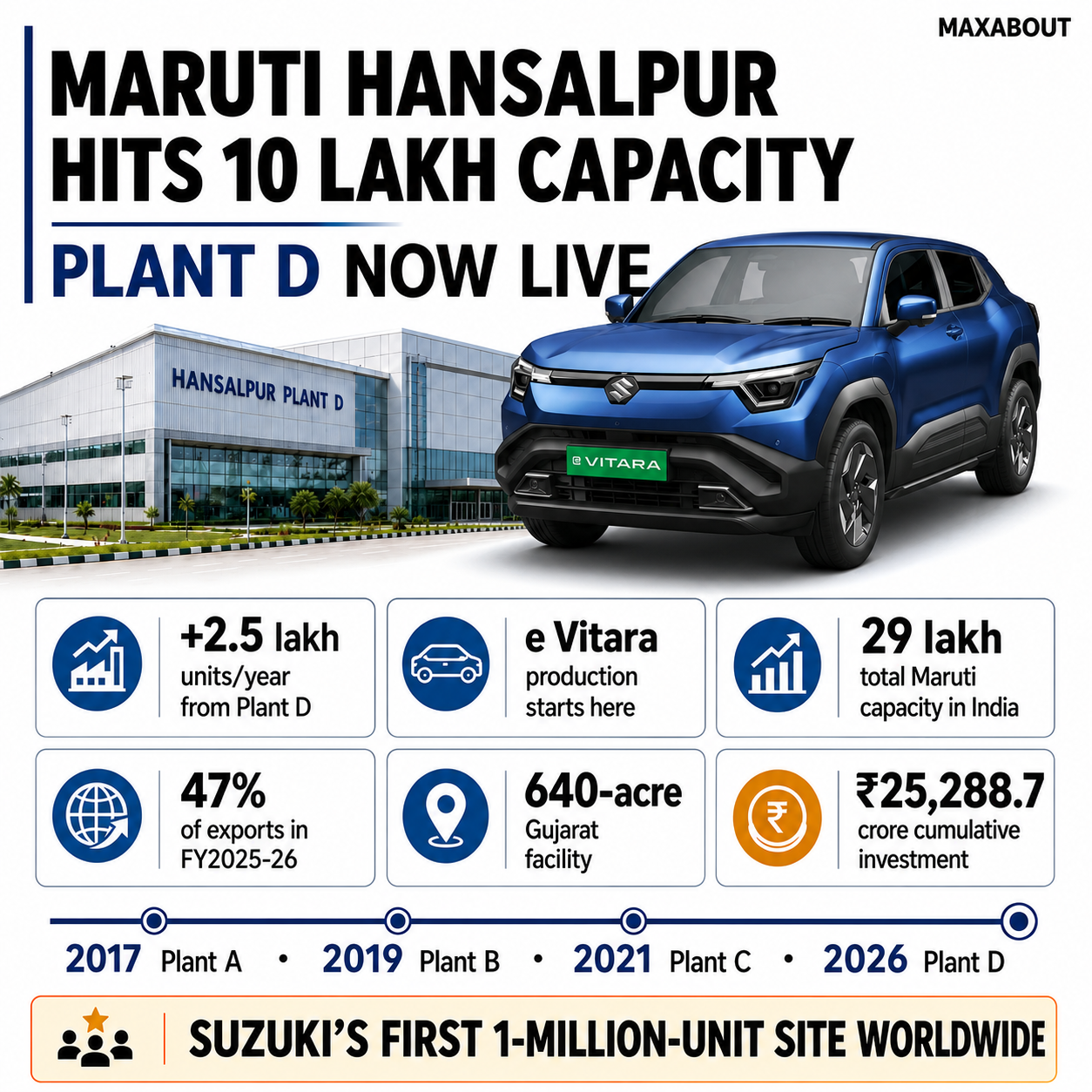
Maruti Suzuki's Hansalpur plant in Gujarat has reached 10 lakh vehicles of annual production capacity after commercial production began at the new Plant D in July 2026. The fourth plant adds 2.5 lakh units a year to the site and initially produces the e Vitara. That makes Hansalpur India's largest passenger-vehicle manufacturing facility at a single location, while also becoming Suzuki's first manufacturing site worldwide with annual capacity of one million vehicles.
What you need to know
Plant D adds 2.5 lakh units annually, taking Hansalpur to 10 lakh units a year.
The new plant initially manufactures the Maruti Suzuki e Vitara.
Maruti Suzuki's combined installed manufacturing capacity in India rises to 29 lakh vehicles annually.
Hansalpur handled nearly 47% of the company's exports in FY2025-26.
The 640-acre site represents cumulative investment of ₹25,288.7 crore, including an estimated ₹3,900 crore for Plant D.
How Plant D changes the Hansalpur facility
Before Plant D began production, Hansalpur had annual capacity of 7.5 lakh vehicles. The new 2.5-lakh-unit line takes the four-plant complex to the one-million-unit mark. The site now produces the Baleno, Fronx, Swift and e Vitara, giving it a mix of high-volume passenger cars and Maruti Suzuki's first major battery-electric model for India and export markets.
The milestone matters beyond its headline number. Concentrating one million units of capacity at a single location can support common logistics, supplier coordination and export movement. It also gives Maruti Suzuki more room to balance domestic demand with overseas shipments as the e Vitara programme scales.
Hansalpur's plant timeline
February 2017: Plant A begins operations.
January 2019: Plant B starts production.
October 2020: The facility crosses one million vehicles in cumulative production.
April 2021: Plant C becomes operational.
May 2026: Hansalpur crosses five million vehicles in cumulative production.
July 2026: Plant D begins commercial production, taking annual capacity to 10 lakh units.
Maruti Suzuki manufacturing capacity in India
| Manufacturing location | Installed annual capacity |
|---|---|
| Hansalpur, Gujarat | 10 lakh vehicles |
| Manesar, Haryana | 9 lakh vehicles |
| Gurugram, Haryana | 5 lakh vehicles |
| Kharkhoda, Haryana | 5 lakh vehicles |
| Total installed India capacity | 29 lakh vehicles |
Hansalpur is now the largest single contributor within this network. Maruti Suzuki has also discussed a long-term ambition of producing four million vehicles annually in India. That is a strategic target rather than Hansalpur's current output, and future capacity additions—including planned facilities—will determine how quickly the company approaches it.
Why the e Vitara and export role matter
Plant D initially building the e Vitara gives Hansalpur a central role in Maruti Suzuki's electric-vehicle transition. The facility already has significant export importance: nearly 47% of the company's overseas shipments in FY2025-26 came from Hansalpur. Combining EV production with an established export base may help the company serve both Indian and international markets from the same manufacturing ecosystem.
For Indian buyers, the capacity increase does not by itself confirm e Vitara prices, booking dates or delivery timelines. Those details require separate official announcements. What it does confirm is that Maruti Suzuki has added meaningful production headroom at the facility responsible for the model's initial manufacturing.
What the milestone means for India's auto industry
A one-million-unit single-location factory shows the scale being built into India's passenger-vehicle manufacturing base. Hansalpur's growth in less than a decade also underlines Gujarat's role in vehicle production and exports. The investment, factory timeline and product mix suggest the site is being positioned not merely as another assembly plant, but as a long-term hub for volume models, EVs and overseas demand.
The immediate development is confirmed: Plant D is operational and the site's installed capacity is now 10 lakh units annually. The bigger questions are how quickly e Vitara volumes ramp up, how Maruti allocates production between domestic and export markets, and when its wider Indian network moves closer to the four-million-unit goal.
FAQs
What is the annual capacity of Maruti Suzuki's Hansalpur plant?
The Hansalpur facility now has installed annual capacity of 10 lakh vehicles, up from 7.5 lakh after Plant D added 2.5 lakh units.
Which vehicle is initially produced at Hansalpur Plant D?
Plant D initially manufactures the Maruti Suzuki e Vitara. The facility's other plants produce models including the Baleno, Fronx and Swift.
Is Hansalpur Suzuki's largest manufacturing site?
Hansalpur is described as Suzuki's first manufacturing site worldwide to reach annual capacity of one million vehicles, and as India's largest passenger-vehicle manufacturing facility at a single location.
What is Maruti Suzuki's total installed manufacturing capacity in India?
With Plant D operational, Maruti Suzuki's combined installed capacity across Hansalpur, Manesar, Gurugram and Kharkhoda is 29 lakh vehicles per year.
The Maruti Suzuki Hansalpur plant capacity milestone is therefore more than a factory expansion: it strengthens the company's EV-production base, adds export flexibility and makes Gujarat central to Maruti Suzuki's next phase of manufacturing growth.
Maxabout Team
Editorial Team
Specializes in: Automotive News, Reviews, Analysis
Want to read more automotive news?
Stay updated with the latest car launches, reviews, and industry insights.
Browse All News