
Maruti Brezza Facelift Spotted: Turbo-Petrol Engine Coming?
Something interesting just surfaced from the Indian automotive world — the Maruti Suzuki Brezza has been spotted undergoing emission testing, and that detail alone is worth paying attention to. Emission testing appearances in India almost always signal that a vehicle is deep into its development cyc...
Editorial Team
Something interesting just surfaced from the Indian automotive world — the Maruti Suzuki Brezza has been spotted undergoing emission testing, and that detail alone is worth paying attention to. Emission testing appearances in India almost always signal that a vehicle is deep into its development cycle. It is not just routine paperwork. It typically means a launch or significant update is genuinely close.
Why does this matter so much? Because the Brezza is not just another compact SUV. It consistently sits at the top of monthly sales charts, month after month. Any change Maruti makes to this vehicle sends ripples across the entire segment. Rivals recalibrate. Buyers reconsider. The Brezza essentially sets the benchmark that everyone else chases.
But here is the thing — the segment is getting crowded. Newer, more feature-loaded alternatives have entered the space recently, putting real pressure on the Brezza to stay relevant. A facelift at this point would be well-timed, almost necessary.
The more intriguing part? There are whispers about a turbo-petrol engine being evaluated for this update. That would be a genuine shift in strategy for Maruti in this space. So naturally, curiosity is running high right now.
Understanding What Emission Testing Sightings Really Tell Us
When a vehicle gets spotted during emission testing — particularly at facilities like ARAI in Pune — it tells you something specific. This is not a casual road test. It is a structured, regulatory process, and manufacturers only submit vehicles for this kind of evaluation when development has reached a reasonably mature stage.
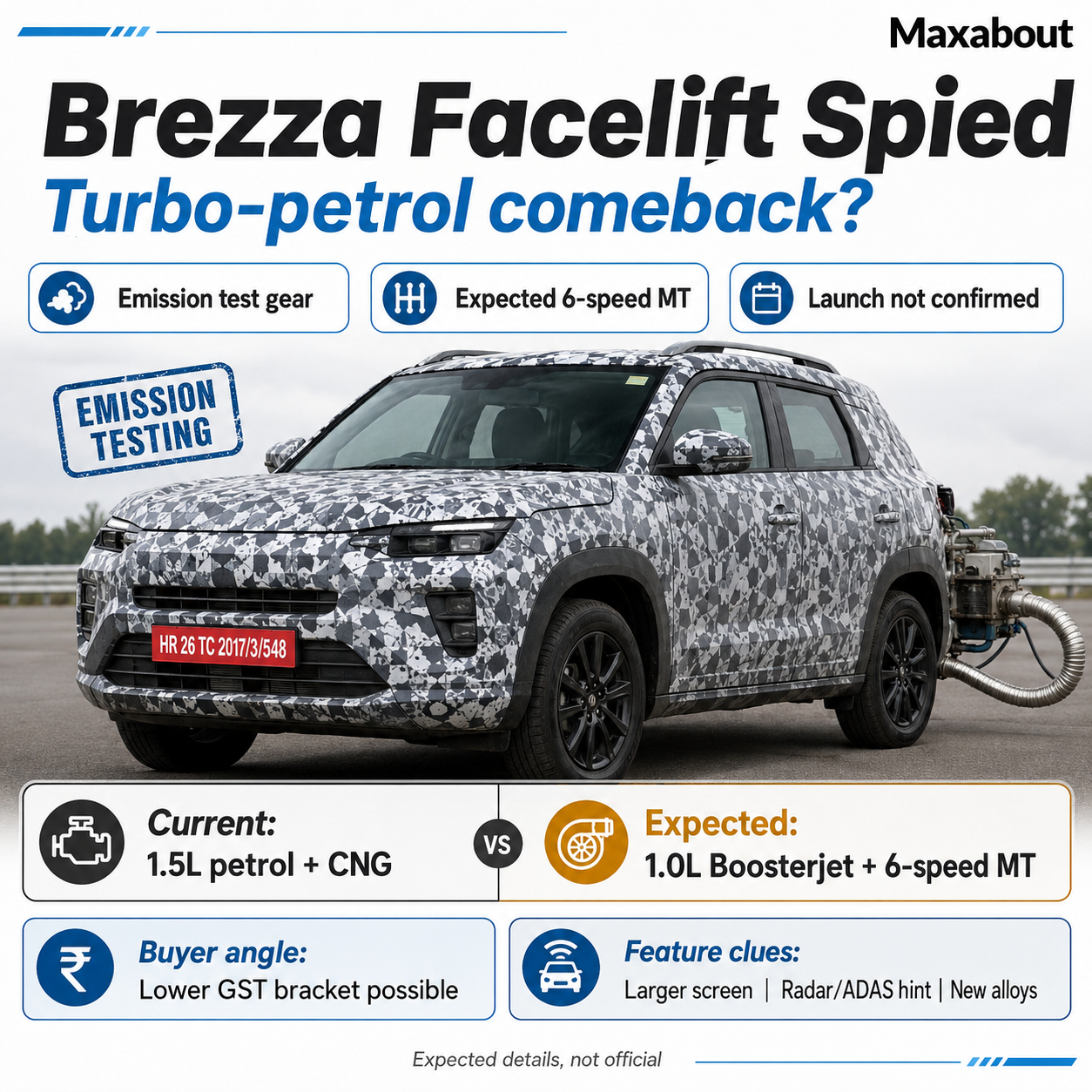 Think of it this way. Early camouflaged spy shots on public roads often mean the car is still being tuned, refined, sometimes fundamentally changed. But an emission testing sighting is different. The powertrain needs to be largely finalised before homologation testing can even begin. You cannot submit a half-developed engine to regulators and expect meaningful results.
What this stage reveals more than anything else is what is under the hood. Cosmetic changes can happen right up until launch. Powertrains, however, need compliance certification ahead of time. So when a new variant or updated model appears at this stage, the engine configuration being tested is almost certainly the real one.
Homologation and launch readiness are still two separate things, though. A vehicle can clear emission certification and still be months away from hitting showrooms. But the gap is measurably shorter than earlier development phases — which is exactly why this kind of sighting generates genuine interest.
The Turbo-Petrol Question: Is Maruti Finally Adding More Punch to the Brezza?
This is where things get genuinely interesting. The emission testing sighting has sparked conversation around one specific possibility — a more performance-oriented turbo-petrol engine being evaluated for the Brezza facelift. Nothing is confirmed. But the speculation is not without basis.
The current 1.5L mild-hybrid unit is competent. It handles city traffic reasonably well and delivers decent fuel efficiency. But outright performance has never been its strong suit. On highway stretches — think Mumbai-Pune expressway or the Delhi-Jaipur corridor — that slight hesitation during aggressive overtaking maneuvers is something experienced drivers notice. It is not dangerous, but it is noticeable.
A stronger turbo-petrol option could meaningfully change that equation. Maruti already has the 1.0L Boosterjet in its global portfolio, and there is always the possibility of engineering a more accessible unit suited to Indian pricing expectations. Either way, a dedicated turbo setup would likely deliver punchier mid-range torque — exactly what highway driving and enthusiast buyers actually want.
Rivals have already moved in this direction. Competitors in the compact SUV space offer turbo-petrol variants that have found genuine buyer traction, particularly among those who prioritize driving engagement over pure efficiency numbers.
Whether Maruti commits to this remains uncertain. But the fact that it appears to be under active evaluation suggests the brand is at least listening to that feedback.
What We Expect from the Brezza Facelift: Design and Feature Upgrades
Beyond the powertrain conversation, the facelift will almost certainly bring visual and feature changes that matter just as much to buyers. Maruti's recent refresh cycle on models like the Baleno and Ertiga gives us a reasonable template for what to expect — cleaner front fascia updates, revised lighting signatures, and interior quality improvements that feel genuinely meaningful rather than cosmetic.
The front end will likely receive the most attention. Restyled LED daytime running lights, a more angular grille design, and revised bumper treatment seem probable, bringing the Brezza visually in line with Maruti's newer design language. Nothing dramatic — but enough to feel fresh on the road.
Inside is where expectations run higher. Urban buyers in Bangalore, Pune, and Delhi are increasingly comparing the Brezza against rivals offering larger touchscreens, wireless charging, ventilated front seats, and panoramic sunroofs — features the current Brezza either lacks or offers only partially. A panoramic sunroof addition, in particular, feels almost mandatory now given how aggressively competitors have pushed it.
From what industry observers have noted, an updated infotainment system with improved connected car features is also likely. ADAS integration — even a basic suite covering lane warnings and autonomous emergency braking — would be a meaningful step forward for a segment that's increasingly safety-conscious.
These aren't wishful additions. They're table stakes now.
How the Current Brezza Holds Up and Where It Falls Short
Here's the honest truth about the current Brezza — it's a genuinely good car that's starting to show its age in specific, uncomfortable ways.
Start with what Maruti gets undeniably right. The service network is, frankly, in a different league. If you live anywhere outside a major metro — think Nagpur, Coimbatore, Patna, Udaipur — having a Maruti workshop within reasonable distance isn't a luxury, it's a real-world necessity. Ownership anxiety drops considerably when you know parts are available and mechanics are familiar with the vehicle.
The mild-hybrid system also delivers where it counts. Regular commuters consistently report fuel efficiency figures hovering around 17-19 kmpl in mixed conditions, which is meaningful given current fuel prices. Combined with competitive pricing and low depreciation, the value proposition remains strong.
But the gaps are real. The interior, while functional, feels noticeably behind rivals in perceived quality. Plastics, surface finishes, the general tactile experience — it simply doesn't impress anymore. The missing panoramic sunroof stings particularly hard when buyers can cross-shop options that offer it at similar price points.
And the 1.5-litre naturally aspirated engine? Adequate for city use, but genuinely struggles when you need confident highway overtaking. From what owners widely report, it's not unpleasant — just uninspiring when pushed.
Reliable, yes. Exciting, not quite.
Pricing Expectations and What the Facelift Could Mean for Competition
The current Brezza sits between ₹8.34 lakh and ₹14.14 lakh — a range that has kept it competitive without feeling extravagant. Maruti historically prices facelifts conservatively, nudging variants up by modest margins rather than dramatically restructuring the lineup. Expect similar restraint here.
A feature-enriched facelift could reasonably push the top variant toward ₹15 lakh or slightly beyond. That's still defensible territory for Maruti loyalists. But add a turbo-petrol option into the equation, and things get genuinely interesting — and potentially complicated.
A turbo variant would likely arrive as a premium trim exclusive, possibly sitting above existing top-spec variants. Think somewhere in the ₹14.5 to ₹16 lakh range, which would directly shadow the Nexon, Venue, and Sonet's upper trims. That's pressure these rivals will absolutely feel.
Indian buyers are famously value-conscious. Every rupee gets scrutinized. Maruti understands this better than almost anyone — their pricing decisions generate industry conversation precisely because they're rarely careless about it.
If the turbo option delivers genuine performance improvement without aggressive pricing, the Brezza facelift could reclaim buyers currently drifting toward more exciting alternatives. That's a significant opportunity Maruti simply cannot afford to mishandle.
Should You Wait for the Brezza Facelift or Buy Now?
This is the question most people actually want answered. And honestly, there's no universal right call — it depends entirely on your situation.
Emission testing sightings typically suggest a launch is somewhere between 6 to 18 months away. That's a wide window. If the Brezza facelift is still in regulatory testing phases, a late 2025 or early 2026 reveal seems realistic. Waiting that long has real costs — you're without a vehicle, or you're extending a rental or existing car's life past its comfortable limit.
Here's the practical side: dealerships are already offering meaningful discounts on the current Brezza as inventory management kicks in. That trend usually accelerates closer to a facelift launch. If you negotiate well right now, you could land a solid deal on a proven, well-supported vehicle.
The resale value concern is genuine though. Buying just before a facelift launch historically dents resale returns when you eventually sell. Buyers in the used market will compare your car against the newer version and price accordingly.
If rivals like the Nexon or Venue already meet your needs, waiting for the Brezza specifically may not be worth it. But if Maruti's service network and ownership costs are priorities, the current model still makes a strong case.
Watch for these signals before making your final call: official teaser releases, dealership training announcements, or production line updates from Maruti's official channels. Those typically confirm an imminent launch far more reliably than spy shots alone.
Final Thoughts: The Brezza Still Has What It Takes, and a Facelift Could Make It Unbeatable
That emission testing sighting is a small detail, but it tells an important story. Maruti is actively working on the next Brezza — and the possibility of a turbo-petrol variant joining that conversation makes this far more exciting than a typical mid-cycle refresh.
The Brezza has always won on practicality, trust, and long-term ownership value. What it has occasionally lacked is that extra spark — the kind of performance or feature depth that makes enthusiasts genuinely excited. A well-tuned turbo-petrol engine, combined with meaningful cosmetic and interior upgrades, could finally close that gap.
From what the evidence suggests, Maruti isn't just refreshing a product — they're defending a segment they built. And in my view, that distinction matters. This isn't a reactive move. It looks like a calculated one.
Will it be enough to pull clear of an increasingly strong Nexon, Venue, and Sonet? That depends entirely on execution. But the foundation is solid, the brand loyalty is real, and the service network advantage is something no competitor has fully neutralized yet.
Stay tuned for official announcements — and share your thoughts below. What would make the new Brezza genuinely worth waiting for? A stronger engine, better features, or simply fresher styling? The conversation is just getting started.
No comments yet
Be the first to share your thoughts!
Want to read more automotive news?
Stay updated with the latest car launches, reviews, and industry insights.
Browse All News