
Mahindra XUV700 Hybrid & Flex-Fuel Variants Spied Testing
Something interesting showed up recently, and if you follow Indian automotive news closely, you'd know why this matters. Mahindra has been spotted testing the XUV700 in not one but two alternative powertrain configurations — a hybrid variant and a flex-fuel version. Spy shots are still circulating, ...
Something interesting showed up recently, and if you follow Indian automotive news closely, you'd know why this matters. Mahindra has been spotted testing the XUV700 in not one but two alternative powertrain configurations — a hybrid variant and a flex-fuel version. Spy shots are still circulating, details remain incomplete, but the implications are significant enough to talk about right now.
Think about the timing here. The Indian government has been actively pushing flex-fuel adoption, with clear policy signals encouraging manufacturers to develop ethanol-compatible vehicles. Simultaneously, there's growing pressure on automakers to bridge the gap between conventional ICE vehicles and full electrics. Mahindra testing both these paths on one of its most popular platforms feels like a deliberate, calculated move rather than coincidence.
For someone currently considering an XUV700 purchase — or planning one in the next year or two — this news genuinely changes the calculation. Fuel costs are a real concern for Indian families, especially with petrol prices remaining volatile. A flex-fuel option could meaningfully reduce running costs, while a hybrid promises better efficiency without the range anxiety of a full EV.
From what industry observers are reporting, Mahindra appears serious about this development cycle. Early days, yes. But worth watching closely.
What the Spy Shots Actually Reveal About the XUV700 Test Mules
Spy shots are always a mixed bag. You get grainy images, heavy camouflage wrap, and a lot of speculation dressed up as analysis. The XUV700 test mules spotted recently are no different — but there are some genuinely interesting details worth examining carefully.
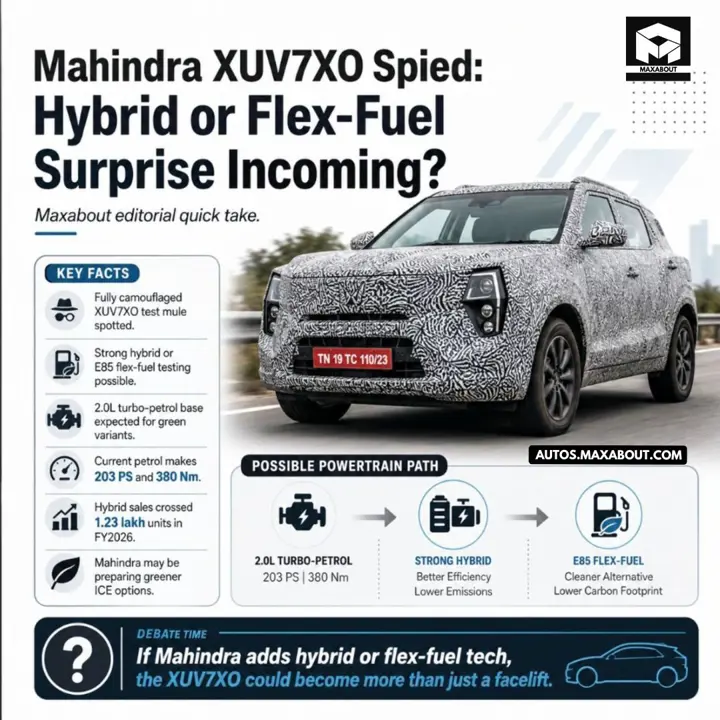 The most discussed observation from automotive reporters covering these sightings is the exhaust configuration. Some mules appear to show a modified exhaust routing compared to the standard petrol and diesel variants currently on sale. This is significant because flex-fuel engines typically require adjustments to fuel delivery systems and exhaust management to handle ethanol blends efficiently.
Several observers also noted additional underhood bulk in certain test vehicles — consistent with hybrid componentry like a motor-generator unit or a supplementary battery pack. Pre-production mules routinely carry prototype hardware that looks far messier than final production versions, so reading too much into packaging specifics would be premature.
Badge details remain completely blacked out. That alone tells you Mahindra is being deliberate about information control at this stage.
What is confirmed: these are active test mules undergoing real-world evaluation on Indian roads. What remains speculative: exact powertrain architecture, efficiency targets, and production timelines. The honest truth is that spy shot analysis has genuine limitations — final production versions could look and function quite differently from what these early prototypes suggest.
Understanding the Two Technologies: Strong Hybrid vs Flex-Fuel Explained Simply
Before speculating further about what Mahindra might be building, it helps to actually understand what these two technologies do — because there is a lot of confusion out there, especially around the word "hybrid."
A strong hybrid is not the same as a mild hybrid. A mild hybrid system essentially uses a small electric motor to assist the petrol engine marginally — it cannot drive the wheels independently on electric power alone. A strong hybrid, like what Toyota uses in the Innova Hycross or the Maruti Grand Vitara, pairs a proper electric motor with a petrol engine in a way where the electric motor can genuinely propel the car on its own at lower speeds. In stop-go city traffic — think Bengaluru's Outer Ring Road at 6 PM, or Delhi's Connaught Place during lunch hour — the petrol engine frequently shuts off entirely while the electric motor handles movement. That is where the real fuel savings happen. The petrol engine kicks back in at higher speeds or when more power is needed. Energy recovered during braking gets stored and reused. The result is significantly better fuel efficiency in city conditions without requiring any external charging.
Flex-fuel is a different idea entirely. It is about what you put in the fuel tank rather than how the engine works. A flex-fuel engine is designed to run on varying blends of petrol and ethanol — including high-ethanol blends like E85, which contains 85 percent ethanol. India's government has been pushing its ethanol blending programme aggressively, targeting 20 percent blending by 2025. Flex-fuel takes that ambition further, making vehicles capable of running on much higher ethanol concentrations. Ethanol is primarily produced from sugarcane and other agricultural sources, which means it is domestically available and potentially cheaper than imported petrol over time.
So why does this matter practically? If ethanol prices remain lower at the pump, a flex-fuel vehicle could offer genuine running cost advantages — particularly for buyers in states where ethanol supply infrastructure is developing faster.
Why Mahindra Might Be Developing Both Technologies Simultaneously
This is where the strategy gets genuinely interesting. Pursuing hybrid and flex-fuel development at the same time is not confusion — it actually reflects a calculated response to where India's market is heading and, more importantly, where it currently stands.
Regulatory pressure is a big part of this. India's CAFE norms are tightening progressively, and automakers face real penalties for fleet-average emissions that exceed permissible limits. A mild hybrid system directly improves those numbers. Flex-fuel compatibility, meanwhile, aligns with government mandates pushing toward E20 and eventually higher ethanol blends. Both technologies help Mahindra stay compliant without committing entirely to electric vehicles — which still carry significant infrastructure risks.
Then there is the infrastructure reality that no one in the industry can honestly ignore. EV charging outside major metros remains genuinely unreliable. For a buyer in Nagpur, Coimbatore, or Lucknow, range anxiety is not just a talking point — it is a practical daily concern. A flex-fuel or hybrid XUV700 variant would require zero new infrastructure investment from that buyer.
In that sense, Mahindra appears to be hedging thoughtfully. If EV adoption accelerates, their electric lineup is ready. If it stalls in tier-2 and tier-3 markets, these alternative fuel options keep those buyers within reach. That is not indecision — that is simply covering the ground that matters.
How a Hybrid or Flex-Fuel XUV700 Could Actually Perform on Indian Roads
Speculation is only useful when grounded in comparable evidence. So let us look at what similar technologies actually deliver elsewhere, and apply that honestly to the XUV700's real-world context.
On the hybrid side, the biggest gains would almost certainly come in city driving. Stop-and-go traffic in Bengaluru or Gurugram — the kind where you crawl three kilometers in forty minutes — is precisely where mild or full hybrid systems recover energy most effectively. From what similar hybrid SUVs have demonstrated, efficiency improvements of 15 to 25 percent in urban conditions are realistic. Highway driving tells a different story. At sustained speeds, the combustion engine carries most of the load, and those efficiency gains narrow considerably.
There is also the weight question. Battery packs add mass, and the XUV700 already sits at a substantial kerb weight. Whether that dulls its highway composure slightly is a genuine consideration worth watching.
Flex-fuel performance comes with its own trade-offs. Higher ethanol blends — E85 particularly — produce slightly lower thermal energy than petrol, which can translate to a modest power dip. Brazil's flex-fuel market has managed this well over decades, but ethanol availability across smaller Indian towns remains inconsistent. That geographical gap is the real challenge, not the engine technology itself.
Expected Pricing and What You'd Actually Pay
Nobody has official numbers yet, and Mahindra certainly isn't talking. But working backwards from how hybrid premiums function in India gives us a reasonable ballpark.
Look at the Maruti Grand Vitara's strong hybrid variant — it commands roughly a ₹2 to ₹2.5 lakh premium over comparable mild-hybrid trims. Apply similar logic to the XUV700's current ladder, which tops out around ₹25 to ₹26 lakh for well-equipped AX7 variants, and a hybrid XUV7XO could realistically land somewhere between ₹27 and ₹30 lakh depending on battery configuration and trim positioning.
The honest question is whether Indian buyers will absorb that premium. From what industry observers consistently note, urban high-mileage drivers — think Delhi NCR or Bengaluru commuters covering 25,000-plus kilometres annually — genuinely recoup fuel savings within three to four years. For them, the math works.
Against rivals like the Maruti Invicto or Toyota Hycross offering proven hybrid credentials, the XUV7XO would need to justify its price through stronger performance, superior technology integration, or Mahindra's improving service network. The flex-fuel angle adds an interesting wildcard — potentially lower running costs where ethanol infrastructure exists — but that remains geography-dependent for now.
What Indian Buyers Should Actually Think About Before Getting Excited
Before you start mentally configuring your XUV7XO hybrid, a honest pause is necessary. What we're looking at are spy shots of test mules — heavily camouflaged prototypes doing engineering validation runs. That's meaningfully different from a confirmed production vehicle with a launch date attached.
Mahindra has a history of testing technology well ahead of market readiness. The gap between a test mule spotted on a highway and an actual showroom launch can stretch anywhere from 18 months to several years. And when these technologies do arrive, they often debut in a single top-spec trim at a premium price point — not across the range as buyers hope.
Then there are the practical concerns worth thinking through honestly. Hybrid battery longevity in Indian heat conditions is a real question. Consistent temperatures above 40°C in cities like Nagpur or Ahmedabad stress battery thermal management systems differently than cooler climates these technologies were originally engineered for.
Service network readiness is another gap. Hybrid systems require specialized technician training and diagnostic equipment — infrastructure that remains concentrated in metro cities. If you're based in a smaller town, that's a genuine after-sales concern worth weighing.
The flex-fuel promise carries similar geography-dependent caveats. Ethanol blends beyond E20 remain inconsistently available outside select urban corridors and highways. Exciting technology deserves measured expectations.
Final Thoughts: Is Mahindra Making the Right Move?
Honestly, yes. Even with the real-world limitations we've discussed, I think Mahindra is reading the room correctly here. India isn't ready to go fully electric overnight — the charging infrastructure, range anxiety, and price sensitivity all tell a very clear story. Bridging that gap with hybrid and flex-fuel options feels like genuinely sensible strategy rather than just headline-chasing.
Between the two technologies, the hybrid variant feels more immediately practical for the average XUV700 buyer today. Fuel savings are tangible, the technology is proven globally, and it doesn't depend on external infrastructure the way flex-fuel does. For someone logging serious kilometres on city commutes in Bengaluru or Pune, that efficiency argument is hard to ignore.
Flex-fuel is the more exciting long-term story — but its payoff remains tied to policy momentum and ethanol distribution expanding beyond current corridors.
What I'm watching closely in coming months: official efficiency figures, pricing relative to the standard variants, and warranty terms covering hybrid components. Those details will determine whether this is genuinely compelling or just clever positioning. Either way, Mahindra deserves credit for not standing still.
Maxabout Team
Editorial Team
Specializes in: Automotive News, Reviews, Analysis
Want to read more automotive news?
Stay updated with the latest car launches, reviews, and industry insights.
Browse All News