
Mahindra Plans ₹15,000 Crore Nagpur Manufacturing Hub and R&D Push
Mahindra plans to invest ₹15,000 crore over 10 years in a new integrated manufacturing hub at Nagpur, Maharashtra, pairing a major physical-capacity commitment with a sharp expansion in research and development. Chairman Anand Mahindra told shareholders that the group's granted patents increased fro...
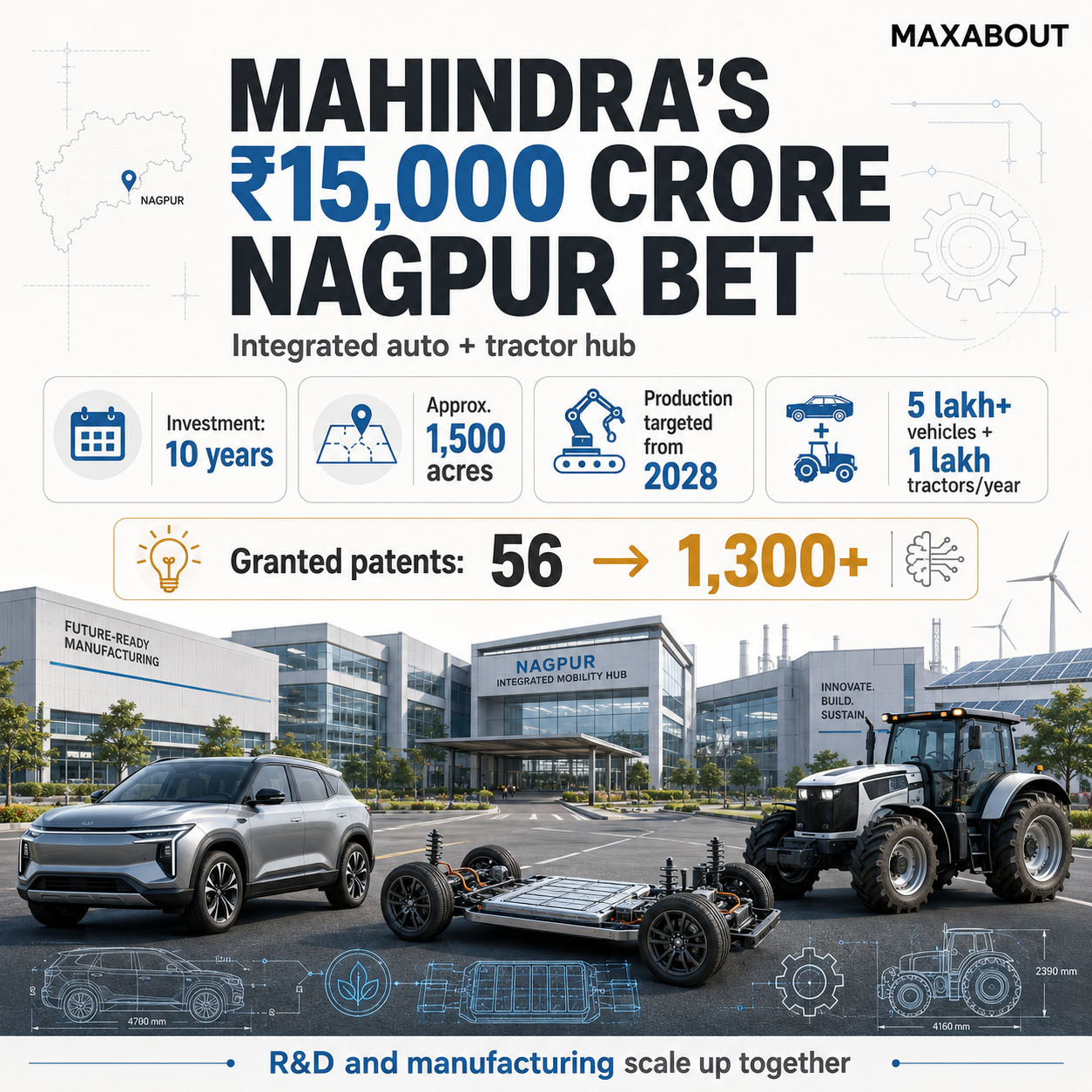
Mahindra plans to invest ₹15,000 crore over 10 years in a new integrated manufacturing hub at Nagpur, Maharashtra, pairing a major physical-capacity commitment with a sharp expansion in research and development. Chairman Anand Mahindra told shareholders that the group's granted patents increased from 56 to more than 1,300 over the past decade—about a 23-fold rise. The proposed Nagpur complex is expected to support automobiles and tractors, with production targeted from 2028 and a powertrain-flexible design intended for combustion, electric and future-technology vehicles.
What you need to know
Investment: ₹15,000 crore planned over a 10-year period.
Location: Nagpur, Maharashtra.
Project: an integrated automobile and tractor manufacturing hub.
Scale: roughly 1,500 acres, according to reported project details.
Production target: operations are planned from 2028.
Expected full-ramp output: more than 5 lakh vehicles and 1 lakh tractors annually.
R&D signal: granted patents rose from 56 to 1,300-plus in a decade.
Mahindra Nagpur manufacturing hub: plan at a glance
| Detail | What is known | Status |
|---|---|---|
| Total commitment | ₹15,000 crore over 10 years | Announced plan |
| Site size | Approximately 1,500 acres | Reported project detail |
| Production start | Targeted from 2028 | Future target |
| Vehicle capacity | More than 5 lakh units annually | Expected at full ramp-up |
| Tractor capacity | About 1 lakh units annually | Expected at full ramp-up |
| Granted patents | 56 to more than 1,300 in a decade | Company statement |
Why the patent number matters
Patent counts do not automatically prove that every invention will become a profitable product. Some patents protect incremental improvements or defensive positions. Even so, the direction is important: moving from 56 to more than 1,300 granted patents suggests that Mahindra is building a larger body of in-house intellectual property across platforms, electronics, software and vehicle systems.
Owning more of the underlying technology can give an automaker greater control over costs, upgrade cycles and differentiation. That matters as vehicles become more software-defined and as electric architectures require closer integration of batteries, power electronics, thermal systems and digital features.
What the Nagpur plant is expected to build
The proposed complex is described as powertrain-agnostic, meaning its long-term role is not limited to one propulsion type. It is expected to support internal-combustion vehicles, EVs and future technologies for domestic and export markets. Reported plans also connect the facility with Mahindra's modular NU_IQ architecture.
At the stated full-ramp scale, Nagpur could become Mahindra's largest single manufacturing location in India. The integrated auto-and-tractor scope may also create shared advantages in suppliers, logistics, testing, energy and industrial infrastructure, although final benefits will depend on execution and the exact production mix.
Why this matters for Indian manufacturing
The project reflects a shift from expanding assembly capacity alone to investing simultaneously in product architecture and intellectual property. For India's automotive sector, that combination is important: local manufacturing creates scale, while in-house engineering can retain more design value and decision-making within the country.
The investment can also deepen the supplier ecosystem in Maharashtra. A planned supplier park and links with existing facilities at Chakan and Nashik could improve component localisation and logistics, but the actual economic impact will develop gradually over the 10-year investment window.
The execution risks to watch
Timeline: large greenfield projects can face land, approvals, infrastructure and supplier delays.
Demand: full-ramp capacity assumes sustained growth across SUVs, tractors, EVs and exports.
Technology conversion: patents and platforms must turn into reliable products that customers choose at scale.
Competition: Mahindra will invest while rivals expand their own ICE, hybrid and EV portfolios.
Capital discipline: a decade-long programme must remain flexible as regulation, batteries, software and trade conditions change.
FAQs
How much will Mahindra invest in Nagpur?
Mahindra plans a total investment of ₹15,000 crore over 10 years.
When is production expected to start?
Production at the proposed Nagpur hub is targeted from 2028. This is a future plan and may evolve during project execution.
What is the planned annual capacity?
At full ramp-up, reported expectations exceed 5 lakh vehicles and 1 lakh tractors per year.
How many patents does Mahindra have?
The company says its granted patents rose from 56 to more than 1,300 over the past decade.
The Mahindra Nagpur manufacturing hub is significant because it links a large factory programme with a broader R&D push. The ₹15,000 crore commitment is ambitious, but the real test will be whether planned capacity, in-house platforms and a much larger patent portfolio translate into competitive vehicles, tractors and exports from 2028 onward.
Maxabout Team
Editorial Team
Specializes in: Automotive News, Reviews, Analysis
Want to read more automotive news?
Stay updated with the latest car launches, reviews, and industry insights.
Browse All News