
Kia Syros EV Launch in August 2026: What to Expect
The Indian EV market is moving faster than most people expected. A few years ago, electric SUVs felt like a distant concept for most buyers here. Today, the conversation has completely shifted — and Kia's upcoming Syros EV is sitting right at the center of it.According to recent industry reports, th...
Editorial Team
The Indian EV market is moving faster than most people expected. A few years ago, electric SUVs felt like a distant concept for most buyers here. Today, the conversation has completely shifted — and Kia's upcoming Syros EV is sitting right at the center of it.
According to recent industry reports, the Syros EV is expected to launch in August 2026. That timeline matters more than it might seem at first glance. Kia has already built serious credibility in India through the Seltos and Sonet — both of which proved that a well-priced, feature-loaded vehicle can genuinely win over Indian buyers. The Syros itself arrived as a petrol and diesel option and found its audience. Now the electric version is coming, and expectations are understandably high.
But let's be honest about something. Indian buyers still carry real concerns around EVs — range anxiety on longer highway runs, the patchy charging network outside major cities, and of course, whether the pricing will actually make sense. These are fair questions, not just hesitation.
From what I've observed across buyer forums and industry discussions, the Syros EV has genuine potential to address several of these concerns head-on. This article breaks down everything we currently know — the expected range, features, pricing, and whether this could finally be the electric SUV that moves mainstream Indian buyers toward making the switch.
What We Know So Far: Kia Syros EV Specs and Features
Let me be upfront about something before diving in — a lot of what surrounds the Syros EV is still in speculation territory. Official announcements have been limited, and Kia India has been deliberately tight-lipped. That said, based on industry reports and platform analysis, there is enough to piece together a reasonable picture.
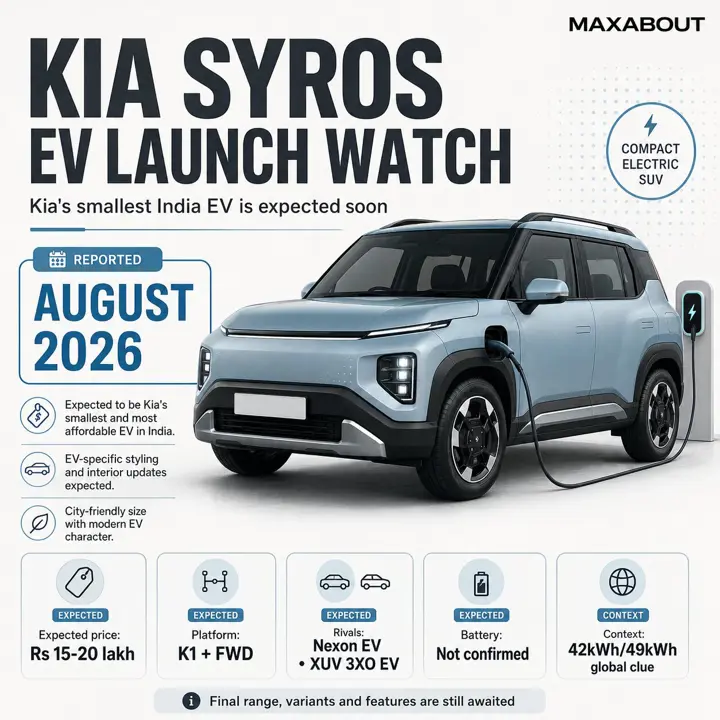 Starting with the battery and range: The Syros EV is widely expected to offer at least one battery pack option in the 45–50 kWh range, with a possible larger pack around 60 kWh for a higher variant. On paper, ARAI-certified range figures might touch 400–450 km. Realistically though — accounting for Indian city traffic, AC usage, and highway driving — expect somewhere between 280 and 350 km of actual, usable range. That is still competitive for this segment.
DC fast charging support appears almost certain, likely at 100 kW or above, which would bring the battery from near-empty to 80 percent in under 45 minutes. AC charging at 11 kW for home use is also anticipated.
On the platform side, the Syros EV is expected to share underpinnings loosely derived from Kia's existing EV architecture, though adapted for the Indian market's cost and road-condition requirements — not a full EV6-level platform.
Feature-wise, expect a large connected infotainment display, Level 2 ADAS, and a panoramic sunroof — all of which are confirmed on the ICE Syros and likely to carry over.
Expected Price and How It Fits India's EV Market in 2026
If the Syros EV gets everything right on paper, pricing will still be the moment of truth. Based on its positioning and segment, expect something in the ₹20 lakh to ₹28 lakh range. That bracket makes sense — it sits above the mass-market entry EVs but well below the premium territory that the EV6 occupies.
By August 2026, the Indian EV market will look noticeably different from today. More competition, better consumer awareness, and — hopefully — a clearer FAME III subsidy framework. If FAME III rolls out with meaningful support for sub-₹25 lakh EVs, the Syros EV could become genuinely compelling. Several states like Maharashtra and Delhi have also been aggressive with additional EV incentives, which could pull the effective price down further.
Kia's ownership cost history offers some reassurance here. Seltos service costs have generally been reasonable, and while the EV6 sits in a different league entirely, its low reported maintenance bills hint at what Kia's EV after-sales experience could feel like at a more accessible price point.
The real challenge is the competition. By mid-2026, this segment will have multiple credible options fighting for the same buyer. Pricing even ₹1-2 lakh too high could cost Kia significantly — because the buyer at this budget is practical, informed, and has real alternatives to consider.
Real-World Range: Can the Syros EV Handle Indian Roads and Conditions?
This is the question that matters most. Not the ARAI certified number Kia will publish in press releases — but what actually happens when you're sitting in stop-and-go traffic on Bengaluru's Outer Ring Road at 6pm, AC running full blast, navigation active, and a low battery warning staring back at you.
As a general rule, Indian real-world range runs 15 to 20 percent below official ARAI figures. That's not a Kia-specific problem — it applies across every EV sold here. So if the Syros EV is claimed at, say, 450 km, expect somewhere between 360 and 385 km under realistic conditions. That's still respectable, but it changes how you plan longer trips.
For daily city use, honestly, range anxiety largely disappears. Most urban commutes in Indian cities — Mumbai, Hyderabad, Chennai — rarely exceed 40 to 60 km per day. Even a conservative real-world range covers a week of typical commuting. The city use case is actually where EVs shine brightest in India, partly because lower highway speeds in urban crawls help recover energy more efficiently.
Highway driving is a different story. A run from Delhi to Jaipur — roughly 280 km — would need careful planning, particularly in peak summer. Indian summers are brutal on battery chemistry. In cities like Nagpur or Jaipur, where temperatures cross 42°C regularly, thermal management systems work overtime. Battery performance can dip noticeably, and that 15-20 percent real-world gap can stretch further.
And the AC point cannot be overstated. Unlike European or American markets where EV range tests factor in moderate temperatures, India's context is fundamentally different. Turning off the AC here isn't a choice — it's genuinely not an option for most of the year. That continuous AC load chips away at range more than most buyers initially anticipate.
Kia's EV6 ownership data offers a useful reference point. From what reviewers and owners have consistently reported, the EV6 handles thermal stress reasonably well for a mainstream EV, with its battery management showing fewer dramatic range drops in heat compared to some rivals. If Kia carries even a portion of that engineering discipline into the Syros EV's more affordable platform, it would be a meaningful advantage. That's an if worth watching closely as real-world tests emerge closer to the August 2026 launch.
Charging Infrastructure: Is India Ready for the Syros EV by 2026?
The battery engineering question leads naturally into another concern that every prospective EV buyer in India eventually circles back to: where exactly am I going to charge this thing? It's an honest question, and the answer in 2025 is somewhere between "it's improving" and "it's not quite there yet."
India's public charging network has grown meaningfully over the last two years. Operators like ChargeZone, Tata Power EV, and Ather's expanding grid have added hundreds of charging points across major urban corridors. DC fast chargers are increasingly visible on key national highways — the Mumbai-Pune Expressway, NH-48 toward Bengaluru, and stretches connecting Hyderabad to Chennai have seen notable additions. For highway travel, the situation is genuinely better than it was even eighteen months ago.
But gaps remain significant in tier-2 cities and rural stretches. If you're planning a road trip from Hyderabad to Tirupati or Chennai to Madurai, range anxiety is still a real calculation, not just an irrational fear.
Home charging, realistically, will be the backbone for most Syros EV buyers. And this is where things get complicated. In independent houses — common across many parts of Chennai's suburbs or Hyderabad's outskirts — installing a home charger is relatively straightforward. An electrician, a dedicated circuit, and a wall box gets the job done.
Apartments are a different story entirely. Shared electrical infrastructure, housing society approvals, limited basement parking circuits — these are genuine friction points that Mumbai and Bengaluru buyers know well. Some forward-thinking residential complexes have started installing common charging bays, but it remains inconsistent and often frustrating to navigate.
By August 2026, the trajectory does look more optimistic. Kia India has signaled intentions to expand its own DC fast-charging network alongside the Syros EV launch, likely piggybacking on the infrastructure groundwork already laid for the EV6. Whether that network density will feel adequate at launch is the real question. Going by how ChargeZone and Tata Power have been scaling, urban highway corridors should be reasonably covered. The last-mile gap in smaller cities, though, will likely still exist.
How the Syros EV Stacks Up Against Its Rivals
The ₹20–30 lakh EV space is getting genuinely crowded, and the Syros EV will not walk into an empty room. The Tata Nexon EV, MG ZS EV, and the incoming Hyundai Creta Electric are all fighting for the same buyer. So what actually separates them?
From what industry observers have noted, Kia's biggest advantage here is not a single spec — it is the overall package feeling more premium than the price suggests. The Seltos and Sonet built that reputation. Buyers who have experienced Kia cabins tend to come away impressed by material quality and feature execution. If the Syros EV carries that forward, it has a real edge over rivals who occasionally feel like they are stretching to justify their asking price.
The Creta Electric is arguably the most direct competitor, and honestly, that fight will be close. Hyundai's service network is vast and trusted. On range, both vehicles are expected to land in similar territory. Kia will need to differentiate on either equipment levels or pricing — possibly both.
Where rivals like the MG ZS EV currently have an edge is pure range confidence on longer drives. MG has also been aggressive on warranty terms. Kia will need a compelling answer to that.
For buyers prioritizing build quality, in-cabin technology, and service experience in metro areas, the Syros EV looks genuinely competitive. For those in smaller cities weighing long-term ownership costs, the decision will be harder.
Who Should Wait — and Who Shouldn't
Let me be straightforward here, because this decision genuinely depends on your specific situation.
The ideal Syros EV buyer looks something like this: you live in Bengaluru, Pune, Hyderabad, or Delhi-NCR, you have a dedicated parking spot with a home charger installed, and your daily commute sits somewhere between 40 and 80 kilometres. You occasionally drive to a neighbouring city on weekends. For that profile, this car makes real sense.
But if you're based in a Tier 3 city where public charging infrastructure is genuinely sparse, the ownership experience could get frustrating quickly. Range anxiety isn't just a phrase — it becomes a daily calculation. That's not a comfortable place to be with any EV right now.
Similarly, if your work requires frequent 300-plus kilometre highway runs, or if your family genuinely needs seven seats, the Syros EV isn't the right answer — regardless of how well it's priced.
There's also an honest timing consideration. August 2026 is over a year away. By then, expect more competitive EVs in this segment, possibly with better range or sharper pricing. Waiting has a cost, but so does rushing.
My honest take? Wait if the Syros EV fits your life. Don't wait if you're forcing your life to fit the car.
Final Verdict: Is the Kia Syros EV Worth the Wait?
After everything considered, here's where I land on this. The Kia Syros EV looks genuinely promising — not in a vague, could-be-anything way, but based on real foundations worth trusting.
Kia's reliability record in India speaks for itself. The Seltos and Sonet have demonstrated that the brand understands Indian buyers — the after-sales network, the build quality, the feature-to-price balance. The Syros platform has already proven capable in its ICE form. That's not nothing. That's actually a strong starting point for an EV.
The expected features, the compact-but-practical packaging, and a maturing fast-charging ecosystem across metros all point in the right direction. India's EV infrastructure in 2026 will look meaningfully better than it does today.
But the honest concerns remain. Pricing is still unknown, and that single factor could change everything. Real-world range in peak summer conditions across cities like Nagpur or Jaipur is unproven. Tier-2 and Tier-3 buyers still face genuine charging challenges.
From what's known so far, this looks like a well-considered EV for the right buyer — urban, moderate daily distances, access to home charging. That's a large audience, and Kia seems to be building directly for them.
As August 2026 approaches, official range figures, confirmed pricing, and variant details will fill in the remaining gaps. Stay close to those announcements — because that's when this waiting game either fully pays off, or sends you looking elsewhere.
No comments yet
Be the first to share your thoughts!
Want to read more automotive news?
Stay updated with the latest car launches, reviews, and industry insights.
Browse All News