
India Two-Wheeler Sales Jump 28.4% in April 2026
28.4%. Let that number sink in for a moment. India's two-wheeler market posted that kind of year-on-year growth in April 2026 — and if you follow this industry even casually, you know that isn't a number you see every quarter.To put it in perspective, growth figures in the 6–12% range are considered...
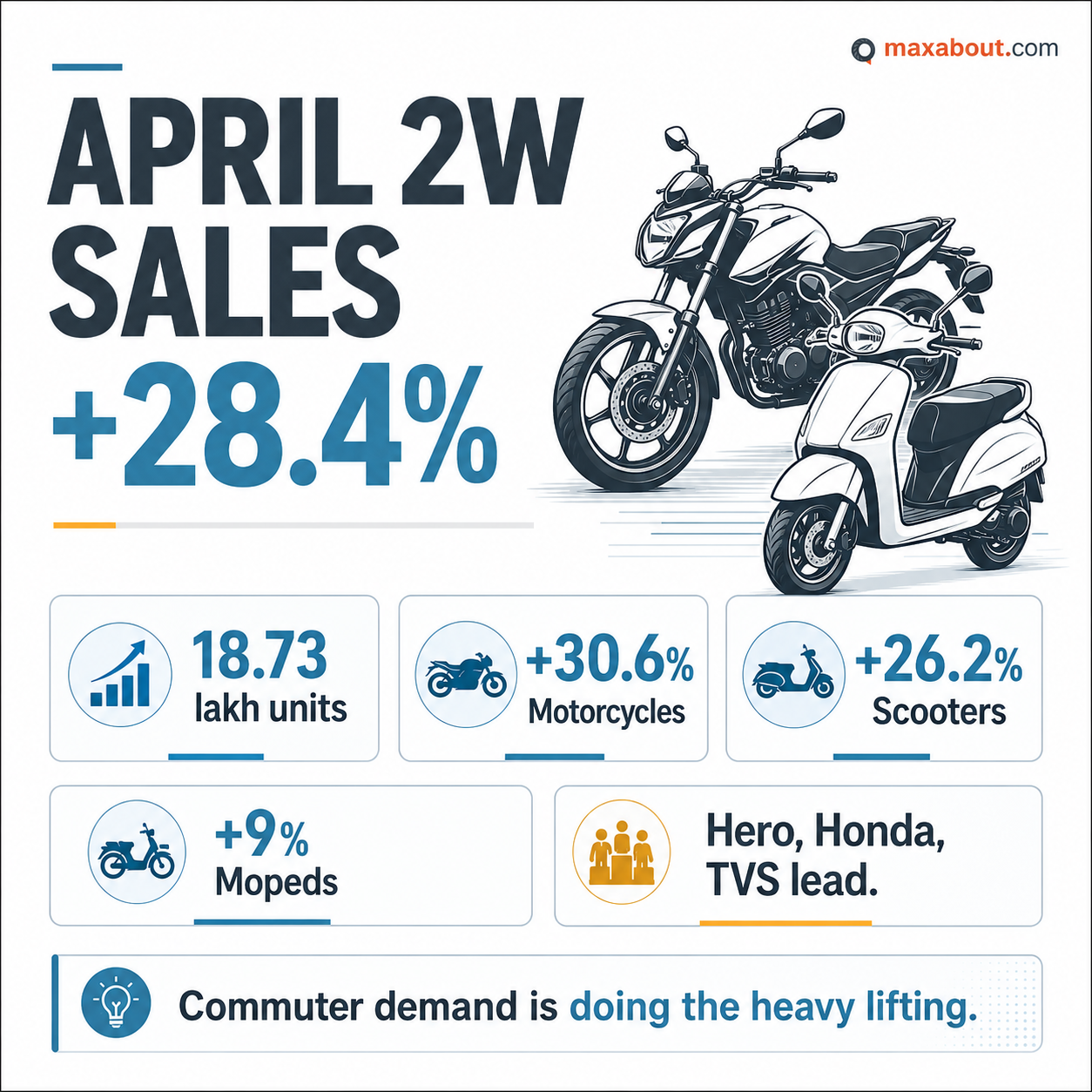
28.4%. Let that number sink in for a moment. India's two-wheeler market posted that kind of year-on-year growth in April 2026 — and if you follow this industry even casually, you know that isn't a number you see every quarter.
To put it in perspective, growth figures in the 6–12% range are considered healthy for a market of this size and maturity. Anything above 20% signals something more meaningful is happening beneath the surface. This isn't just strong seasonal momentum. This is a confluence of factors that analysts have been watching build slowly — and April appears to be where they all landed at once.
The timing matters. April traditionally benefits from post-summer buying patterns, with rural households seeing fresh liquidity after the rabi harvest cycle wraps up. Urban commuters, meanwhile, have been steadily returning to personal mobility solutions after years of recalibrating post-pandemic habits. Both forces seem to have aligned this month.
What makes this figure worth examining closely — rather than simply celebrating — is the question of sustainability. A single month's spike can reflect pent-up demand, favorable financing conditions, or a calendar effect. Whether April 2026 marks the start of a genuine upcycle or a temporary surge is exactly what the rest of this analysis will try to unpack.
What Drove the April 2026 Two-Wheeler Sales Surge?
Several forces appear to have converged in April, and it's worth unpacking them individually rather than attributing the jump to any single cause.
Rural demand was a significant contributor. Industry observations suggest that a reasonably strong Rabi harvest season improved cash flow in rural households across states like Punjab, Haryana, and parts of Madhya Pradesh. When farm income rises, the first major purchase for many rural families tends to be a two-wheeler — practical, affordable, and essential for daily mobility where public transport remains thin.
 April also sits at the edge of the wedding season calendar. From what analysts have noted, entry-level motorcycles and scooters see a consistent lift during this period, as families make aspirational purchases tied to celebrations and gifting.
There's also the matter of pent-up demand. A relatively quieter Q1 meant that some buying decisions were simply delayed, and April became the release valve. Add to that a wave of new model launches — fresher variants, updated features, competitive pricing — which gave first-time buyers a genuine reason to walk into a showroom.
Fuel price stability played a quieter but real role too. With petrol costs holding steady, the cost-per-kilometre argument for two-wheelers stayed compelling compared to alternatives. Attractive EMI structures from manufacturers made monthly commitments feel manageable for budget-conscious buyers.
None of these factors alone explains a 28.4 percent spike. Together, they do.
Which Segments Led the Charge — Scooters, Entry Motorcycles, or Premium Bikes?
Growth at this scale rarely comes from one corner of the market. Based on historic segment trends, the 100-125cc commuter motorcycle almost certainly did the heaviest lifting. This segment has an almost gravitational pull in Tier 2 and Tier 3 cities — places like Nashik, Coimbatore, Rajkot, and Bareilly — where reliable, fuel-efficient transport is a genuine daily necessity, not a lifestyle choice. Industry patterns suggest this category alone accounts for a significant portion of total two-wheeler volumes, and April 2026 likely followed that same logic.
Scooters, however, deserve serious attention here. Urban and semi-urban buyers — particularly women commuters — have been shifting toward automatic scooters steadily over the past few years. The convenience factor in stop-and-go city traffic is hard to argue against. From what industry data consistently shows, the 110-125cc scooter segment has been closing the gap with commuter motorcycles in cities like Pune, Lucknow, and Kochi.
The premium 200cc-plus segment remains a smaller slice numerically, but its growth rate has been impressive. Enthusiast buyers are spending more confidently, and that trend appears intact.
Electric two-wheelers contributed, but realistically remain a modest portion of overall volumes. The infrastructure and range anxiety conversation is still ongoing for many buyers.
The Rural-Urban Split: Where Is the Real Growth Happening?
The headline number of 28.4 percent growth is impressive, but the more interesting story is where exactly that demand is coming from. And honestly, it is not a simple answer.
Rural India continues to carry the weight here. Districts feeding into cities like Nagpur, Patna, Indore, and Coimbatore have always shown strong two-wheeler dependency, and that has not changed. For a farmer, a small trader, or a daily wage worker in these regions, a 110cc commuter motorcycle is not a lifestyle choice — it is genuinely essential infrastructure. Better road connectivity under recent highway expansion programs has actually extended the reach of dealerships into smaller towns, making purchases more accessible than before.
Local financing through regional NBFCs and cooperative lenders has also played a quiet but significant role. From what industry observers note, first-time buyers in semi-urban markets are showing stronger conversion rates this cycle.
Urban markets tell a different story. Cities like Bengaluru, Hyderabad, and Ahmedabad are seeing premiumisation take hold. Buyers there are gravitating toward feature-rich scooters and mid-displacement motorcycles, prioritising comfort and technology over pure economy.
So the growth is real on both ends — just driven by very different motivations. Rural volumes provide the foundation, while urban upgrades add value to the overall numbers.
Electric Two-Wheelers: A Growing but Still Emerging Piece of the Pie
Within this broader sales surge, electric scooters deserve their own conversation. They are growing, genuinely. But calling them a dominant force right now would be getting ahead of reality.
Cities like Bengaluru, Pune, and Delhi-NCR are where electric two-wheelers have found their most comfortable footing. Daily commuters with predictable routes, access to home charging, and some tolerance for the occasional service hiccup — these buyers are increasingly warming up to electric options. The value proposition makes sense when you do the math on fuel savings over a year.
Policy support has played a meaningful role here. The FAME subsidy framework, despite its evolving structure, has helped bring down upfront costs enough to make electric scooters a genuine consideration rather than a fringe choice. State-level incentives in places like Maharashtra and Karnataka have added further push.
But step outside the major metros and the picture changes considerably. Charging infrastructure gaps remain a genuine barrier in smaller towns and rural areas. Range anxiety on longer intercity stretches is a real concern buyers openly discuss. And after-sales service in tier-3 cities? That is still a work in progress for most players in this segment.
Battery longevity questions also linger in the background. From what industry observers report, many prospective buyers hesitate specifically over long-term battery replacement costs. The segment is promising — just not quite ready to carry the entire growth story yet.
What This Sales Boom Means for Buyers Right Now
A 28.4 percent jump sounds exciting. But before you walk into a dealership caught up in that energy, it is worth pausing to think about what this growth actually means for you as a buyer.
The good news first. High sales volumes generally mean dealers are moving stock confidently, and manufacturers are keeping supply lines active. That translates to better inventory availability on most mainstream models. You are less likely to wait three months for a standard commuter bike today than you might have two years ago.
However, the popular models — particularly the high-demand electric scooters and the 100-125cc segment leaders — can still carry waiting periods. Dealers know what is selling, and they have little reason to discount those specific vehicles. Where you can negotiate is on accessories, extended warranties, and bundled service packages. That is genuinely where the flexibility exists during high-demand months.
From what experienced buyers consistently report, visiting at least three dealerships in your city before committing makes a real difference. On-road prices vary more than most people expect, even within the same city.
The broader advice is simple — market momentum should inform your decision, not drive it. A booming sales month creates subtle pressure to act quickly. Resist that. The right two-wheeler for your daily needs matters far more than buying during a record-breaking month.
Can This Growth Momentum Sustain Through the Rest of 2026?
Honestly, that is the question worth sitting with. A 28.4 percent jump is impressive, but one strong month does not automatically signal a sustained trend. There are genuine reasons for optimism — and equally genuine reasons for caution.
On the positive side, rural income conditions look relatively stable heading into mid-2026. Favorable monsoon forecasts, if they hold, typically translate into stronger agricultural earnings by the third quarter. Historically, that kind of income improvement flows directly into two-wheeler purchases, particularly entry-level commuters. Add to that several confirmed model launches expected around June and July — manufacturers rarely sit on new products when market sentiment is this strong.
Expanding EV infrastructure is another factor worth watching. More public charging points across Tier-2 cities could meaningfully accelerate electric two-wheeler adoption through the remainder of the year, sustaining volume even if conventional fuel sales plateau.
But the headwinds are real. Rising insurance premiums are quietly eating into the affordability argument that makes two-wheelers so attractive in the first place. Fuel price uncertainty adds another layer of unpredictability. And there is a legitimate question about how much of April's volume simply reflected pent-up demand — purchases delayed from earlier months that finally happened together, creating an artificially elevated number.
In my view, the underlying demand fundamentals remain solid. Whether April's specific numbers repeat is a separate question entirely.
The Bigger Picture: Two-Wheelers as India's Mobility Backbone
Step back from the monthly numbers for a moment. A 28.4% jump is striking, but what it really confirms is something most urban analysts tend to underestimate — the two-wheeler is not India's backup plan. It is the main plan.
From the congested bylanes of Mumbai's western suburbs to the long open stretches connecting small towns in Punjab, the scooter and the commuter motorcycle carry this country forward every single day. Across income groups. Across age groups. Across geographies that no metro rail or app-based cab will realistically reach anytime soon.
The EV conversation is important. The car market's growth is real. But neither tells you what a two-wheeler sales figure tells you — how confident ordinary households feel about spending, about their income stability, about the near future. When this segment moves sharply upward, it reflects genuine ground-level optimism in a way that luxury car sales simply cannot.
That is what makes April's numbers worth paying attention to beyond the headline. The two-wheeler market is arguably India's most honest economic indicator — unfiltered, broad-based, and deeply connected to how real life actually functions here.
Maxabout Team
Editorial Team
Specializes in: Automotive News, Reviews, Analysis
Want to read more automotive news?
Stay updated with the latest car launches, reviews, and industry insights.
Browse All News