
India Rare Earth Magnet Scheme: What It Means for EVs
What Is India's Rare Earth Magnet Scheme and Why Does It Matter for Car BuyersHere is a government decision that did not make many headlines but could quietly shape what you pay for your next electric vehicle. The Centre has extended the timeline for its ₹7,280 crore rare earth magnet scheme — and i...
What Is India's Rare Earth Magnet Scheme and Why Does It Matter for Car Buyers
Here is a government decision that did not make many headlines but could quietly shape what you pay for your next electric vehicle. The Centre has extended the timeline for its ₹7,280 crore rare earth magnet scheme — and if you are even remotely considering an electric car or scooter in the next two to three years, this matters more than you might think.
So what exactly are rare earth magnets? In plain terms, these are extraordinarily powerful magnets made from elements like neodymium and dysprosium. They sit at the heart of every electric motor. Without them, there is no efficient powertrain. No smooth acceleration. No reliable range. They are, in a very real sense, the muscle behind every EV on Indian roads today.
The problem is that India currently imports the vast majority of these magnets, mostly from China. That dependency pushes up manufacturing costs, which eventually lands on the price tag of your electric vehicle.
This scheme aims to build domestic production capacity. The extension means more time for manufacturers to set up local supply chains properly. For buyers, the key questions are:
Will EVs actually get cheaper because of this?
How soon could the impact be felt?
Which vehicles and segments benefit first?
This piece answers all of that.
Understanding the ₹7,280 Crore Scheme: What the Government Actually Announced
At its core, this is a production-linked incentive framework — the government essentially pays manufacturers a portion of their revenue as a reward for producing rare earth magnets domestically. The logic is straightforward: build it here, and we will support you financially while you scale up.
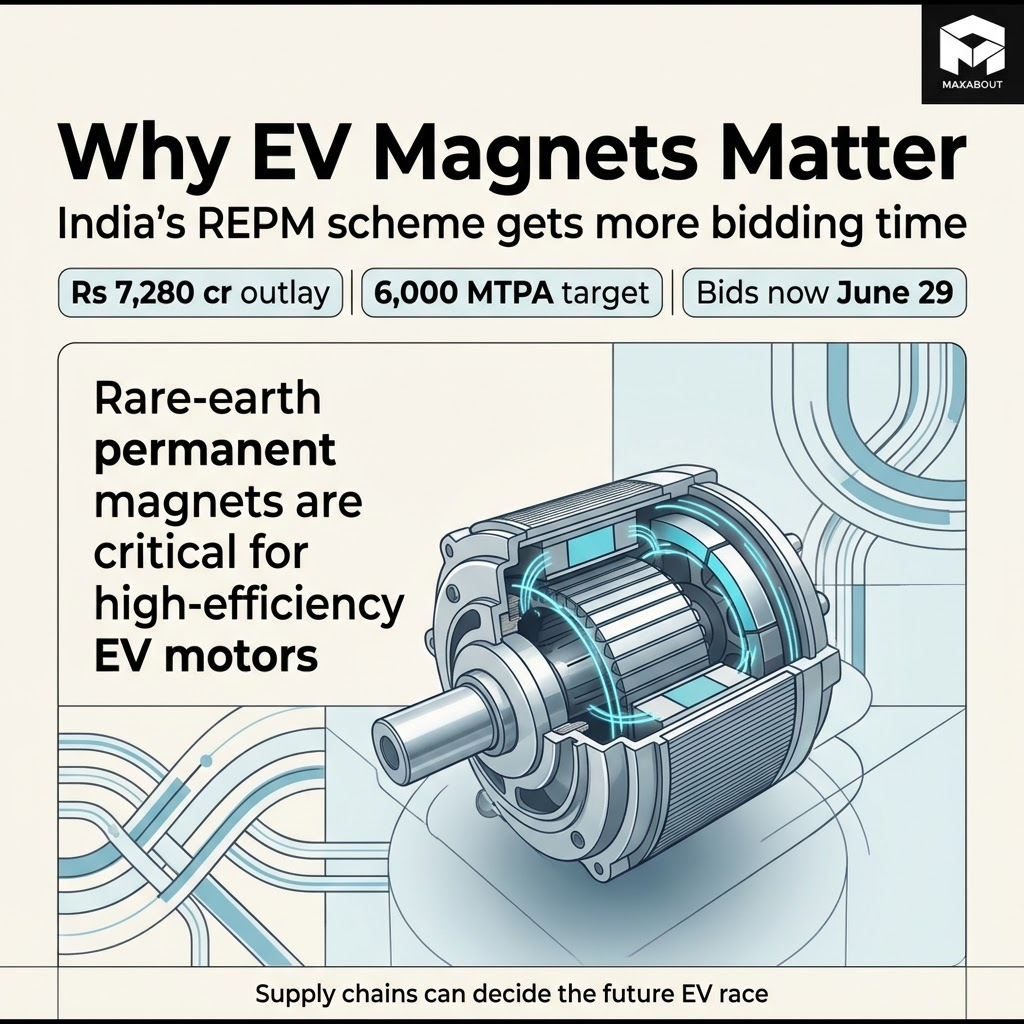 The specific magnet type at the centre of this scheme is the neodymium-iron-boron (NdFeB) magnet. If that sounds technical, here is why it matters practically — these magnets sit inside the electric motors that power EVs. Without them, there is no efficient motor. And right now, India imports the overwhelming majority of these from China, which controls a significant share of global rare earth processing capacity.
The original timeline gave manufacturers a fixed window to establish production facilities and begin hitting output targets. However, according to recent official announcements, that deadline has now been extended. The reason cited broadly is that setting up rare earth processing and magnet manufacturing infrastructure is genuinely complex — it requires specialised equipment, trained personnel, and environmental clearances that take time to work through.
The government's stated goal here ties directly into the broader self-reliance in critical components agenda. Rare earth magnets are classified as strategically sensitive materials, and depending on a single import source creates real supply chain vulnerability — something industry reports flagged sharply during the pandemic-era disruptions.
The extended timeline is meant to give manufacturers a realistic runway, not let them off the hook entirely.
Why India Is So Dependent on Imported Rare Earth Magnets Right Now
The uncomfortable truth is that India currently imports the overwhelming majority of its rare earth magnets — and China controls somewhere around 85-90% of global refined rare earth supply. That is not a comfortable position for any country trying to build a serious domestic EV industry.
For Indian EV manufacturers, this dependency shows up in very practical ways. Every permanent magnet motor in an electric scooter or car contains rare earth magnets. When global prices shift — or when supply chains tighten — Indian assemblers absorb those cost pressures directly. There is very little buffer.
From what industry reports have consistently highlighted, the pandemic years exposed just how fragile this arrangement is. Shipping delays, port backlogs, and sudden price spikes created real production headaches for manufacturers trying to scale up.
Without domestically produced magnets, Indian EV prices remain partly hostage to import costs and global commodity swings — factors completely outside any local manufacturer's control. That is a structural weakness, not just a temporary inconvenience.
Which is exactly why abandoning this scheme entirely would be far more damaging than any delay. The extension is frustrating, yes — but the alternative is simply continuing an import dependency that leaves Indian manufacturers perpetually exposed.
How the Timeline Extension Affects Indian EV Manufacturers and Upcoming Models
For anyone tracking upcoming electric two-wheelers and passenger EVs in India, this extension has very real, practical consequences. It is not just a policy footnote — it directly shapes what manufacturers can plan, price, and promise.
The core issue is straightforward. Permanent rare earth magnets sit inside the motors of virtually every mainstream EV sold in India today — from mass-market electric scooters to premium passenger cars. Until domestic production reaches meaningful scale, every unit of that magnet has to be sourced from abroad, primarily from China. That import dependency does not disappear because a government scheme exists. It only changes when actual production capacity comes online.
A longer timeline means Indian manufacturers continue navigating import costs for now. That pressure quietly finds its way into margins or, eventually, consumer pricing. Faster cost reduction for buyers gets pushed further out. From what industry observers note, this is one reason aggressive EV pricing in India has proven genuinely difficult to sustain.
That said, there is a reasonable argument for the extension. Rushing suppliers into underprepared facilities rarely ends well — quality inconsistencies, underperforming motors, and reliability concerns would ultimately hurt the very manufacturers depending on these components. A realistic timeline, even an extended one, is more useful than an optimistic deadline nobody can meet. Manufacturers at least get clearer preparation windows for their upcoming model roadmaps.
The Bigger Picture: India's EV Cost Problem and the Rare Earth Connection
Step back from the policy details for a moment and ask the obvious question: why do EVs in India still feel expensive for the average buyer? A decent electric car starts around ₹10 lakh and climbs quickly from there. Even two-wheelers carry a noticeable premium over their petrol equivalents. The reasons are layered, but raw material costs — particularly rare earth elements used in permanent magnet motors — sit near the top of that list.
Rare earth magnets are not a minor component. Neodymium-iron-boron magnets, used in most modern EV motors, directly influence motor efficiency, power density, and ultimately the cost of the entire drivetrain. When those magnets are imported — processed and priced by overseas suppliers — every rupee of that dependency shows up somewhere in the vehicle's sticker price.
China's dominance in affordable EVs did not happen by accident. A significant part of that story is vertical integration — mining, processing, magnet manufacturing, and motor assembly all happening within the same supply ecosystem. That compression of the supply chain removes layers of margin and logistics cost that importing nations simply have to absorb.
India is attempting something similar, and in theory, the logic is sound. If domestic magnet manufacturing scales successfully under this scheme, component costs could soften meaningfully — creating realistic conditions for well-specced electric cars in the ₹8 lakh to ₹15 lakh range to become genuinely viable within this decade.
In my view, though, the challenges are being somewhat underestimated in official optimism. China spent decades building that ecosystem. India is starting later, with thinner processing infrastructure for rare earth materials and a smaller base of experienced motor manufacturers.
That does not make the effort pointless — it makes realistic timelines and honest benchmarks more important than ever.
Pros and Cons of Extending the Scheme Timeline
So the government has pushed the deadline. The immediate reaction from some quarters is frustration — and honestly, that is understandable. But I think the full picture is more complicated than a simple pass or fail.
On the positive side, this extension arguably reflects mature thinking. Forcing manufacturers to meet artificial deadlines often produces exactly the wrong outcome — substandard components, rushed investments, and facilities that exist only on paper. Rare earth magnet production genuinely requires time to build proper metallurgical capacity, skilled workforces, and quality benchmarks. Keeping the long-term goal alive while adjusting the path toward it is, in principle, responsible policy.
The downside, though, is real. Every month of delay means continued dependence on imports — primarily from China — which directly affects component costs. Those cost pressures do eventually reach consumers, slowing the point where electric vehicles become genuinely affordable at scale.
There is also a harder concern worth raising honestly. Extensions can become patterns. When timelines shift once without clear accountability, future investors and manufacturers quietly start discounting official deadlines entirely.
My personal read? This particular extension feels more like realistic adjustment than alarming negligence — but only if it comes with sharper milestones and transparent progress reporting. Without those, it risks becoming the first of several quiet deferrals.
What This Means If You Are Thinking About Buying an Electric Car or Scooter in 2024 or 2025
Here is the honest answer: do not build your purchase decision around this scheme's timeline. The benefits — if they materialise — will take years to flow from magnet factories down to showroom pricing. Waiting for that to happen is not a strategy. It is indefinite postponement dressed up as patience.
If you are commuting daily in Bengaluru or Delhi, the running cost argument for EVs already makes practical sense right now, at current prices. Charging at home overnight versus filling petrol through stop-and-go traffic — the monthly savings are real and measurable, regardless of what happens with rare earth supply chains.
Buyers in Tier 2 cities face a genuinely different calculation though. Charging infrastructure gaps make the ownership experience less predictable, and that is a legitimate reason to hold off — not scheme timelines, but actual ground realities around public charging access.
The broader picture, however, is encouraging. India's EV ecosystem is building genuine momentum — more models, improving service networks, and policy intent that remains consistent even when individual scheme deadlines slip. That underlying direction matters more than any single extension notice. Buy when it fits your life. The infrastructure around you will be meaningfully better in two years regardless.
Final Thoughts: Is India's Rare Earth Strategy on the Right Track?
Honestly, this is not a clean story with a tidy conclusion. The timeline extension is neither a disaster nor a non-event. It reflects something more complicated — the genuine difficulty of building industrial capability from near-zero in a sector where China holds overwhelming dominance.
The ₹7,280 crore scheme, even delayed, represents serious intent. Whether that intent translates into functioning domestic magnet production is the question worth watching. Good policy announcements and actual rare earth processing capacity are very different things.
My cautious read: if the next three to five years see even partial delivery — operational processing facilities, a handful of verified domestic magnet suppliers, and measurable cost reduction in Indian-made EV motors — that would be real progress. For buyers, it could eventually mean more competitive pricing on premium EVs and fewer supply disruptions affecting waiting periods.
The milestones that would genuinely signal momentum include confirmed facility commissioning dates, domestic OEM partnerships, and export-grade output. Until then, watch the execution, not just the announcements.
Maxabout Team
Editorial Team
Specializes in: Automotive News, Reviews, Analysis
Want to read more automotive news?
Stay updated with the latest car launches, reviews, and industry insights.
Browse All News