
Hyundai Expands EV & Battery Research Network in India
Something significant is happening in India's automotive landscape, and it goes beyond just another car launch. Hyundai Motor Group is expanding its EV and battery research network in India — and that decision tells you a lot about how seriously the global industry is taking this market right now.Th...
Editorial Team
Something significant is happening in India's automotive landscape, and it goes beyond just another car launch. Hyundai Motor Group is expanding its EV and battery research network in India — and that decision tells you a lot about how seriously the global industry is taking this market right now.
Think about it. Fuel prices keep climbing. Delhi, Mumbai, Bengaluru — urban air quality is a genuine concern for millions of people. And the government isn't quietly nudging manufacturers toward electrification anymore. The push is loud, structured, and backed by real policy.
India sits at a fascinating intersection. It's one of the largest automotive markets in the world, yet electric vehicle adoption is still in its early stages. That's not a weakness — that's exactly what makes it attractive for deep research investment. There's room to shape how things develop here, not just react to an already mature market.
For everyday buyers, this expansion matters more than it might seem at first. More local research typically means better-tuned products — vehicles designed with Indian road conditions, temperatures, and usage patterns in mind, not just adapted from somewhere else. From what industry observers are noting, this could meaningfully change what affordable EVs look like in India over the next few years.
What Exactly Is Hyundai Expanding in India?
The expansion isn't just one thing — it's a layered effort. From what official announcements and industry reports indicate, Hyundai Motor Group is building out its research and development presence in India across two distinct but connected tracks: electric vehicle systems research and battery technology development. These sound similar but serve different purposes, and understanding that difference actually matters.
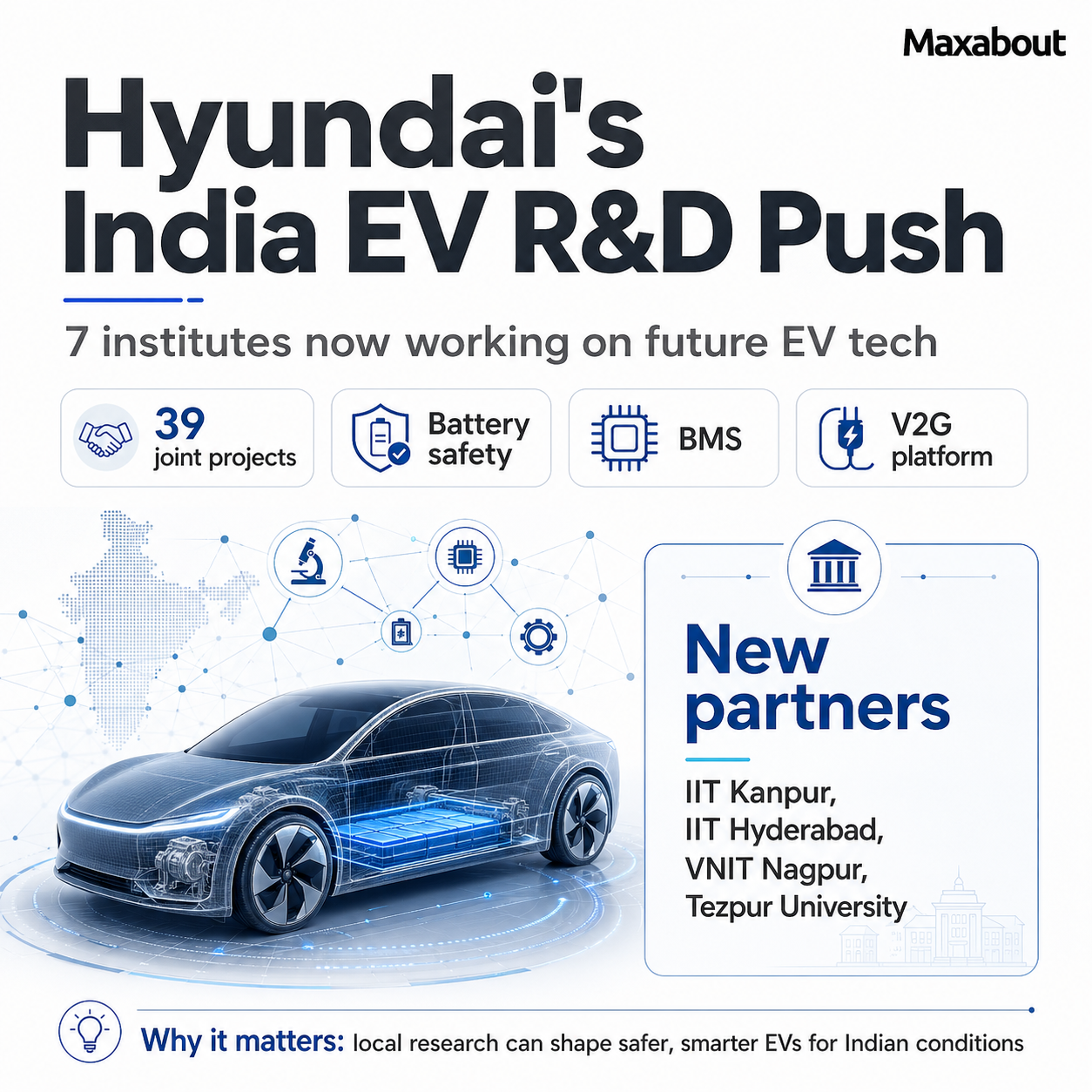 EV research broadly covers how a vehicle behaves — motor efficiency, thermal management in extreme heat, software calibration for stop-start urban traffic, and how the drivetrain holds up on broken roads. Battery research, on the other hand, goes deeper into the cell itself — chemistry, charge cycle durability, how capacity degrades in high-temperature climates like those across most of India.
Both matter independently. A well-designed battery in a poorly tuned vehicle still frustrates buyers. And a smooth-driving EV with a battery that loses range quickly in Indian summers won't earn long-term trust.
Reports suggest the group is also looking at partnerships with local suppliers and technical institutions to support this work — a practical move, since sourcing knowledge and components locally reduces costs and speeds up development cycles suited to Indian conditions specifically.
Why India Makes Sense as an EV Research Hub
Honestly, if you want to stress-test an electric vehicle, India might be the most demanding proving ground on the planet. No controlled lab environment replicates what Indian roads actually throw at a car daily.
Think about the extremes involved. A battery performing well in Mumbai's coastal humidity faces completely different chemistry challenges than one baking under Rajasthan's summer heat, sometimes crossing 48 degrees Celsius. Add Himalayan cold-weather operation to that list, and you have a thermal testing range that most countries simply cannot offer within a single market.
Then there's the traffic reality. Bengaluru and Delhi together represent some of the world's densest urban congestion. Stop-and-go driving for hours directly impacts battery discharge patterns, regenerative braking efficiency, and thermal management in ways that highway-dominant markets never expose.
Beyond conditions, Indian consumer expectations are uniquely demanding. Range anxiety here isn't irrational — charging infrastructure gaps are real, especially outside major metros. Buyers need batteries that genuinely deliver consistent range, not just impressive specification-sheet numbers.
Government policy is also pulling in the right direction. The FAME scheme and PLI incentives for battery manufacturing create a supportive environment for long-term investment. For a research network thinking decades ahead, that policy stability matters considerably.
The scale of potential adoption here is simply too large to research from a distance.
What This Means for Hyundai and Kia EVs Sold in India
The practical question, of course, is whether any of this actually translates into better cars for Indian buyers. Research networks sound impressive in press releases. But let's think through what localized battery research could realistically deliver.
Start with thermal management. The Ioniq 5 and Kia EV6 are genuinely excellent electric vehicles, but they were engineered primarily for temperate climates. Indian summers — think Delhi in May, or the humidity of Chennai year-round — stress battery chemistry in ways European test cycles simply don't capture. If Hyundai's India-based research teams are studying how cells behave under these specific conditions, this could eventually mean battery packs that maintain consistent performance even when temperatures outside are pushing 45 degrees.
For the Creta Electric, which sits at a price point where real volume sales happen, localized component sourcing could be genuinely significant. This could eventually lead to modest but meaningful price reductions, making the Creta Electric more competitive against what will surely be an increasingly crowded segment over the next few years.
There is also the possibility of India-specific variants emerging — battery configurations tuned for shorter urban commutes rather than highway touring. That would be a smart approach for a market where most buyers are covering city distances daily.
None of this happens overnight. But the foundation being built right now matters.
The Battery Challenge: Why Local Research Actually Matters
Here is something that does not get discussed enough. A battery pack engineered and validated in Munich or Seoul behaves very differently once it starts living through a Chennai summer. Ambient temperatures regularly touching 40 to 42 degrees Celsius, combined with direct sunlight on dark-colored body panels, can push the battery thermal environment into territory that European or Korean test cycles simply never account for.
Heat is genuinely the enemy of lithium-ion chemistry. Prolonged exposure accelerates degradation, meaning a battery that retains 90% of its capacity after four years in a temperate climate might tell a noticeably different story after the same period in coastal Tamil Nadu or the interior of Rajasthan.
Then there is the real-world range conversation. Claimed figures are measured under controlled conditions. Indian urban driving — with its dense stop-and-go traffic, frequent idling, aggressive air conditioning use — creates a very different load profile. The gap between claimed and actual range on Indian roads can be significant, which directly affects buyer confidence.
Research happening on Indian soil, with Indian traffic patterns and Indian climate data feeding into development, can address these gaps far more precisely. That is the core argument for localized battery research rather than simply importing solutions developed elsewhere.
Solid-state batteries remain an exciting longer-term possibility — better thermal stability, higher energy density — but practical, near-term improvements to existing lithium-ion chemistry for tropical conditions may matter more urgently for Indian buyers right now.
How This Fits Into India's Larger EV Ecosystem
Hyundai is not operating in isolation here. Across the industry, there is a genuine and growing momentum building around India as a serious EV development hub — not just a sales market for technologies designed elsewhere.
Tata Motors has arguably led this conversation longest, with local battery assembly operations and a charging network that continues expanding. Maruti Suzuki, historically cautious about full electrification, has now committed meaningfully to EV investment including local production timelines. When companies with such different philosophies start moving in the same direction, it usually signals something real rather than performative.
Government policy is pushing hard in parallel. India's 2030 EV adoption targets — 30% of private cars, 70% of commercial vehicles, 80% of two and three-wheelers — are ambitious by any measure. The FAME scheme and Production Linked Incentive programs have created genuine financial reasons for private companies to invest locally rather than simply import finished products.
But honest assessment requires acknowledging the gaps. Charging infrastructure remains concentrated around metro cities. Drive from Nagpur toward smaller districts or through large stretches of Rajasthan, and the charging desert problem becomes very real, very quickly. Grid reliability in many Tier 2 and Tier 3 towns adds another layer of uncertainty for potential buyers.
Private research investment like Hyundai's complements public policy, but it cannot substitute for infrastructure spending. Both need to accelerate together, or consumer confidence will remain fragile outside urban centers.
Real Talk: Will Indian Buyers Actually Benefit Anytime Soon?
Honestly? Not immediately. And it is worth being straightforward about that.
Research expansions like this operate on long timelines. Battery chemistry breakthroughs, localised software development, thermal management improvements suited to Indian conditions — these take years to move from lab to showroom. Someone sitting on the fence about buying a Creta Electric or an Ioniq 5 in 2025 or 2026 will not wake up tomorrow to find prices significantly lower or range suddenly doubled because of this announcement.
From what user reviews and automotive observers consistently report, current Hyundai EV ownership in India is a mixed experience. The vehicles themselves draw genuine praise — the Creta Electric in particular gets strong feedback on ride quality and cabin refinement. But service network depth outside major cities remains a concern. Technicians trained specifically for EV diagnostics are still concentrated in larger urban centres, which creates anxiety around post-purchase support.
Charging support has improved, but slowly. Software updates have been inconsistent in rollout frequency compared to what owners expected.
Does this research expansion change the buying decision today? Not directly. Think of it as a positive signal about long-term commitment rather than immediate relief. If you need an EV right now, evaluate today's product on today's merits — range, service access, charging availability in your specific city. The research investment matters more for buyers in 2028 and beyond.
Final Thoughts: A Promising Step, But the Journey Is Long
Expanding research infrastructure in India is not a small commitment. It signals that Hyundai Motor Group sees this market as genuinely central to its EV future — not just a sales destination, but an active contributor to how next-generation batteries and electric platforms get developed.
That matters. India's driving conditions, climate extremes, and affordability expectations are unlike any other major market. Research rooted here has a better chance of producing solutions that actually work here.
But measured optimism is the right approach. Research takes years to translate into products. Infrastructure still needs serious government and private investment. Charging reliability outside major cities remains genuinely uncertain. These are real barriers that no press announcement resolves overnight.
The honest takeaway: this is a foundation being laid, not a problem being solved. And foundations, when built properly, do matter enormously over time.
So I'd love to hear where you stand — are you feeling close to making the EV switch, or are you still waiting for prices to drop further and charging networks to mature? Drop your thoughts below. There's no wrong answer here, and real conversations like these help everyone make better decisions.
No comments yet
Be the first to share your thoughts!
Want to read more automotive news?
Stay updated with the latest car launches, reviews, and industry insights.
Browse All News