
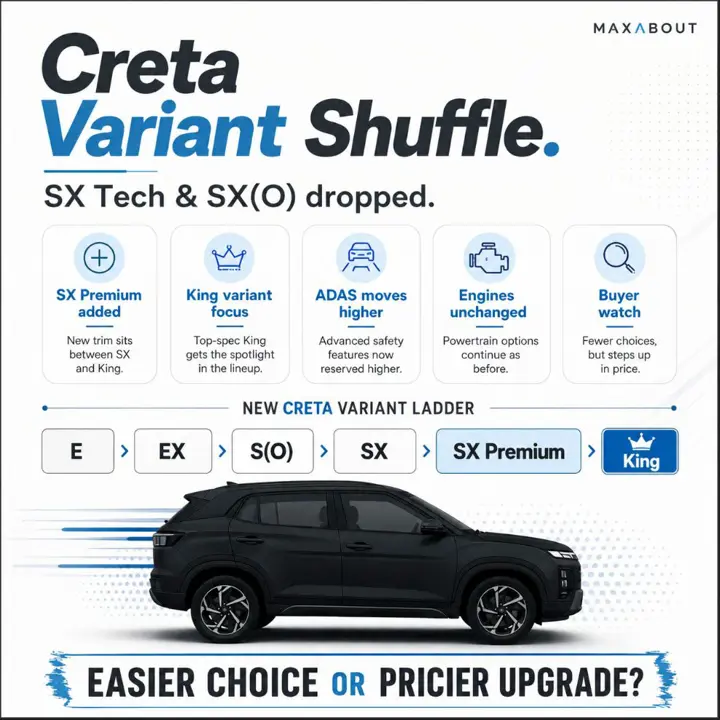
Hyundai Discontinues Creta SX Tech & SX(O) Trims
You spend three weekends visiting dealerships, configure your ideal variant on the website, maybe even shortlist a colour — and then you discover the trim you wanted has quietly disappeared from the lineup. No announcement, no warning. Just gone. If you were eyeing the Hyundai Creta SX Tech or SX(O)...
Editorial Team
You spend three weekends visiting dealerships, configure your ideal variant on the website, maybe even shortlist a colour — and then you discover the trim you wanted has quietly disappeared from the lineup. No announcement, no warning. Just gone. If you were eyeing the Hyundai Creta SX Tech or SX(O), that frustration is very real right now.
Hyundai has discontinued both the SX Tech and SX(O) trims from the current Creta lineup. These were not minor, forgettable variants. They sat at the top of the range and carried most of the premium features that made the Creta feel genuinely well-equipped — think panoramic sunroof, ADAS suite, ventilated seats, and the larger touchscreen setup that buyers in cities like Bangalore, Pune, and Delhi were actively comparing against rivals.
This matters more than it normally would because the Creta is not some niche product. It consistently ranks among India's top-selling SUVs, and a large portion of buyers stretch their budgets specifically for these higher trims. Removing them mid-cycle, without much fanfare, raises obvious questions about what Hyundai is planning next — and whether buyers currently in the market are getting a fair deal.
So what exactly changed, and what does this mean if you were seriously considering one of these variants?
What Were the SX Tech and SX(O) Trims — And Why Did Buyers Love Them
To understand why this discontinuation stings, you first need to appreciate what these two variants actually offered. The SX Tech and SX(O) sat at the top of the Creta's trim ladder, priced roughly between ₹17 lakh and ₹20 lakh depending on the powertrain. That is serious money for a mass-market SUV — but the features packed into these variants made the ask feel surprisingly reasonable.
 The headline attraction was the panoramic sunroof, which has become almost a purchase trigger for a significant chunk of Indian buyers, particularly younger ones. Pair that with ADAS — Hyundai's Level 2 driver assistance suite covering lane keep assist, forward collision warning, and adaptive cruise control — and suddenly you were getting technology that luxury sedans were offering just a few years ago.
The 10.25-inch touchscreen with connected car features, ventilated front seats for brutal Indian summers, and the Bose sound system made the cabin feel genuinely premium. From what most reviewers consistently noted, the interior experience at this spec level punched well above the price point.
That was precisely the appeal. Buyers could skip brands like Jeep or Volkswagen's higher trims and still feel like they had not compromised. The SX(O) especially felt like a near-complete package — which is exactly what made losing it so frustrating.
Why Hyundai May Have Made This Decision — Reading Between the Lines
So why pull trims that were genuinely well-received? The answer probably has less to do with the product itself and more to do with business logic.
Variant rationalization is something automakers do more often than buyers realize. When a model carries too many trims too close together in pricing and features, it creates production complexity without proportional revenue gains. Hyundai likely looked at its Creta lineup and identified overlap — trim levels that were cannibalizing each other rather than expanding the overall customer base.
There is also the refresh cycle argument. Industry patterns suggest the Creta could be approaching a mid-cycle update. When manufacturers prepare for that, they often quietly simplify the outgoing variant structure first. Features get pulled, reshuffled, and then reintroduced with a facelift — sometimes at better price points, sometimes not.
From a demand perspective, it is worth considering that mid-spec variants almost always outsell top-spec ones in India. Buyers here tend to balance features against monthly installments very carefully. If the SX Tech and SX(O) were moving slower than the S and SX trims, the math would eventually point toward consolidation.
This broader trend of lineup simplification is visible across brands in India right now — fewer trims, cleaner positioning, reduced dealer inventory pressure. Hyundai is simply following a playbook the industry has already started writing.
How This Affects Buyers Who Were Eyeing These Variants
If you were actively considering the SX Tech or SX(O), this news genuinely changes your decision-making process. And the impact looks different depending on exactly where you are in your buying journey.
If you hadn't booked yet, you are actually in the most flexible position. The remaining SX trim still covers a solid chunk of what most buyers realistically need — you get the panoramic sunroof, connected car features, and a reasonably complete feature set. Moving down to SX from SX Tech is not a dramatic compromise for everyone. But if you specifically wanted the ADAS suite or the ventilated seats, those features may not survive the trim restructuring. Worth confirming with your dealer exactly what the current SX configuration includes before assuming anything.
If you already placed a booking, reach out to your dealership immediately. From what buyers have reported, dealers are handling this differently across cities — some are offering full refunds without hassle, others are pushing customers toward remaining stock. Do not just wait passively for an update. Be direct, ask specifically about your options, and get any commitment in writing.
For future used car buyers, this could actually work in your favor. Once discontinued trims stop being produced, existing stock sometimes gets cleared at slightly better negotiated prices. An SX Tech unit sitting in a dealership yard becomes a motivated seller's problem pretty quickly.
The honest advice here is simple — do not rush a decision just because a trim disappeared. The Creta lineup still offers strong value. Take a breath, reassess what features actually matter in your daily driving, and then decide.
The Remaining Creta Trim Lineup — What You Can Still Buy Today
After the dust settles on the SX Tech and SX(O) discontinuation, here is what the Creta ladder actually looks like right now.
The E variant sits at the base. Honest assessment — it exists mainly on paper. Bare essentials, no connected features, basic safety. Unless you are a fleet buyer or running extremely tight on budget, this one rarely makes sense for a personal purchase.
The EX steps things up meaningfully. You get a more complete feature set without paying for things most buyers never use. For someone navigating stop-and-go traffic in Mumbai daily, this trim is surprisingly livable.
Then comes the S and S(O) pairing — this is where most buyers should honestly stop and think. The S(O) in particular lands some genuinely useful features at a price that still feels reasonable. From what reviewers consistently note, this is the sweet spot for city-heavy driving.
The SX trim now sits closer to the top of the accessible range. It carries the sunroof, better infotainment, and creature comforts that make long Bengaluru-to-Mysuru or Chennai-to-Puducherry highway runs noticeably more comfortable. For frequent highway drivers, this is the variant worth serious consideration.
Is anything overpriced? Possibly. The gap between S(O) and SX feels wider in cost than it does in actual daily usefulness for purely urban buyers.
What This Means If You Already Own an SX Tech or SX(O)
If you bought one of these trims, the natural question is: does this hurt your resale value? Honestly, it is not straightforward. Discontinuation can cut both ways.
In some cases, rare trims actually hold their value better. Buyers who specifically want the panoramic sunroof or the advanced ADAS features will hunt the used market for exactly your configuration. That targeted demand can work in your favour when negotiating.
On the other hand, if buyers perceive a discontinued trim as harder to service or source parts for, they may offer less. This is where Hyundai's wide service network genuinely reassures. With over 1,300 service touchpoints across India — covering metros like Mumbai and Delhi down to smaller towns — parts availability for existing SX Tech and SX(O) vehicles is unlikely to be a real concern in the short to medium term. Manufacturers are also obligated to support parts supply for years after discontinuation.
From what industry patterns suggest, well-equipped trims from popular nameplates rarely depreciate sharply simply because a variant gets quietly removed. The Creta nameplate remains enormously strong in India, which provides a natural cushion.
Keep your service records clean and maintained. That documentation matters far more to a used-car buyer than whether your trim still appears in the current brochure.
Alternatives Worth Considering If the Creta No Longer Fits Your Needs
If the trimmed-down Creta lineup feels like a step back from what you were expecting, the mid-size SUV segment in India is genuinely competitive right now. There are real options worth exploring without any compromise on features.
When evaluating alternatives, focus on a few things that actually matter on Indian roads:
ADAS availability — forward collision warnings and lane assist are increasingly common in this bracket
Panoramic or large sunroofs — still a strong priority for most buyers in this segment
Connected car features — remote access, over-the-air updates, and app integration
After-sales network — especially if you live outside metros like Mumbai or Delhi, service center density matters enormously
From what industry observers consistently note, several rivals now offer feature-rich top trims at price points that overlap directly with the Creta's current range. The competition has genuinely narrowed.
In my view, the smartest approach is to test-drive two or three options before deciding. Prioritize long-term ownership costs and service accessibility in your specific city over specification sheets alone.
Final Thoughts — Step Backward or Smart Business?
Honestly, this move sits somewhere in between. Hyundai has clear business logic here — streamlining variants reduces complexity, manages inventory better, and likely protects margins. That is not cynical thinking; that is how large manufacturers operate in competitive markets.
But the frustration for buyers who were specifically waiting for those top trims is completely valid. Losing a fully-loaded option mid-cycle feels abrupt, regardless of the reasoning behind it.
Worth remembering though — variant discontinuations happen regularly in India. Features disappear, repackage, and return under refreshed trim names. This is unlikely to be permanent.
So here is the practical takeaway. If the remaining Creta trims cover everything you genuinely need, there is no reason to overthink this. The Creta's core strengths — resale value, service network, overall reliability — remain unchanged.
But if those specific top-trim features were central to your buying decision, reassess now rather than waiting. Explore your alternatives with fresh eyes. The market has strong options available today, not hypothetically.
Do not let brand loyalty or sunk research time drive a purchase that no longer fits your requirements.
No comments yet
Be the first to share your thoughts!
Want to read more automotive news?
Stay updated with the latest car launches, reviews, and industry insights.
Browse All News