
Hyundai Bayon-Based Compact SUV Spotted Testing in India
Something interesting showed up recently. A compact SUV, believed to be based on Hyundai's European-market Bayon, was spotted testing on Indian roads. Camouflaged, but clearly carrying Hyundai's design language. And honestly, that's enough to get people talking.For those unfamiliar, the Bayon is a s...
Something interesting showed up recently. A compact SUV, believed to be based on Hyundai's European-market Bayon, was spotted testing on Indian roads. Camouflaged, but clearly carrying Hyundai's design language. And honestly, that's enough to get people talking.
For those unfamiliar, the Bayon is a subcompact crossover sold in Europe — sitting below the Tucson, offering a stylish, city-friendly profile with decent practicality. It never made it to India in its original form. But from what recent spy shots suggest, Hyundai may be working on a India-specific interpretation of that platform, potentially tailored for our market's unique demands.
Why does this matter? Because the compact SUV space in India right now is genuinely fierce. The Maruti Fronx, Tata Nexon, Kia Sonet, and even Hyundai's own Venue are all fighting hard for the same buyer. A new entry needs a strong reason to exist — and based on early observations, this one might just have it.
Hyundai has been on an aggressive expansion path in India lately. New powertrains, updated platforms, fresh body styles — the momentum is real. The timing of this test mule appearing feels deliberate. Whether this becomes a direct Venue replacement, a new nameplate, or something else entirely — that's the question worth exploring.
What the Spy Shots Tell Us About the India-Spec Model
Spy shots are always a game of reading between the lines. The camouflage does its job well, but certain things are simply hard to hide. From what has been observed in the test mule images circulating recently, the silhouette is compact but noticeably upright — suggesting a roof height that prioritizes headroom over sleek styling. That's a practical choice, and honestly, a smart one for Indian buyers.
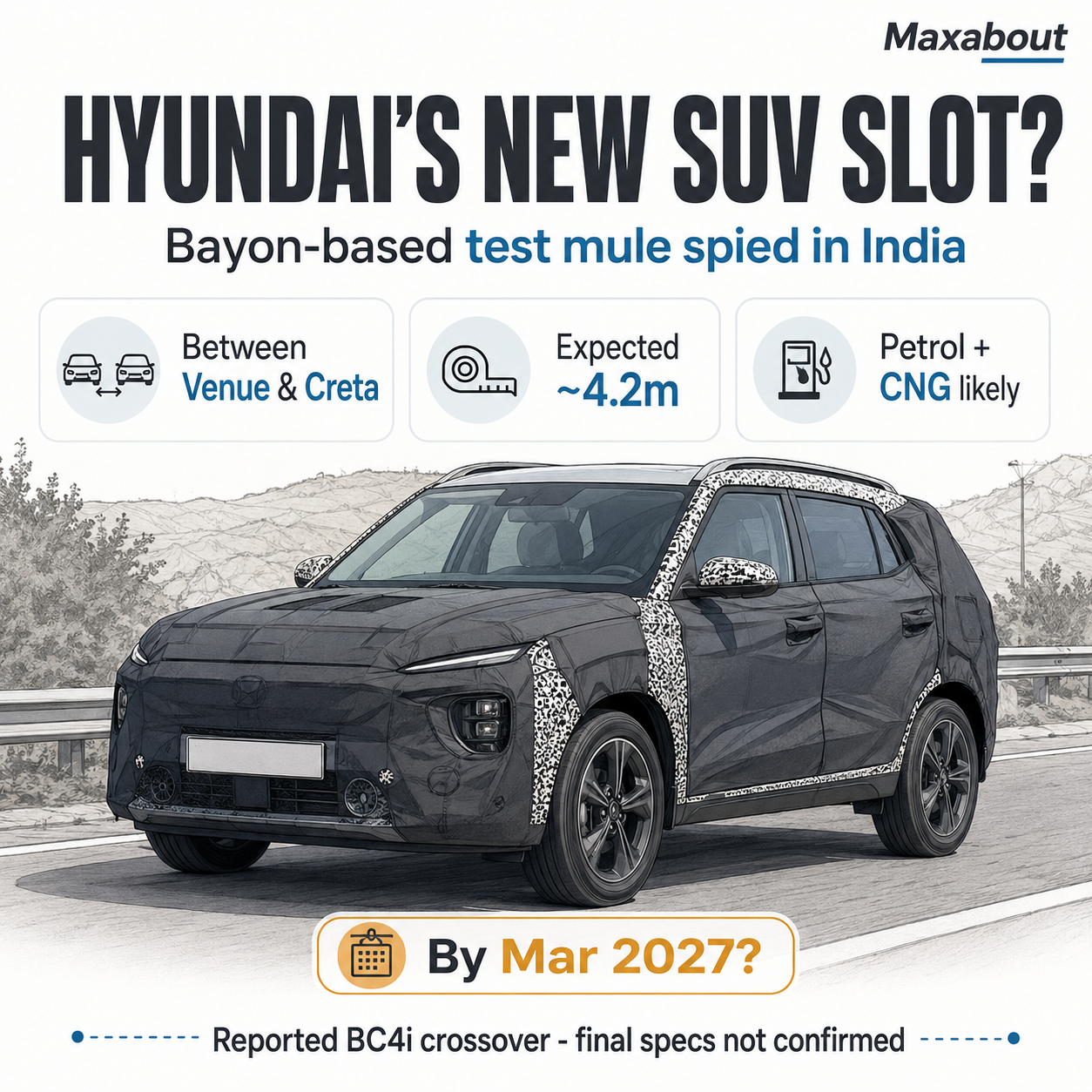 The wheel arches look reasonably pronounced, hinting at alloy sizes somewhere in the 16 to 17-inch range. Nothing confirmed, but the proportions suggest this isn't going for an aggressive, low-slung stance. The overall body length appears to slot comfortably between a premium hatchback and a proper compact SUV — which is exactly the territory Hyundai seems to be targeting.
The heavily wrapped front and rear ends make it difficult to comment on lighting signatures or grille design. That's speculation territory, best avoided for now. What is visible, however, is the overall ground clearance — it looks adequate for broken urban roads, though whether it handles something like a Pune highway or a monsoon-flooded Mumbai street remains to be seen.
Testing on Indian roads, particularly around Chennai and Pune proving grounds, typically signals a launch window 12 to 18 months out. If that pattern holds, things could get interesting by late 2025 or early 2026.
The Bayon Blueprint: What the European Model Offers and What India Might Get
The European Bayon is a genuinely interesting car. It sits on Hyundai's K2 platform — the same underpinning the Venue uses — which immediately tells you something important: Hyundai already knows how to make this architecture work in India. The Bayon in Europe measures roughly 4,180mm in length, which puts it squarely in compact SUV territory, slightly longer than the current Venue but shorter than the Creta. That dimensional sweet spot is clearly deliberate.
Engine options abroad include a 1.0-litre T-GDi turbocharged petrol in both 100PS and 120PS states of tune, alongside a mild-hybrid setup. The interior is confident rather than flashy — clean horizontal dashboard layout, a reasonable infotainment screen, and decent rear-seat space for the segment.
Now, what actually arrives in India is a different conversation. From what industry observers consistently note, Hyundai tends to localize aggressively. The 1.0 T-GDi is a strong candidate, but a naturally aspirated 1.2-petrol could appear to anchor a more accessible price point. Given India's fuel economy sensitivity, a CNG variant seems almost inevitable — Hyundai has proven willing to go that route with the Venue.
Ground clearance will almost certainly be recalibrated upward. European roads and a flooded Chennai street in July are simply not comparable situations. Feature adjustments are likely too — ventilated seats, larger screens, and rear AC vents tend to be non-negotiable expectations for Indian buyers in this segment.
All of this remains informed speculation, of course. But Hyundai's India playbook is consistent enough that these patterns feel more probable than not.
Where Would This SUV Sit in Hyundai's India Lineup?
This is where things get genuinely complicated for Hyundai. The Venue is already doing a solid job in the sub-4-metre space — it sells consistently, has a loyal customer base, and carries strong brand recognition. So what exactly does a Bayon-based product solve?
The honest answer is: it depends entirely on how Hyundai chooses to position it. There are really only a few realistic options here, and none of them are without risk.
If this SUV slips in below ₹10 lakh, it directly cannibalizes the Venue's entry variants. That feels unlikely. More probable is a bracket somewhere between ₹11 lakh and ₹14 lakh — slightly above the Venue's sweet spot, but still below the Creta. That gap exists, but it's narrow. Hyundai would need a very clear identity for this product to justify its presence there.
The Bayon's design language is arguably its strongest argument. It looks distinctly more expressive than the Venue — sharper, more styled, more lifestyle-oriented. That could work in its favour if Hyundai positions it as a design-first choice for younger buyers who want something that stands out in a parking lot rather than simply checking specification boxes.
But portfolio cannibalization is a real concern. Two similarly sized Hyundai SUVs competing for overlapping buyers is a delicate balancing act, and not one every manufacturer gets right.
The Competition This SUV Will Have to Face Head-On
Let's be honest — stepping into the sub-four-metre SUV space right now is not for the faint-hearted. This segment has become one of the most fiercely contested battlegrounds in the Indian market, and any new entrant, regardless of brand reputation, has to earn its place.
Maruti Fronx and Toyota Taisor together represent arguably the sharpest value proposition in this space. The Fronx benefits from Maruti's legendary service network and running cost reputation — two factors that genuinely move purchase decisions in smaller cities and towns. The Taisor mirrors that with Toyota's reliability badge. Together, they dominate the rational, practical buyer's mindset.
Tata Nexon continues to hold strong on safety credentials and a genuinely spacious cabin for its footprint. Its star rating resonates with family buyers, and Tata's improving service quality has softened one of its historical weaknesses.
Kia Sonet punches hard on feature richness and interior quality — areas where a Bayon-based product might naturally compete. That rivalry could get interesting.
The gap worth exploiting? Design distinctiveness and a genuinely premium cabin experience — something most rivals treat as secondary. If Hyundai prices this sensibly, that combination could attract buyers who feel the current options are either too conservative or too utility-focused. But sharp pricing is non-negotiable here. Strong products have stumbled badly in this segment simply by arriving ₹50,000 too expensive.
What Indian Buyers Actually Want From a Compact SUV in 2025
Here's the thing — "compact SUV buyer" isn't one type of person. Someone purchasing in Bengaluru's tech corridors has genuinely different priorities than someone in Nagpur or Patna. Understanding that split matters when evaluating whether a Bayon-based model earns real consideration.
Ground clearance remains non-negotiable for a large portion of buyers. Tier-2 city roads after monsoon season are genuinely punishing. From what owners consistently report, anything below 190mm starts feeling inadequate once you're navigating waterlogged stretches or broken village roads connecting smaller towns. Urban buyers in Pune or Hyderabad care about this too — just differently. For them, it's about scraping on steep apartment parking ramps rather than surviving flooded roads.
Boot space is another area where expectations have quietly risen. Families routinely packing for weekend drives want practical loading room, not just an impressive number on a spec sheet. Rear seat comfort on longer stretches — say, a Bengaluru to Mysuru run — matters enormously to buyers who frequently travel with elderly parents.
Then there's the service network conversation. Feature lists impress showroom visitors. Service reliability wins long-term loyalty. Hyundai's existing network is genuinely one of its strongest advantages here — buyers in smaller cities already trust it.
Fuel efficiency expectations sit around 16-18 kmpl for petrol variants in real-world conditions. Anything significantly below that invites comparison pressure from rivals. A Bayon-based entry would need to clear all these bars simultaneously — not just tick a few boxes.
Expected Price Range and Value Proposition: Will It Make Sense?
Pricing will make or break this one. Based on Hyundai's positioning history and where the Venue currently sits, a Bayon-based compact SUV would likely enter somewhere between ₹10 lakh and ₹14.5 lakh across variants. That's an informed estimate, not a confirmed number — but it aligns with how Hyundai has traditionally layered its portfolio.
The tricky part? The Venue already occupies that space comfortably. So Hyundai either prices this slightly above to justify differentiation, or slots it below to capture a different buyer. Neither is straightforward. Price it too close to the Venue and buyers will simply ask why they shouldn't just get the more established model. Price it too high and it starts competing with the Creta's base variants — a difficult conversation.
From what industry observers have noted about Hyundai's recent launches, the brand rarely enters a segment aggressively on price. They lead with features instead. That strategy works — but only if the features genuinely feel premium relative to rivals. In this segment, the Nexon and Brezza already offer strong feature-per-rupee value. Hyundai would need to match that or exceed it meaningfully.
Resale value, at least, is a genuine strength. Hyundai vehicles hold their value reasonably well across Indian cities, which quietly improves the overall ownership equation. That long-term calculation matters to practical buyers.
Should You Wait for This or Buy Something Else Right Now?
Honestly, this is the question that actually matters. Spy shots and speculation are interesting, but your transport needs are real and immediate.
From what the testing activity suggests, a launch before late 2025 seems optimistic. Early-stage road testing in India typically means at least 12 to 18 months before showroom arrival — sometimes longer if localisation work is still ongoing. That is a meaningful wait.
And waiting has real costs. You miss current festive season offers, exchange bonuses, and finance deals that may not return in the same form. Living without a personal vehicle in cities like Bengaluru or Pune, where public transport has genuine gaps, is a daily inconvenience that no amount of anticipation fixes.
If your need is urgent, buy what works for you now. The Nexon, Brezza, and Venue are genuinely sorted products with established service networks across most Indian cities. None of them will leave you disappointed.
But if you can comfortably wait six to eight months before reassessing? Then watching how this one develops costs you nothing. What would make it truly worth the anticipation is a distinctive feature set, honest pricing, and real-world fuel efficiency suited to Indian driving patterns — not just another badge in an already crowded lineup.
Maxabout Team
Editorial Team
Specializes in: Automotive News, Reviews, Analysis
Want to read more automotive news?
Stay updated with the latest car launches, reviews, and industry insights.
Browse All News