
Honda WN7 Electric Bike Design Patent Filed in India
Honda has been quietly making moves in India's electric space, and the latest one is hard to ignore. The company has filed a design patent for something called the WN7 — an electric two-wheeler — right here in India. That detail matters more than it might seem at first glance.A design patent filing ...
Editorial Team
Honda has been quietly making moves in India's electric space, and the latest one is hard to ignore. The company has filed a design patent for something called the WN7 — an electric two-wheeler — right here in India. That detail matters more than it might seem at first glance.
A design patent filing is not a mood board or a concept render buried in some Tokyo presentation. It signals that Honda is serious enough about a product to legally protect its visual identity in a specific market. Companies don't go through that process for vehicles they have no intention of selling. So when Honda files one in India, it's worth sitting up and paying attention.
From what early reports suggest, the WN7 appears to be an electric motorcycle or scooter-adjacent design — distinct from anything currently in Honda's India lineup. The timing is no accident either. The Indian electric two-wheeler segment is genuinely heating up, with brands like Ola Electric, Ather, and TVS carving out real market presence and pushing buyers to reconsider their options.
For anyone watching the EV space closely, this is exactly the kind of early signal worth tracking. Nothing is confirmed yet, but Honda planting this flag in India's patent system suggests the WN7 could be part of a much larger electric strategy aimed directly at Indian roads and Indian riders.
What We Know About the Honda WN7 Design Patent So Far
A design patent is a specific kind of intellectual property protection — and it's worth being clear about what that actually means before reading too much into it. Unlike a utility patent, which covers how something works, a design patent protects how something looks. So what Honda has secured here is essentially legal ownership over the WN7's visual form. That's actually quite telling on its own.
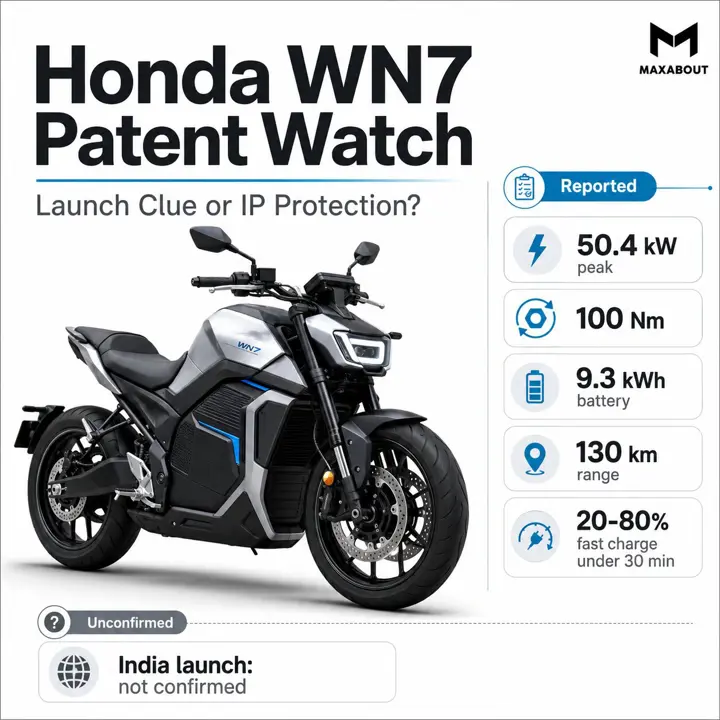 Based on patent images, the WN7 carries a sharp, forward-leaning silhouette that reads more premium than Honda's current electric scooter lineup. The body panels appear more sculpted, with pronounced creases running along the side profile. From what the filing suggests, the front-end design features a distinctive lighting signature — slim, layered elements that give it a modern, almost aggressive face compared to the softer styling on something like the Activa Electric.
The overall stance looks compact but planted, which could hint at a design philosophy suited to urban commuting. Panel structure appears tightly integrated, suggesting a cleaner, more refined build quality aesthetic.
However, the patent confirms none of the following — battery capacity, motor output, range figures, pricing, or a launch timeline. Those remain completely open questions. Honda has made no official announcement regarding the WN7's India launch. The patent was filed with India's intellectual property office, which at minimum confirms Honda is protecting this design specifically for this market.
How the WN7 Design Compares to Honda's Current Electric Lineup
To understand where the WN7 might fit, it helps to look at what Honda has already built. The EM1 e: — Honda's entry-level electric scooter launched in Japan and parts of Europe — is a practical, modest machine. Compact, lightweight, and designed around a swappable battery system. It was never a design statement. It was Honda being cautious, testing the waters.
From what industry observers have noted, the WN7's patented silhouette reads differently. It appears more purposeful, with sharper lines suggesting Honda is moving beyond that conservative approach. Whether this represents a natural evolution or a genuine design reset is an interesting question.
Honda's broader Electric Vision strategy targets 30 electric two-wheelers globally by 2030. India is central to that ambition — the sheer volume of the market makes it impossible to ignore. However, Honda has been notably slow in responding to India's EV momentum. While domestic manufacturers have aggressively expanded their electric portfolios, Honda's India presence has remained largely petrol-focused.
That said, Honda does have an established manufacturing partnership in India through Honda Motorcycle and Scooter India, which gives them genuine local production capability. If the WN7 does reach Indian roads, that infrastructure matters significantly for pricing and availability.
The Indian Electric Two-Wheeler Market: Where Would the WN7 Fit In?
The Indian electric two-wheeler space right now is genuinely exciting — and crowded. You have budget options sitting below ₹1 lakh, mid-range commuters between ₹1–1.5 lakh, and a growing premium segment pushing ₹1.5–2.5 lakh. Established players have moved fast, and buyers in cities like Bengaluru, Pune, and Delhi are no longer treating electric two-wheelers as experimental purchases.
A Honda-branded electric bike would almost certainly land in the premium commuter to performance-oriented segment — roughly ₹1.5 lakh and above. That is where the brand positioning makes sense. Honda is not going to compete on price alone, nor should it.
What urban Indian buyers are genuinely asking for comes down to a few clear priorities. Real-world range matters more than claimed figures — riders navigating Bengaluru's stop-and-go traffic or Chennai's heat want honest numbers, not ideal-condition estimates. Charging compatibility with existing infrastructure is equally critical, as is after-sales reliability. A service network that actually understands electric drivetrains is something many buyers still feel is missing from the market.
This is where Honda's brand trust becomes a serious competitive asset. But trust only carries a vehicle so far. Indian buyers at the premium end are informed and increasingly demanding — they will cross-check specs, read real-world reviews, and compare value carefully. Competitive pricing backed by strong specifications is non-negotiable.
Design Language and Practicality: Will It Work on Indian Roads?
Beyond pricing and service networks, there's a more immediate question worth asking — does the WN7 actually look built for India? Patent images suggest a forward-leaning, urban-focused silhouette. Clean lines, a compact frame, and what appears to be a relatively upright riding position. That last part matters more than most people realize.
City traffic across Mumbai, Bengaluru, or Delhi demands a certain ergonomic setup. You need good low-speed maneuverability, clear sightlines, and a riding position that doesn't punish your back after forty minutes in stop-and-go conditions. From what the patent sketches indicate, Honda seems to have considered this. The geometry looks relaxed enough for urban use without feeling sluggish.
Ground clearance, however, is where things get genuinely interesting. Mumbai during monsoon season is a different planet. Roads disappear under water, and a bike with insufficient clearance simply becomes a problem. Smaller towns across Maharashtra, Uttar Pradesh, and Tamil Nadu add aggressive speed breakers into the equation — the kind that would scrape a low-slung design without mercy.
Storage is another practical gap worth watching. The WN7's styling appears form-forward, which sometimes comes at the cost of under-seat space or practical carrying capacity. For Indian riders who routinely carry bags, groceries, or helmets, that trade-off genuinely matters.
Honestly, the design looks promising — but stylish intentions need real-world validation.
Honda's Service Network: A Real Advantage in the EV Space
Design aside, there's another reason the WN7 deserves serious attention — and it has nothing to do with how it looks. Honda operates one of the largest two-wheeler service networks in India, with thousands of dealerships spread across metros, tier-2 cities, and even smaller towns. That reach is genuinely rare, and in the EV segment, it could be a decisive differentiator.
Here's the honest reality: many EV startups have launched promising products but struggled badly with after-sales. Riders in cities like Patna, Coimbatore, or Rajkot often find themselves stranded — not because the bike broke down dramatically, but because a software glitch went unresolved for weeks, or a replacement battery module simply wasn't available locally. That's a painful experience, and it's quietly damaging EV adoption.
A Honda-backed electric two-wheeler changes that equation considerably. Buyers would likely get faster service turnaround, genuine spare parts availability, and trained technicians within reasonable distance — comforts that matter enormously for everyday commuters.
That said, Honda would need to specifically invest in EV-focused technician training across its network. Servicing a battery management system or diagnosing motor software isn't the same as conventional mechanical work. That transition isn't automatic — it requires deliberate effort and real capital.
Potential Challenges Honda Will Face Bringing the WN7 to India
A strong service network only gets you so far. The harder battle Honda faces is on price, perception, and practicality — and honestly, none of those will be easy.
Indian buyers are exceptionally value-conscious. Ola Electric has spent years conditioning the market to expect aggressive pricing. TVS iQube offers a credible, well-rounded package at competitive price points. If the WN7 arrives with a premium tag — which seems likely given Honda's positioning — it will face immediate resistance from buyers who have been trained to compare rupee-per-kilometre costs obsessively.
Then there's the import duty question. If Honda doesn't manufacture the WN7 locally, duties could push pricing into territory that simply doesn't make sense against domestic competition. Local production takes time and investment. That delay alone could cost Honda its first-mover advantage in this segment.
Range anxiety remains real outside metro cities. Mumbai, Bengaluru, and Delhi have growing charging infrastructure — but commuters in Nagpur, Coimbatore, or Lucknow still face genuine gaps. Honda will need a clear answer: fast-charging support, battery swapping, or both.
Perhaps the most underrated challenge is Honda's own petrol lineup. The Activa's loyalty runs deep. Convincing existing Honda customers to switch to an electric alternative — rather than just repurchasing what they trust — is a genuinely difficult internal battle.
What Indian Riders Should Watch For as Honda WN7 Developments Unfold
Right now, the honest answer to most WN7 questions is: we simply don't know. Launch timeline, pricing, battery specifications, range figures — none of it is confirmed. A patent filing is a signal of intent, not a product announcement. That distinction matters.
That said, there are specific moments worth watching. Honda India's official press communications, any Auto Expo appearance, and further patent activity around charging or powertrain components would each tell us something meaningful about how seriously this is being developed for the Indian market specifically.
My personal read? Cautious optimism feels right here. Honda rarely files design patents without some commercial intention behind them. But the gap between intention and a well-priced, well-supported electric scooter on Indian roads can be enormous.
If you're actively shopping for an electric two-wheeler today, don't wait indefinitely. The current market has genuinely capable options worth evaluating on their own merits. Waiting for a product with no confirmed launch date is a real cost in itself.
Patents are promising. Excitement is understandable. But Honda's real credibility in this space gets decided the moment an actual product hits the road — not a moment before.
No comments yet
Be the first to share your thoughts!
Want to read more automotive news?
Stay updated with the latest car launches, reviews, and industry insights.
Browse All News