
Honda Sub-4M SUV India Launch Planned for 2028
Honda has always had a certain reputation in India — reliable, refined, maybe a little premium-priced. But walk into any Honda dealership today and you'll notice something missing. While Maruti Brezza, Hyundai Venue, Tata Nexon, and Kia Sonet have been fighting it out in showrooms across the country...
Editorial Team
Honda has always had a certain reputation in India — reliable, refined, maybe a little premium-priced. But walk into any Honda dealership today and you'll notice something missing. While Maruti Brezza, Hyundai Venue, Tata Nexon, and Kia Sonet have been fighting it out in showrooms across the country, Honda has been watching from the sidelines. No compact SUV. No sub-4 meter contender. Nothing in one of the fastest-growing segments in Indian automotive history.
That's about to change — at least if the 2028 timeline holds up.
From what official announcements and industry reports suggest, Honda is seriously planning to enter the sub-4 meter SUV space in India within the next few years. And honestly, this is a bigger deal than it might sound at first. This segment doesn't just sell well — it defines how millions of Indian families buy their first or second car. The combination of compact dimensions for city parking, decent ground clearance for broken roads, and a price point that sits around ₹8 lakh to ₹15 lakh makes these vehicles genuinely practical for everyday Indian life.
The real question worth asking is — why did Honda wait this long? And more importantly, does entering in 2028 still make sense?
Why the Sub-4 Meter SUV Segment Is India's Most Competitive Battleground
There's a very specific reason every major automaker fights tooth and nail for space in this segment. The GST structure in India gives vehicles under 4 meters a significant tax advantage — attracting 28% GST plus a smaller cess compared to longer vehicles, which directly translates into more affordable showroom prices. For buyers, that difference can mean several thousand rupees saved without compromising on features. It's a structural incentive that essentially shaped how this market evolved.
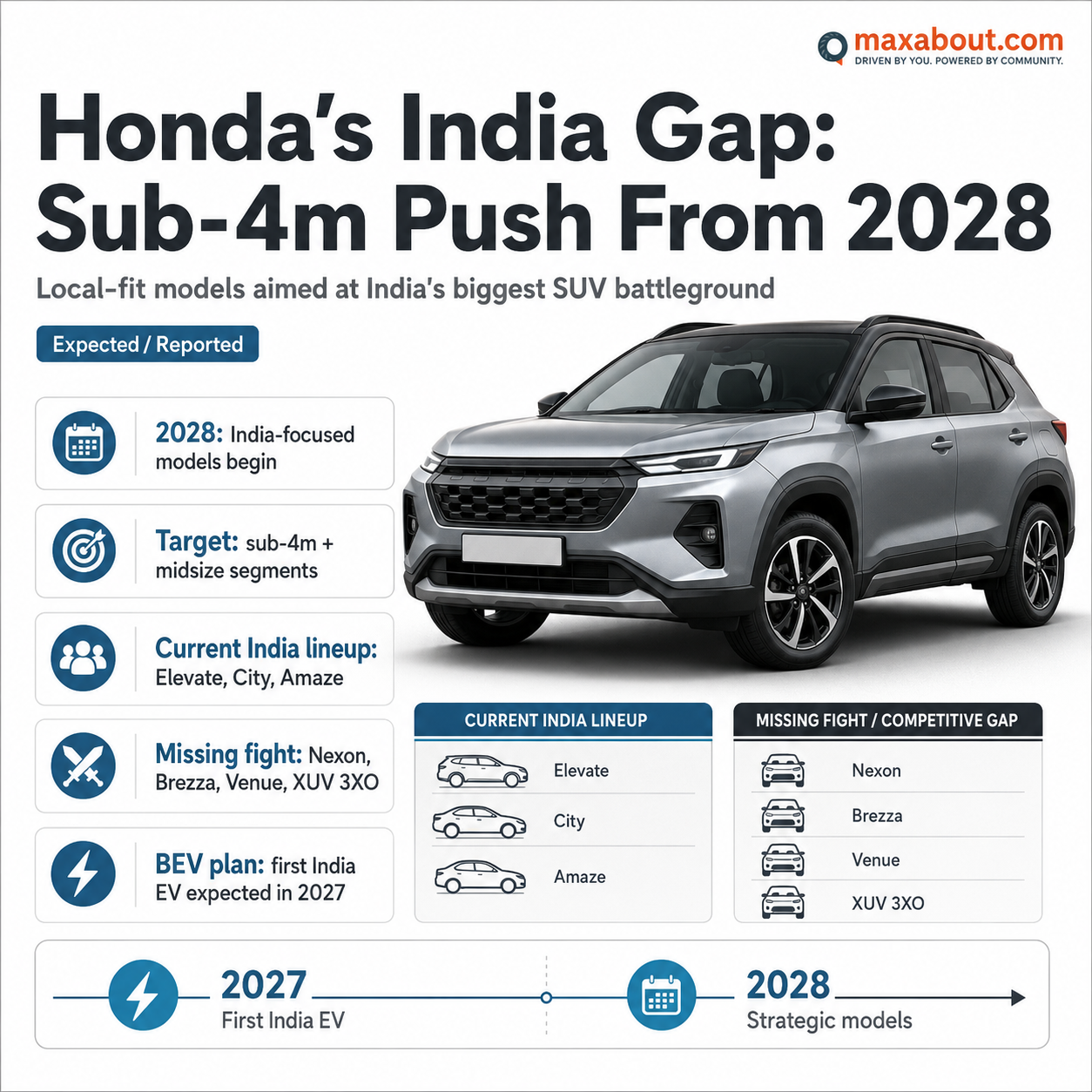 The sales numbers tell the story plainly. Models like the Maruti Brezza, Tata Nexon, Hyundai Venue, and Kia Sonet consistently sit among India's top-selling vehicles month after month. This isn't occasional demand — it's sustained, high-volume consumption driven by real purchasing decisions across Tier 1 and Tier 2 cities alike.
And the reasons make complete sense when you think about Indian daily life. Parking in Mumbai's residential colonies or navigating Bengaluru's increasingly narrow service lanes genuinely demands a compact footprint. At the same time, roads in Pune's outskirts or practically anywhere outside metro limits still throw up broken patches, unmarked speed breakers, and waterlogging — situations where ground clearance isn't a luxury, it's a necessity.
For Honda, this is both an enormous opportunity and a genuinely difficult entry point. The competition has had years to build loyalty, refine their products, and establish service trust. Arriving in 2028 means facing established players who already understand exactly what Indian buyers want here.
Honda's Current India Lineup: The Gap That's Been Hard to Ignore
Honda's India story is genuinely complicated. The City and Amaze have been reliable, well-built sedans that earned real loyalty from a certain kind of buyer — typically someone who values refinement and long-term reliability over flash. That reputation still holds. But the Indian market has shifted dramatically, and Honda's lineup simply hasn't moved with it.
The WR-V existed, briefly. It attempted to fill this compact SUV space but never really landed convincingly. Discontinued without leaving much of a mark, it felt like a half-hearted response to a segment that demanded full commitment.
What Honda currently lacks is a credible answer to the Nexon, Brezza, Venue, or Sonet — cars that younger, first-time buyers are actively choosing. That demographic isn't particularly interested in sedans. They want height, presence, and perceived value. Honda offers none of that right now in this price bracket.
Industry observations suggest Honda's overall market share in India has quietly eroded over recent years. That's not surprising when your portfolio has a visible hole exactly where buyer interest is strongest.
The quality is still there. Nobody seriously disputes that. But quality alone doesn't win segments — presence does. And in the sub-4 meter SUV space, Honda has simply been absent.
What We Know So Far: Specs, Platform, and Design Expectations
Here's where honesty matters most — very little has been officially confirmed. What exists right now is a combination of Honda's own broad strategic announcements, industry speculation, and reasonable assumptions based on how Honda typically operates. So take everything here with that understanding clearly in mind.
The most interesting question surrounding this vehicle is the powertrain. Will Honda bring a hybrid setup, or simply drop in a conventional turbo petrol engine to stay competitive on price?
From what industry reports suggest, Honda is genuinely weighing both options. Their strong hybrid system — the kind already seen in the City e:HEV — is arguably their biggest technical advantage in India right now. That car has built real credibility among buyers who prioritize fuel efficiency without wanting a full electric vehicle. Carrying that technology into a compact SUV body would be a compelling move.
That said, a strong hybrid setup adds cost. In a segment where pricing sensitivity is extreme, Honda will need to thread a very careful needle. A turbo petrol option — perhaps around 1.0 or 1.5 litres — feels more likely as a base offering, possibly with hybrid as a higher variant.
On design, Honda's recent global SUV direction offers some clues. Models like the WR-V internationally and the Elevate here in India suggest a cleaner, more mature aesthetic compared to rivals chasing aggressive styling. Expect something similarly composed — not flashy, but well-proportioned.
But again, 2028 is still some distance away. A lot can change.
Pricing Expectations and Where Honda Will Need to Position Itself to Win
This is honestly where things get complicated for Honda. Pricing a sub-4 metre SUV in India isn't just a numbers exercise — it's a tightrope walk. Price too low and you hurt your own brand perception. Price too high and buyers simply scroll past you toward the Creta or even a base Seltos.
Realistically, expect Honda to land somewhere in the ₹10 lakh to ₹15 lakh range for the standard variants. That's not a guess pulled from thin air — it's roughly where Honda's positioning logic tends to sit. The Amaze, City, and Elevate all carry a modest premium over equivalent competitors, and there's no reason to believe this SUV will break that pattern.
The problem is that ₹10–12 lakh puts Honda directly against some very established, very competitive names. Maruti Brezza, Tata Nexon, and Hyundai Venue have years of trust, service network depth, and aggressive pricing already locked in. Honda entering at similar numbers without a genuinely compelling reason to choose it over those alternatives will be a tough sell.
Then there's the hybrid question. If Honda brings a hybrid variant — which, given their global push toward electrification, feels plausible — pricing could push toward ₹14–15 lakh or beyond. The real question is whether Indian buyers in this segment are ready for that conversation.
Fuel efficiency genuinely drives purchase decisions here. On congested city roads in Bengaluru or Delhi, where you're barely moving half the time, strong mileage figures matter enormously to everyday buyers. A hybrid's promise is real and meaningful. But paying a significant premium upfront to recover savings gradually — that calculation still makes many buyers hesitant in this price bracket.
Honda will need to make that value story very clear, very early.
The 2028 Timeline: Is Honda Playing It Too Safe or Being Strategically Smart?
Four years is a long time in this segment. By 2028, Maruti, Hyundai, and Tata will have iterated through additional generations of their sub-4M offerings. Customer loyalty deepens with every service visit, every positive ownership experience. Honda is essentially asking Indian buyers to wait — and patience is not something this market is known for.
The honest concern here is compounding irrelevance. Honda already lost significant ground in the mass-market space. Every year without a credible compact SUV is another year of buyers gravitating toward competitors, building habits, and recommending those brands to family and friends.
That said, there is a reasonable argument for patience. Entering a crowded segment with a rushed, undifferentiated product would be worse than arriving late with something genuinely compelling. If Honda uses this window to develop a strong hybrid specifically engineered for Indian conditions — real-world city efficiency, reliable performance in extreme heat, sensible pricing — that justifies the delay.
By 2028, the market itself will look different. EV adoption will have progressed, though probably not dominantly so in this price bracket. Buyer sophistication will increase. A well-executed hybrid could actually land at precisely the right moment.
The risk is real, but so is the opportunity. Honda's timing only looks smart if the product is exceptional.
Honda's Strengths and Weaknesses Heading Into This Launch
Let's be straightforward here. Honda arrives at this segment with genuine advantages — but also some real vulnerabilities that deserve honest acknowledgment.
On the strengths side, Honda's reliability reputation remains one of its most durable assets in India. Owners genuinely trust the brand, and that trust took decades to build. The hybrid technology is arguably class-leading, refined through global deployments in ways competitors simply haven't matched yet. Service quality in metro cities — Mumbai, Bengaluru, Delhi, Pune — is consistently well-regarded.
The weaknesses, however, are significant. Dealer reach in Tier-2 and Tier-3 cities is noticeably thinner compared to Maruti or Hyundai. A buyer in Nagpur or Coimbatore thinking long-term about servicing convenience may hesitate. That's a legitimate concern, not a minor one.
The premium pricing perception is another hurdle. First-time SUV buyers — a massive chunk of this segment — often associate Honda with aspirational, slightly out-of-reach pricing. Competing at ₹10–15 lakh aggressively requires shifting that perception considerably.
Then there's the late mover disadvantage. Brand loyalty in this segment forms early. Buyers who chose Nexon or Creta in 2024 may not be switching in 2028 without a compelling reason.
Honda's strengths are real, but so are the gaps. Neither should be overlooked.
Should Indian Car Buyers Be Excited About Honda's Sub-4 Meter SUV Plans?
Honestly? Cautiously, yes. But with eyes open.
Honda entering this segment is genuinely interesting news. Not because the car exists yet — it doesn't — but because of what it could represent. A manufacturer with Honda's engineering reputation, potentially bringing hybrid efficiency to a price point that most Indian families can actually consider, is worth paying attention to.
That said, excitement needs to be earned. For this SUV to truly land, Honda would need to get several things right simultaneously. Pricing around ₹10–13 lakh, meaningful ground clearance for roads outside Mumbai and Bengaluru's better stretches, a strong service network in Tier 2 and Tier 3 cities, and a feature list that doesn't feel outdated against 2028 standards. That's a demanding checklist.
The buyers most likely to respond warmly are Honda loyalists who've trusted City or Amaze for years, and efficiency-conscious buyers genuinely interested in hybrid technology without paying premium SUV prices. That's a real audience.
But here's the bigger picture. More serious competition in India's sub-4 meter segment — regardless of who wins — pushes every manufacturer harder. Better features, sharper pricing, improved after-sales. Indian buyers ultimately benefit from that pressure.
2028 is still far away. A lot can change. But for now, this is a development worth watching carefully.
No comments yet
Be the first to share your thoughts!
Want to read more automotive news?
Stay updated with the latest car launches, reviews, and industry insights.
Browse All News