
Haryana EV Charger Mandate: New Building Rules Explained
Haryana has made EV charging infrastructure a mandatory part of new and renovated building planning. Under an amendment to the Haryana Building Code 2017, residential complexes will need at least one EV charging point for every five parking slots, while qualifying commercial and non-residential buil...
Editorial Team
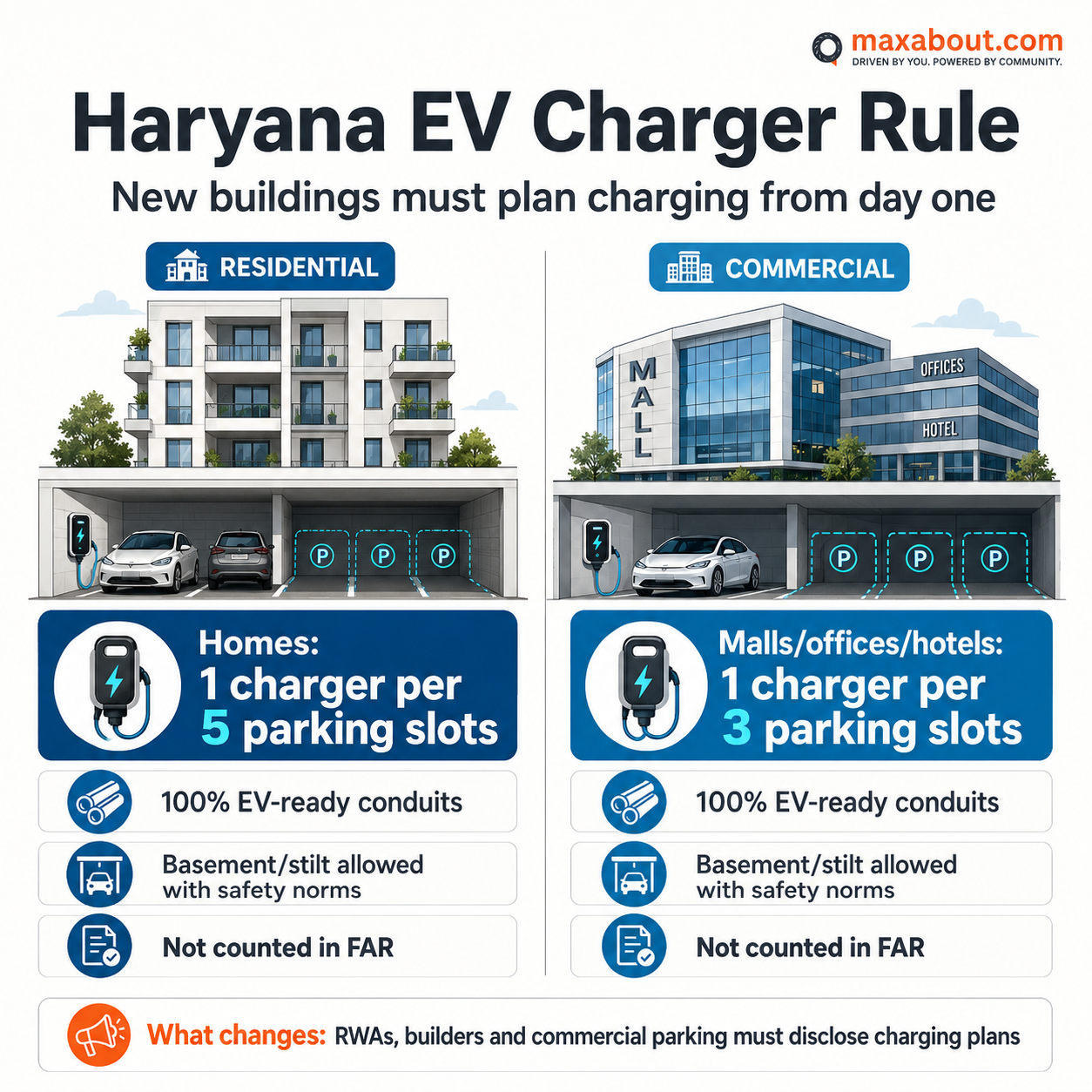
Haryana has made EV charging infrastructure a mandatory part of new and renovated building planning. Under an amendment to the Haryana Building Code 2017, residential complexes will need at least one EV charging point for every five parking slots, while qualifying commercial and non-residential buildings will need one charger for every three parking slots.
What you need to know
Residential group housing, cooperative housing projects and RWA-managed complexes must provide one EV charger for every five parking slots.
Commercial buildings such as malls, hotels and offices with parking for at least 10 cars must provide one charger for every three parking slots.
Projects must be 100 percent EV-ready with charging conduits planned into the parking infrastructure.
EV charging infrastructure will not be counted in FAR calculations, reducing one possible planning hurdle.
Basement and stilt parking chargers are allowed when electrical and fire-safety norms are followed.
Residential vs commercial charger rules
| Building type | Minimum charger ratio | Who it affects |
|---|---|---|
| Residential complexes | 1 charging point per 5 parking slots | Group housing societies, cooperative housing projects and RWA-managed complexes |
| Commercial and non-residential buildings | 1 charging point per 3 parking slots | Malls, hotels, offices and similar buildings with parking for at least 10 cars |
Why this matters for EV owners in Haryana
For EV buyers in Gurugram, Faridabad and other Haryana cities, home and workplace charging access is often more important than public fast-charger counts. A clear building-code requirement can make charging less dependent on individual negotiations with builders, RWAs or facility managers.
The 100 percent EV-ready conduit requirement is especially important. It means new projects must prepare the electrical pathway for charging infrastructure from the beginning, even if every parking slot does not immediately get a charger. That can reduce future retrofitting cost, civil work and disputes over whether a building is technically ready for EV charging.
What changes for builders, RWAs and commercial properties?
Developers will need to disclose EV charging provisions while applying for occupation certificates. For new projects, this pushes charging from a convenience feature into the approval and compliance conversation.
For existing flat owners, the reported rules allow chargers in allotted parking spaces after required electrical, fire and power-distribution certifications. This does not mean every owner can install a charger without process, but it gives apartment residents a clearer route for requesting private charging access.
Basement and stilt parking chargers are allowed with conditions
The amendment allows charging infrastructure in basement and stilt parking areas, provided the installation follows electrical and fire-safety requirements. This point matters because many urban housing societies and commercial buildings place most parking in basements or stilt areas.
Detailed fire-safety rules are still expected from the Haryana Fire and Emergency Services Department. Until those details are issued and interpreted by local authorities, residents and developers should treat installation standards, electrical load approvals and fire compliance as essential parts of the process.
What it means for the EV market
If implemented well, the Haryana EV charger mandate could reduce one of the biggest ownership barriers: uncertainty around reliable daily charging. It also gives carmakers, charging-network operators, housing societies and commercial property owners a stronger reason to plan charging capacity at the design stage rather than after residents start buying EVs.
The rule may be especially relevant for NCR commuters who live in apartment societies and depend on overnight charging. It could also make malls, offices and hotels more attractive as destination-charging locations, provided the charger quality, power availability and payment systems are practical.
FAQs
What is Haryana's new EV charger rule for residential buildings?
Residential group housing, cooperative housing projects and RWA-managed complexes must provide at least one EV charging point for every five parking slots.
What is the charger requirement for commercial buildings?
Commercial and non-residential buildings such as malls, offices and hotels with parking for at least 10 cars must provide at least one EV charger for every three parking slots.
Can EV chargers be installed in basement or stilt parking?
Yes, chargers are allowed in basement and stilt parking areas when the installation follows applicable electrical and fire-safety norms.
Does this rule guarantee a charger for every parking slot?
No. The minimum charger ratios are one charger per five residential parking slots and one charger per three qualifying commercial parking slots. However, projects must be EV-ready with conduits, which should make future expansion easier.
Haryana's EV charging amendment is a practical policy shift because it links electric mobility with real parking infrastructure. For apartment residents, RWAs, developers and commercial property managers, the next key test will be how clearly the safety rules, certification process and on-ground enforcement are implemented.
No comments yet
Be the first to share your thoughts!
Want to read more automotive news?
Stay updated with the latest car launches, reviews, and industry insights.
Browse All News