
Haryana Bans Petrol Diesel Cabs in NCR: EV Rules Explained
Haryana's Bold EV Mandate for Cab Aggregators: What Just ChangedSomething significant just happened in Haryana, and it's going to affect millions of daily commuters across the NCR. The Haryana cabinet has officially approved new rules that will ban petrol and diesel vehicles from operating under cab...
Editorial Team
Haryana's Bold EV Mandate for Cab Aggregators: What Just Changed
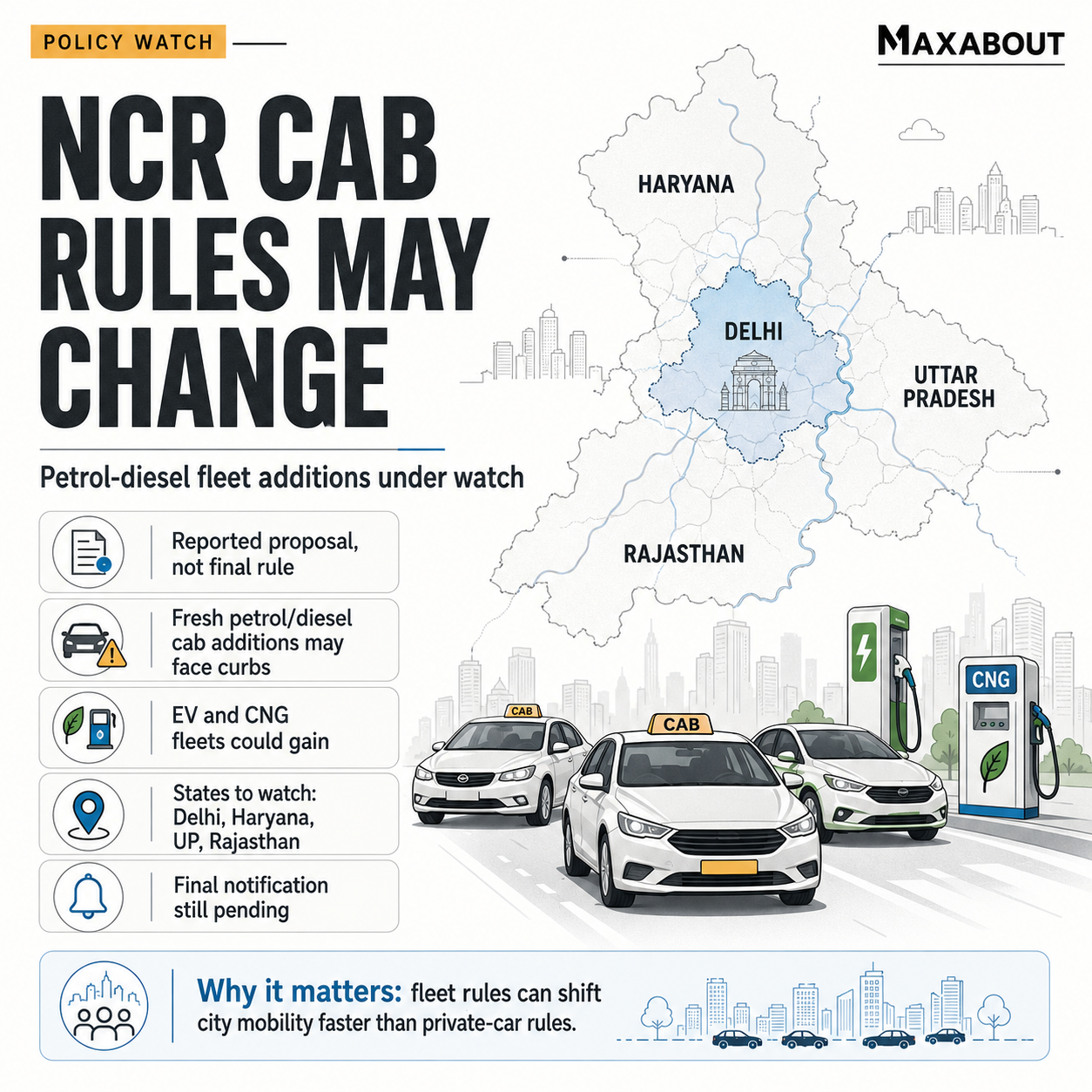
Something significant just happened in Haryana, and it's going to affect millions of daily commuters across the NCR. The Haryana cabinet has officially approved new rules that will ban petrol and diesel vehicles from operating under cab aggregator platforms in the National Capital Region. That means Ola, Uber, and every similar platform will eventually have to run fully electric fleets in cities like Gurugram and Faridabad.
Think about the scale here. On any given workday, hundreds of thousands of people across NCR depend on app-based cabs to get to offices, airports, railway stations, and hospitals. This isn't a minor tweak to existing policy. It's a structural shift in how cab-based mobility will function in one of India's most congested and polluted urban corridors.
What makes this moment matter beyond Haryana is the signal it sends. Other states are watching closely, and if this transition works, it could become a template for cities like Pune, Bengaluru, and Hyderabad.
In this article, we'll break down exactly what the new rules say, how the transition is expected to work, what it means for drivers and passengers, and honestly, where the real challenges still lie.
Which Cities and Routes Are Actually Affected
Let's get specific, because "NCR portion of Haryana" can sound vague until you map it onto real roads and real commutes. The districts covered here are Gurugram, Faridabad, Sonipat, and Panipat. If you live or work in any of these areas and rely on aggregator cabs regularly, this rule directly touches your daily routine.
The Delhi-Gurugram corridor on NH-48 is probably the single busiest stretch affected. Thousands of office commuters travelling between Cyber City, DLF phases, and central Delhi use Ola and Uber cabs every single morning and evening. That entire flow falls under this mandate.
Faridabad's industrial belt is another critical zone. Workers and mid-level professionals commuting toward Noida or South Delhi frequently use aggregator services across this corridor. Sonipat, increasingly a bedroom community for Delhi professionals, adds another layer of daily cab-dependent traffic.
From what industry observers note, the rule appears to cover both intracity operations within these districts and intercity rides originating from them. So an Uber booked in Gurugram heading to IGI Airport? Covered. A local ride within Faridabad? Also covered.
Airport travellers especially should take note. A significant share of morning airport runs from Gurugram depend entirely on aggregator fleets.
The Timeline: When Do Aggregators Actually Have to Go Electric?
This is where things get genuinely murky. The cabinet approval is real, but a clear, publicly confirmed phase-wise rollout calendar has not yet been spelled out in full detail. What we know is that the direction is set — petrol and diesel vehicles will be phased out for aggregator operations across these NCR districts. The precise cut-off dates, however, remain a work in progress at the implementation level.
And that gap matters enormously in practice.
Look at how Delhi handled its own EV transition mandates. Announcements came with great urgency. Ground reality moved far slower. Charging infrastructure lagged. Drivers resisted. Deadlines quietly shifted. The pattern is familiar enough that scepticism here is reasonable, not cynical.
The harder question is what happens to existing petrol and diesel cab owners already registered with aggregators. Are they given a grace period to upgrade? Compensated in any form? Or simply delisted once the deadline arrives? Official announcements have not addressed this clearly yet. For thousands of individual owner-drivers, that silence is genuinely worrying.
Flipping an entire regional fleet to electric is not a policy decision — it is a logistics operation spanning financing, infrastructure, and driver livelihoods. Policy announcements and ground reality rarely move at the same speed.
What This Means for Cab Drivers and Fleet Owners
Let's talk about the people this policy actually lands on. A driver in Gurugram who financed a Maruti Suzuki Ertiga CNG two years ago — monthly EMI still running, platform rating built up over hundreds of trips — now faces a hard question: what exactly happens to that vehicle, and that income, once the deadline hits?
The financial math is uncomfortable. A Tata Nexon EV starts around ₹14.5 lakh, and the Tata Tigor EV sits at roughly ₹12 lakh. These are the most visible options in the cab segment right now, and they are genuinely capable vehicles. But for an individual owner-driver already carrying an existing loan, absorbing a fresh commitment of this size is not straightforward. Banks typically require clean credit profiles and meaningful down payments. Many small fleet operators in Faridabad simply do not have that runway.
Then there is the resale problem. The moment this policy gains traction, the secondary market for petrol and CNG cabs in NCR weakens. Buyers know these vehicles lose aggregator eligibility. Resale values drop, leaving drivers stuck between an asset that has lost value and a new one they cannot easily afford.
Some central and state government FAME II subsidies do exist, and certain aggregators have announced vague transition support programs — but from what industry observers report, actual disbursement and eligibility clarity remain patchy at best.
Honestly, the policy intention is sound. Cleaner air in NCR is a legitimate goal. But good intent does not pay an EMI. Pushing this burden onto individual drivers without structured financial support feels less like a transition plan and more like a deadline with consequences.
Is the EV Infrastructure in NCR Haryana Ready for This Shift?
Let's be direct about this: the honest answer is no, not yet. The policy ambition is racing ahead of the ground reality by a significant margin, and anyone who tells you otherwise probably hasn't tried finding a fast charger in Faridabad at 11 PM.
Gurugram is the most EV-ready part of Haryana's NCR stretch, and even there, the public fast-charging network is thin. Most operational chargers are concentrated around select malls, corporate parks like Cyber City, and a handful of highway-adjacent locations. Step outside those pockets — into Sohna Road's deeper residential corridors, old Gurugram, or Manesar — and availability drops sharply. Faridabad's situation is noticeably worse. The charging infrastructure there is genuinely sparse, with most stations either under-maintained or inconveniently located for commercial operators running tight schedules.
Then there's the residential charging problem, which in my view is the most underappreciated challenge here. A large proportion of cab drivers in NCR Haryana live in rented accommodations — shared rooms, paying guest setups, densely packed colonies in areas like Nathupur or Tigra. These places have no dedicated parking, let alone a wall socket a driver could use overnight. Home charging, which is the backbone of practical EV ownership everywhere in the world, is simply not accessible for this demographic.
Compare this with Delhi, where the government has been more aggressive — at least on paper — about deploying public chargers across residential zones, bus depots, and municipal parking. Delhi's numbers still fall short of genuine adequacy, but the deployment trajectory and institutional push are visibly stronger than what Haryana has demonstrated so far.
Range anxiety adds another layer. Many cab routes from Gurugram or Faridabad extend toward Alwar, Rewari, Panipat, or even further. On these intercity stretches, fast-charging options are genuinely unreliable. A driver running a long-distance airport or outstation trip cannot afford a 45-minute charging stop mid-route — that's lost income, and it's a real operational risk that current infrastructure does not resolve.
Official targets sound ambitious, but targets and installed, functional chargers are two very different things. The infrastructure reality and the policy deadline are currently mismatched — and that gap will ultimately fall on drivers to absorb.
How This Compares to EV Policies in Delhi and Other Indian States
Haryana is not acting in isolation here. Delhi has been pushing electric mobility in commercial transport for several years, with subsidies, reduced registration fees, and explicit fleet electrification targets under its EV Policy 2020. The difference is that Delhi largely used incentives to pull aggregators toward EVs. Haryana is using a mandate to push them — a notably harder approach.
Maharashtra and Karnataka have similarly encouraged EV adoption in cab fleets, particularly around Mumbai and Bengaluru, through subsidy schemes and preferential permits. But again, encouragement is different from prohibition. Haryana appears to be moving further and faster than most states in simply banning the alternative.
The real complication is operational fragmentation. A cab booked in Delhi that drops a passenger in Gurugram crosses a state border mid-trip. These journeys happen thousands of times daily. When states maintain different compliance rules, different permit structures, and different vehicle eligibility criteria, aggregators operating across that boundary face genuine regulatory confusion — not hypothetical confusion, but practical, daily uncertainty about which rules apply when.
Whether Haryana is ahead of the curve or simply creating a policy patchwork depends entirely on whether neighbouring states coordinate. Right now, that coordination does not appear imminent.
What Cab Users Can Expect: Fares, Availability, and Wait Times
For most people booking a cab in Gurugram or Faridabad, the policy debate matters less than one simple question: will my ride cost more and take longer to arrive? Honestly, in the short term, the answer is probably yes to both.
As petrol and diesel cabs get phased out faster than EV replacements enter the fleet, expect reduced availability during peak hours. The transition window — roughly the next 12 to 24 months — is where the real friction will show. Fewer vehicles on the platform during morning office rushes or late-night returns means longer wait times, particularly in areas outside central Gurugram.
On fares, EV cab operating costs are genuinely different. Charging infrastructure, battery depreciation, and limited vehicle options at scale all factor in. Whether aggregators absorb those costs or pass them to passengers remains unclear, but historically, platforms have leaned toward the latter.
That said, there is a real upside. EV cabs are noticeably quieter, the driving experience tends to be smoother, and for a region consistently ranked among India's most polluted urban areas, cleaner air is not a small benefit. The long-term picture looks better. Getting there, however, will require patience from everyday commuters.
The Bigger Picture: Is Forced EV Transition the Right Approach for India?
This is where the debate gets genuinely complicated. India has made serious climate commitments, and the pressure to act is real. But the people most directly affected by a mandate like this are not large corporations with deep balance sheets. They are individual drivers running thin margins, often supporting families on daily earnings. That tension does not resolve easily.
Here is my honest view: commercial fleets are actually the ideal starting point for EV adoption. High daily mileage, relatively predictable urban routes, centralised parking — these conditions make the economics of EVs far more compelling than they are for private owners. If EVs are going to prove themselves at scale in India, cab fleets are the logical testing ground.
But logic and execution are different things. A well-designed policy can still stumble badly if the supporting infrastructure is not ready. Charging networks in the NCR region remain patchy. Without serious investment there, drivers face real operational anxiety that no mandate can simply legislate away.
In my view, a smarter approach would have paired this mandate with aggressive driver subsidies, low-interest fleet financing, and a public charging rollout timeline with accountability built in. Incentives alongside obligations, not obligations alone.
In the coming months, watch for how aggregators structure driver support programs, whether the state government accelerates charging infrastructure tenders, and crucially, how enforcement actually unfolds on the ground. That last part will tell us everything.
No comments yet
Be the first to share your thoughts!
Want to read more automotive news?
Stay updated with the latest car launches, reviews, and industry insights.
Browse All News