
Electric Two-Wheeler Price Hike in India: What Buyers Must Know
If you have been quietly planning to switch to an electric scooter this year, here is something worth knowing before you visit a showroom — prices have moved up, and in some cases, quite sharply. Over the past year or two, the electric two-wheeler segment in India has seen multiple price revisions t...
Editorial Team
If you have been quietly planning to switch to an electric scooter this year, here is something worth knowing before you visit a showroom — prices have moved up, and in some cases, quite sharply. Over the past year or two, the electric two-wheeler segment in India has seen multiple price revisions that caught a lot of prospective buyers off guard.
And honestly, that stings. Millions of people were looking at electric scooters as a genuine escape from rising petrol costs. The math seemed straightforward — lower running costs, fewer trips to the fuel station, and an upfront price that felt within reach. That calculation has become a little more complicated now.
Several factors have pushed prices higher. Subsidy reductions under government schemes removed a cushion that many buyers had factored in. Import duty structures on certain components added further pressure. Raw material costs, particularly for battery-grade lithium, have also played a role in squeezing manufacturer margins — some of which gets passed directly to you.
From what industry observers have noted, this is not a single-event story. It has been a gradual shift, sometimes a few thousand rupees at a time, that adds up considerably over multiple revisions.
This piece will break down what has actually changed, which segments have been hit hardest, and what a practical buyer should keep in mind right now.
Why Are Electric Two-Wheeler Prices Going Up? The Real Reasons Explained
Let's start with the most significant driver: subsidies. The FAME II scheme, which cushioned electric two-wheeler prices considerably, has been winding down and restructuring into the newer PM E-DRIVE scheme. On paper, the intent remains the same — push EV adoption. In practice, the transition period created a funding gap, and manufacturers could not absorb that gap alone. The result was straightforward: prices went up.
Popular scooters from well-known brands saw increases ranging from ₹5,000 to ₹15,000 within months of subsidy revisions. That is not a trivial jump when you are already stretching a budget to justify an electric purchase over a conventional alternative.
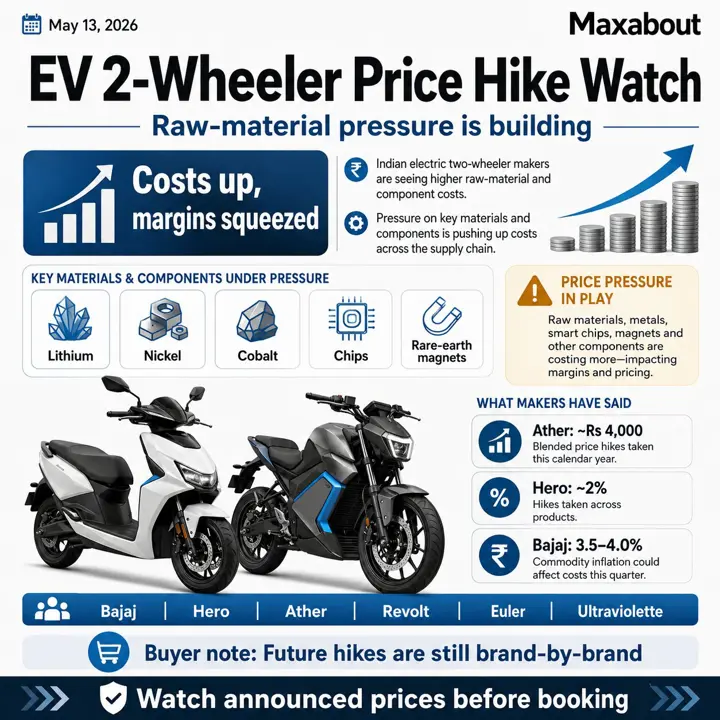 Then there is the battery situation. Globally, lithium-ion cell costs have been declining — that part is true. But in India, import duties on battery cells offset much of that global relief. Manufacturers sourcing cells internationally face a cost floor that domestic production has not yet been able to undercut meaningfully.
Localization mandates add another layer. Under domestic value addition requirements, brands must source a defined percentage of components locally. The intention is sound — build a homegrown supply chain. But in the short term, shifting supply sources costs money, and those transition costs filter down through pricing.
Currency fluctuations compound this further. A weaker rupee makes imported components — motors, controllers, certain battery management system parts — more expensive almost automatically, regardless of whatever else is happening in the market.
How Much Have Popular Electric Scooters Actually Gone Up in Price?
So what does all of this actually mean at the showroom level? Let me put some practical numbers to it.
In the mass-market segment — scooters that were originally positioned around the ₹80,000 to ₹1 lakh mark — prices have quietly but steadily climbed. Models that launched as genuinely budget-friendly options are now sitting closer to ₹1.1 lakh to ₹1.3 lakh ex-showroom. That is not a trivial shift. For a buyer stretching their budget, a ₹20,000 to ₹30,000 increase can completely change the financial calculation.
The premium segment, roughly ₹1.2 lakh to ₹1.5 lakh and above, has seen hikes too — but the percentage impact feels smaller simply because the base price is higher. In absolute terms, though, some of these models have added ₹8,000 to ₹15,000 over the past year or so, based on what industry observers have tracked.
Then there is the ex-showroom versus on-road gap, which varies considerably depending on where you live. In cities like Mumbai, Pune, Bengaluru, and Delhi, state-level policies still influence the final price meaningfully. Maharashtra and Karnataka have historically offered additional purchase incentives, which can soften the blow somewhat. Delhi buyers have also benefited from state-level support at various points.
From what recent market reports suggest, the on-road price in a subsidy-friendly state can still be ₹5,000 to ₹15,000 lower than in a state with no such provisions — a difference worth researching before you visit any showroom.
The Subsidy Situation: FAME II Is Over — What Comes Next?
If you've been following electric two-wheeler prices over the past year or so, you've probably noticed things got noticeably more expensive. A big part of that story is the end of the FAME II scheme — Faster Adoption and Manufacturing of Electric Vehicles — which ran for several years and directly reduced what buyers paid at the dealership counter.
Under FAME II, eligible electric two-wheelers received a central government subsidy linked to battery capacity. At its peak, this translated to real money off the sticker price — we're talking reductions that sometimes reached ₹20,000 to ₹30,000 per vehicle. Buyers didn't need to apply separately or claim anything later. The discount was built into the purchase price, which made it clean and straightforward.
That scheme has now wound down. What's replaced it — at least partially — is PM E-DRIVE, announced through official government channels. The intent remains supportive of EV adoption, but the structure and scale differ. Industry reports suggest the revised framework is more targeted, with tighter eligibility criteria around vehicle specifications and manufacturer compliance. For everyday buyers, that means the automatic price cushion they once enjoyed has largely disappeared at the central level.
The saving grace, for some, is state-level intervention. Maharashtra, Gujarat, and Delhi have maintained their own EV incentive programmes that partially compensate for the central subsidy pullback. Gujarat in particular has been relatively consistent with purchase-linked benefits, while Delhi has periodically refreshed its EV policy to keep momentum going.
So should you wait for better policy clarity, or buy now? Honestly, that's the difficult part. Future subsidy announcements are genuinely unpredictable, and waiting could mean missing current state schemes that may themselves expire or change. Buying now at least gives you certainty over what you're paying.
Is Buying an Electric Scooter Still Worth It Despite the Price Increase?
Let's set aside policy uncertainty for a moment and ask the more grounded question: when you run the actual numbers over three to five years, does an electric scooter still make financial sense compared to a conventional 125cc petrol scooter?
From what most long-term EV users report, the answer leans toward yes — but with important conditions attached. The upfront cost gap has widened. A reasonably specced electric scooter now sits anywhere between ₹1.1 lakh and ₹1.5 lakh post-price hikes, while a reliable 125cc petrol scooter can be had for ₹75,000 to ₹90,000. That's a meaningful difference at the point of purchase.
But the ownership math starts shifting once you factor in running costs. Based on ownership data shared widely across owner communities, charging an electric scooter daily costs roughly ₹15 to ₹25 per full charge depending on your city's electricity tariff. A petrol scooter covering the same 30–40 km daily commute will burn through fuel worth ₹60 to ₹80 at current prices. Over a year, that gap compounds significantly.
Maintenance is the other side of this equation. Electric scooters have fewer moving parts — no oil changes, no carburetor servicing, no clutch wear. From what most long-term EV users report, annual maintenance costs run noticeably lower, often saving ₹4,000 to ₹7,000 per year compared to petrol equivalents.
For city riders in Hyderabad, Chennai, or Jaipur — where stop-and-go traffic is simply everyday reality — electric scooters actually perform at their best. Regenerative braking recovers energy precisely in the conditions that drain petrol engines the hardest. Practically speaking, urban commuting is where electric two-wheelers make the strongest case for themselves.
Range anxiety, though, deserves an honest mention. Most current electric scooters offer 80 to 120 km of real-world range, which comfortably covers typical city commutes. The concern is less about daily use and more about occasional longer trips or charging access in tier 2 cities like Coimbatore or Udaipur, where public charging infrastructure remains inconsistent. Home charging largely solves this for most buyers, but it does require planning.
Battery replacement is the longer-term wildcard. Most batteries carry a 3-year or 50,000 km warranty, but replacement costs beyond that — potentially ₹20,000 to ₹35,000 — are a real consideration in a 5-year ownership plan. This single factor can meaningfully shift the cost-benefit calculation for high-mileage riders.
So the honest verdict is this: if your daily commute is under 50 km, you have home charging access, and you plan to keep the scooter for at least four years, the economics still favor electric — even at today's higher prices. If you're in a tier 2 city with limited charging options, or if you need frequent intercity flexibility, a petrol scooter remains the more practical choice for now.
Which Buyer Profile Makes the Most Sense for an Electric Two-Wheeler Today?
Knowing whether the economics work is one thing. Knowing whether you specifically are the right buyer is another. Let me break this down honestly.
The urban daily commuter is still the clearest fit. If you're riding 30–50 km a day through Bengaluru's traffic or Mumbai's crowded lanes, an electric scooter genuinely makes life easier — lower running costs, no fuel queues, and the stop-start city riding actually suits the motor's efficiency. The key requirement here is home charging access. If you live in an independent house or a society with a dedicated parking bay and a power point, you're in an ideal situation.
Apartment dwellers without that access face a real problem. Carrying a charging cable to your sixth-floor flat every night is not a sustainable habit. This is where many urban buyers underestimate the friction involved.
The tier 2 city buyer needs to be more cautious. Public charging infrastructure in smaller cities remains inconsistent, and service network coverage for electric scooters is still catching up. A single breakdown can mean days without your vehicle.
Households with a backup vehicle are well-positioned. The electric scooter handles daily duties while the second vehicle covers longer or emergency trips — a practical arrangement that removes range anxiety almost entirely.
Gig economy riders present an interesting case. High daily distances can make the fuel savings compelling, but the battery wear from aggressive daily cycles deserves serious consideration before committing.
Tips for Getting the Best Deal Right Now
Before you finalize anything, spend twenty minutes on your state government's official EV portal. Several states are still running subsidy schemes that can knock ₹5,000 to ₹15,000 off the purchase price — but these windows close without much warning. Don't assume your dealer has the latest information.
On-road prices vary more than people realize. Registration charges differ across districts and sometimes between neighboring cities. If you're near a district or state border, it's genuinely worth calling a dealer on the other side to compare final numbers.
Timing matters too. Festival season — Navratri through Diwali — is when brands typically offer exchange bonuses, complimentary accessories, or extended warranty packages. These aren't guaranteed discounts, but they add real value without touching the sticker price.
Read the battery warranty document carefully. Specifically look for capacity retention guarantees — some brands promise 70% capacity through 500 cycles, others through 800. What happens in year three or four matters as much as the headline warranty period.
Finally, find existing owners. Local forums, apartment complex groups, or even a quick conversation outside a charging point will tell you more about real-world range and reliability than any brochure. Those honest accounts are worth far more than a polished test ride on a smooth showroom stretch.
Looking Ahead: Will Electric Two-Wheeler Prices Stabilize in India?
There is cautious reason for optimism here — but it comes with honest caveats worth understanding before you make any decisions.
The structural shift that could meaningfully move prices downward is domestic battery cell manufacturing. Several gigafactory projects are now in various stages of development across India, backed partly by the government's PLI scheme incentives. If even a handful of these reach meaningful production scale within the next 18 to 24 months, the dependency on imported cells — currently a significant cost driver — should ease. Locally manufactured cells mean less currency exposure and shorter supply chains. That combination historically translates into more predictable pricing.
Globally, battery pack prices have been declining steadily over the past decade, and industry analysts broadly expect that trend to continue. India has lagged in seeing those global gains reflected at retail. But as domestic manufacturing matures, that gap should gradually narrow.
However, realism matters here. Policy continuity is never guaranteed. Subsidy structures have shifted before and could shift again. Global raw material markets — lithium, cobalt, nickel — remain volatile. Currency fluctuations add another unpredictable layer for manufacturers sourcing anything internationally.
So should you buy now or wait? Honestly, that depends entirely on your situation. If your daily commute is predictable, you have reliable charging access, and the current pricing fits comfortably within your budget, waiting indefinitely rarely makes sense. But if finances are stretched or your usage pattern is irregular, a little patience may reward you. The market is moving in the right direction — just not in a straight line.
No comments yet
Be the first to share your thoughts!
Want to read more automotive news?
Stay updated with the latest car launches, reviews, and industry insights.
Browse All News