
E22, E25, E27 and E30 Petrol Blends Get Excise Duty Exemption in India
E22, E25, E27 and E30 petrol blends have received a central excise duty exemption in India, giving higher ethanol-blended fuels a clearer path toward commercial rollout. The move follows the establishment of fuel standards for these blends and arrives soon after the introduction of E85, but motorist...
E22, E25, E27 and E30 petrol blends have received a central excise duty exemption in India, giving higher ethanol-blended fuels a clearer path toward commercial rollout. The move follows the establishment of fuel standards for these blends and arrives soon after the introduction of E85, but motorists should note one key point upfront: availability and vehicle compatibility will decide how useful these fuels are in the real world.
What You Need To Know
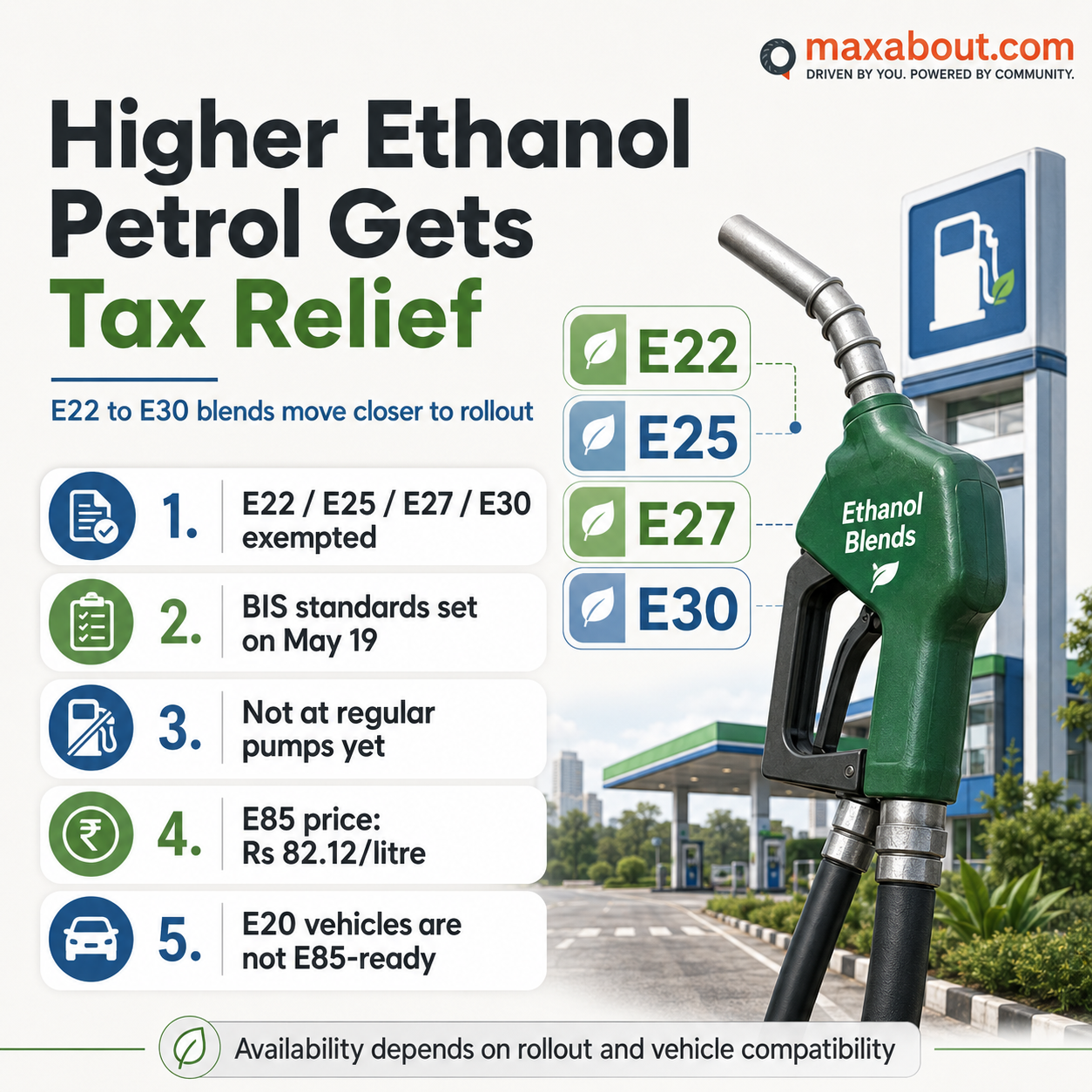
India has exempted E22, E25, E27 and E30 petrol blends from central excise duty.
Fuel standards for these higher blends were set by BIS on May 19.
These blends are not yet available at regular fuel stations.
E85 fuel was introduced separately at Rs 82.12/litre, compared with E20 petrol at Rs 102.12/litre in Delhi on June 11.
Existing E20 vehicles are not automatically suitable for very high ethanol blends such as E85.
What Are E22, E25, E27 And E30 Fuels?
The number in each blend name refers to the approximate ethanol percentage in petrol. E22 means petrol blended with 22 percent ethanol, E25 means 25 percent ethanol, and the same logic applies to E27 and E30. These blends sit above India's E20 rollout and below much higher ethanol fuels such as E85.
| Fuel Blend | Ethanol Share | Current Buyer Relevance |
|---|---|---|
| E20 | 20 percent | Current mainstream ethanol-blended petrol benchmark |
| E22 | 22 percent | Standard set; excise exemption announced |
| E25 | 25 percent | Standard set; excise exemption announced |
| E27 | 27 percent | Standard set; excise exemption announced |
| E30 | 30 percent | Standard set; excise exemption announced |
| E85 | 85 percent | Pilot rollout context; needs compatible flex-fuel vehicles |
Why The Excise Duty Exemption Matters
The exemption can make higher ethanol blends more attractive for oil marketing companies and fuel retailers once the supply chain is ready. In simple terms, a tax benefit improves the commercial case for selling these fuels, especially if they can be priced below regular petrol or E20 petrol.
The policy also fits India's broader ethanol-blending goals: reducing crude-oil imports, improving energy security, creating additional demand for agricultural feedstock, and lowering some transport emissions depending on production and use patterns.
E85 Price And Rollout Context
E85 has been introduced at Rs 82.12/litre, which is Rs 20 lower than E20 petrol's Delhi price of Rs 102.12/litre on June 11. In the short term, the rollout plan focuses on about 50-100 E85 stations across Delhi-NCR and the Mumbai-Pune-Nagpur corridor, with a target of 500 E85 dispensing stations by the end of 2026.
That price gap is attention-grabbing, but it should not be read as an immediate benefit for every petrol-car owner. E85 is a much higher ethanol blend and requires compatible vehicles.
Compatibility: Why E20 Cars Are Not E85-Ready
Current E20-compatible vehicles should not be treated as E85-compatible by default. Very high ethanol blends require additional engineering around engine calibration, fuel-system durability, corrosion resistance and material compatibility. Using the wrong fuel can create reliability risks and may affect warranty coverage.
Flex-fuel vehicles are designed for a wider ethanol range. India's early flex-fuel story includes vehicles such as the production-spec Wagon R Flex Fuel, which has been shown for commercial use, although its price has not been announced.
What It Means For Indian Buyers And Fleets
For private buyers, the near-term message is to watch compatibility labels and owner-manual guidance rather than chasing lower fuel prices blindly. For fleet operators, the combination of lower E85 pricing and dedicated flex-fuel vehicles could become interesting if station availability improves along major corridors.
The bigger transition will depend on three things: consistent fuel supply, clear vehicle compatibility, and transparent pricing at pumps. Without all three, the exemption remains a policy enabler rather than an instant consumer benefit.
FAQs
Are E22, E25, E27 and E30 fuels available at regular petrol pumps?
No. Standards and excise-duty exemption are in place, but these higher blends are not yet available at regular fuel stations.
Can an E20 car run on E85?
No. E20 compatibility does not mean E85 compatibility. E85 needs vehicles engineered and validated for very high ethanol content.
What is the E85 fuel price in India?
E85 has been introduced at Rs 82.12/litre, which is Rs 20 lower than E20 petrol's Delhi price of Rs 102.12/litre on June 11.
How many E85 stations are planned?
The short-term plan is about 50-100 stations across Delhi-NCR and the Mumbai-Pune-Nagpur corridor, scaling to 500 by the end of 2026.
The E22 E25 E27 E30 petrol blends exemption is an important step in India's ethanol roadmap, but buyers should treat it as groundwork for future rollout. The real benefit will arrive only when compatible vehicles, reliable pump availability and transparent pricing come together.
Maxabout Team
Editorial Team
Specializes in: Automotive News, Reviews, Analysis
Want to read more automotive news?
Stay updated with the latest car launches, reviews, and industry insights.
Browse All News