
CNG Price Hike in Delhi NCR: Crosses ₹80/kg Mark
It happened quietly, as these things often do. Two days, two hikes, and suddenly Delhi's CNG price has crossed ₹80 per kg — a number that would have seemed unlikely not long ago. For millions of commuters across NCR who switched to CNG specifically to escape the pain of petrol and diesel prices, thi...
Editorial Team
It happened quietly, as these things often do. Two days, two hikes, and suddenly Delhi's CNG price has crossed ₹80 per kg — a number that would have seemed unlikely not long ago. For millions of commuters across NCR who switched to CNG specifically to escape the pain of petrol and diesel prices, this feels like a gut punch.
Think about the auto driver starting his shift at 6 AM on Ring Road. Or the cab aggregator driver clocking twelve hours a day on the Delhi-Gurgaon expressway. Or the family in Dwarka that bought a CNG hatchback because the monthly fuel math made obvious sense. For all of them, this is not just a number on a pump board — it is a direct hit to take-home income and household budgets.
Two consecutive hikes in 48 hours sends a particular kind of anxiety through the commuter community. It signals instability. People start questioning decisions they were confident about.
In this piece, I want to walk through what has actually happened with CNG prices recently, run the real financial numbers for different user types, and honestly assess whether CNG still makes economic sense in 2024 — or whether the calculus is quietly shifting.
How Did We Get Here? A Quick Look at CNG Price Hikes in NCR
Let me lay out the timeline clearly, because it matters. Within a span of roughly 48 hours, IGL — Indraprastha Gas Limited, the sole distributor managing CNG supply across Delhi-NCR — revised prices twice in succession. The cumulative effect pushed Delhi's CNG rate past the ₹80 per kg mark, a threshold that would have seemed almost unthinkable just a couple of years ago.
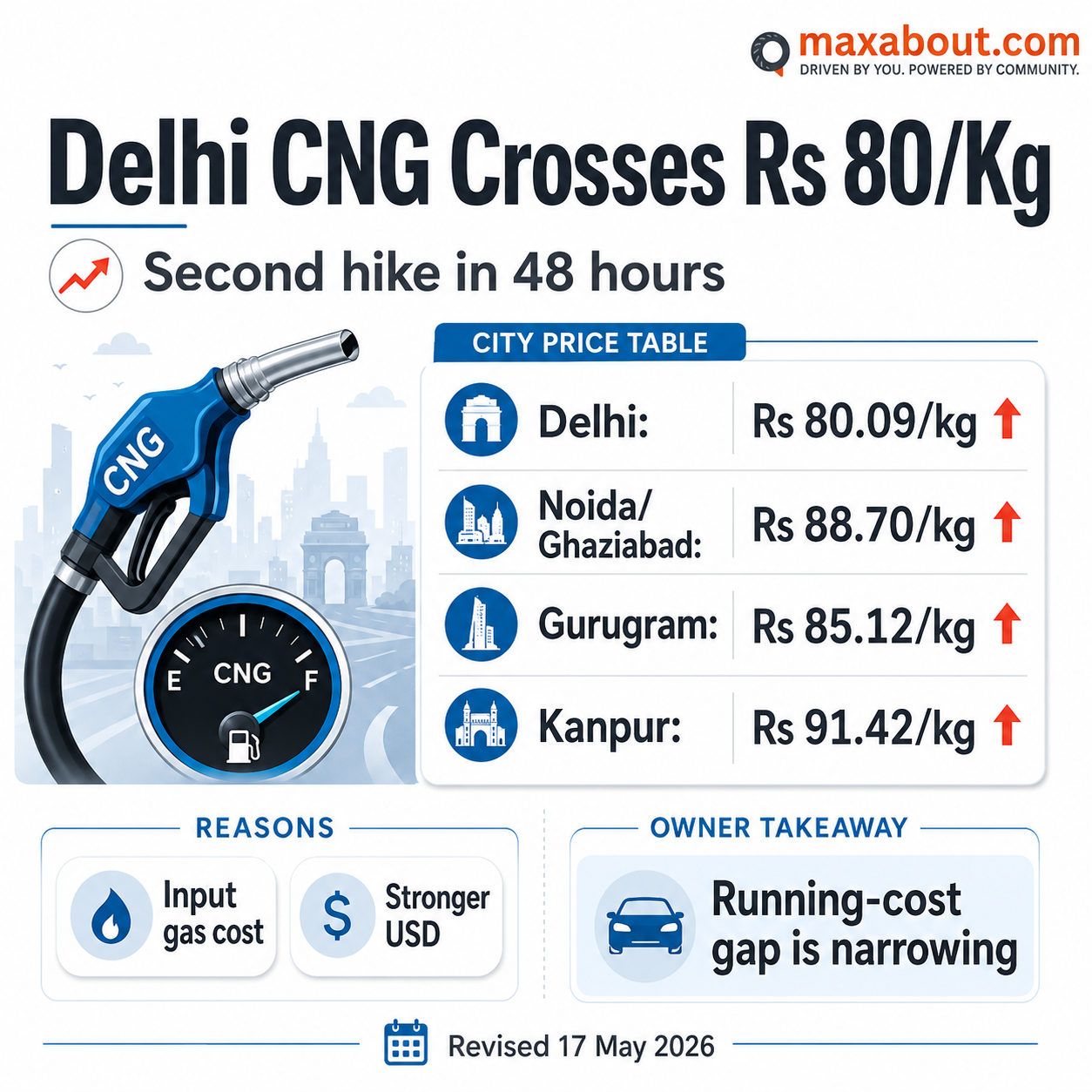 Cast your mind back to 2020 and 2021. CNG was genuinely exciting. It sat comfortably in the ₹42–₹45 per kg range in Delhi, and people were switching from petrol cars in significant numbers. The math was obvious and the environmental case felt like a bonus on top of real savings.
Then the creep began. Upstream natural gas costs — largely tied to global commodity prices and government allocation policies — started climbing. IGL, like other city gas distributors, passes those input costs downstream. By 2022 and into 2023, prices had already crossed ₹70 per kg through a series of smaller revisions. Each hike drew complaints, but people absorbed them.
What makes this latest round feel different is the back-to-back nature of it. Two increases in two days signals something more volatile than routine adjustment — it suggests the pressure upstream is acute right now, not gradual.
The Real Financial Hit: Breaking Down the Monthly Cost for CNG Car Owners
Let's get into the actual numbers, because that's what really matters when you're filling up every week.
Take a Maruti Wagon R CNG, one of the most common sights on Delhi roads. It returns roughly 20-21 km per kg in real-world urban conditions — not the ARAI figure, but what most owners actually see navigating stop-start traffic between Gurgaon and Connaught Place. At ₹80/kg, here's what a typical month looks like:
Monthly distance: ~1,400 km (a reasonable NCR average)
CNG consumed: ~67 kg (at 21 km/kg)
Monthly fuel bill: approximately ₹5,360
Now compare that against running the equivalent petrol variant. Petrol in Delhi currently sits around ₹94-95 per litre. The petrol Wagon R manages roughly 18 km per litre on city roads. The same 1,400 km would consume about 78 litres — costing you nearly ₹7,400 per month. So the saving is still real, around ₹2,000 monthly.
But here's where it gets uncomfortable. The CNG variant costs roughly ₹85,000–₹1 lakh more at the showroom. At ₹2,000 saved per month, you're looking at a break-even period of 42-50 months — three and a half to four years. Until recently, that figure hovered closer to 30 months. The math still works, but the patience required has grown considerably.
Is CNG Still Worth It? Honest Pros and Cons After the Price Hike
The short answer is: yes, but with more caveats than before. Let me break this down honestly.
Even at ₹80/kg, CNG still delivers a lower cost-per-kilometre than petrol sitting above ₹95 in Delhi. That fundamental advantage hasn't disappeared. Emissions are meaningfully lower too, which matters if you're navigating odd-even restrictions or simply want a cleaner conscience about your daily commute through Connaught Place or the Delhi-Meerut Expressway. Resale value for factory-fitted CNG variants also holds reasonably well in metro markets, where buyers understand the fuel equation.
But the cons are harder to dismiss now. The price gap with petrol has visibly shrunk, and that changes the conversation. Beyond the numbers, practical ownership frustrations are real. Boot space in factory CNG cars is genuinely compromised — that cylinder isn't going anywhere. And refueling infrastructure outside Delhi proper remains patchy. Anyone who's sat in a 45-minute queue at a CNG station in Noida's Sector 62 or near Gurgaon's Rajiv Chowk during morning peak hours knows exactly what I mean.
Highway trips bring their own anxiety. CNG range is limited, stations are sparse once you leave city limits, and the fallback to petrol mode defeats the purpose somewhat.
Perhaps the most underappreciated frustration, though, is psychological. Many buyers specifically chose CNG to escape fuel price volatility. That was the promise — stability while petrol swung wildly. Two hikes in two days makes that promise feel increasingly hollow. The savings exist, but the sense of insulation? That's quietly eroding.
The Ripple Effect: Auto Drivers and Cab Operators Caught in the Middle
Private car owners have it tough, but at least they have choices. The people who genuinely have nowhere to turn are the auto rickshaw drivers and cab operators who run their entire livelihood on CNG. In Delhi-NCR, that's hundreds of thousands of people.
Consider a typical Ola or Uber driver completing eight to ten trips daily across Gurugram or Noida. Every ₹2 to ₹3 hike per kilogram directly cuts into daily earnings — money that doesn't come back without a corresponding fare revision. And fare revisions from aggregators? They notoriously lag behind fuel cost increases by weeks, sometimes months. During that gap, drivers absorb the difference themselves. There's no mechanism to protect them in real time.
Auto rickshaw drivers face an even harder reality. Delhi auto fares are government-regulated, which means drivers cannot unilaterally charge more. They're locked into rates that haven't kept pace with this kind of sudden, consecutive price movement. Two hikes in two days leaves them with no legal recourse and no buffer.
This is where the fuel price story becomes genuinely human. These aren't abstract percentage increases — they translate directly into a driver finishing the day with less than he needed to cover his family's expenses. That's the ripple effect that rarely makes the headline.
Should You Still Buy a CNG Car in 2024? Honest Advice for NCR Buyers
If you're currently weighing options between the Maruti Wagon R CNG, Hyundai Grand i10 Nios CNG, or Tata Tiago CNG, this price movement deserves your attention — but it shouldn't necessarily change your decision. Context matters enormously here.
Your monthly mileage is the single most important number. From what industry analysts consistently highlight, if you're driving 1,500 km or more per month within city limits, CNG still delivers meaningful savings even at ₹80/kg. The math holds up. Petrol at current NCR rates makes that kind of daily commuting genuinely expensive over time.
However, if you're driving under 800–900 km monthly, or if highway trips are a regular part of your routine, the case weakens considerably. CNG infrastructure on national highways remains patchy. Running out of CNG between stations and switching to petrol mode frequently defeats the entire financial purpose.
One thing worth being firm about: always choose factory-fitted CNG over aftermarket kits. Manufacturer-integrated systems offer better safety standards, warranty coverage, and smoother engine integration. The saving from an aftermarket kit rarely justifies the trade-offs.
Some buyers may reasonably prefer a wait-and-watch approach right now, given two consecutive hikes within 48 hours. That instinct isn't wrong.
Also worth evaluating seriously — electric vehicles are becoming increasingly competitive in exactly this segment for city commuters. The calculation is shifting faster than most people expect.
What Can Regulators and Automakers Do? The Bigger Picture
Step back for a moment and this situation becomes more complex than just pump prices. CNG pricing in India is deeply tied to domestic natural gas allocation policies and the cost of imported LNG, which has been genuinely volatile globally over the past two years. When international gas markets spike, that pressure eventually flows downstream to city gas distribution networks — and ultimately to the person filling up at the CNG station.
The government has historically offered subsidized gas allocations to city gas distributors, which kept retail prices stable. Those policies have evolved considerably, and the buffer that once absorbed global shocks has thinned. That's a policy conversation worth having openly.
From the automaker side, manufacturers are still expanding their CNG portfolios because demand signals remain strong. But sustained price hikes could genuinely slow adoption — particularly among first-time buyers who made the switch based on affordability promises that now look shakier.
The real question is whether India needs a more stable, predictable pricing mechanism for city gas — something that protects millions of urban commuters and small transport operators who restructured their finances around CNG economics. These aren't casual users. They made real commitments.
That stability doesn't have to mean permanent subsidies. It could mean price bands, longer revision cycles, or clearer communication. Two hikes in 48 hours, without warning, undermines trust in ways that are hard to rebuild.
The Bottom Line: CNG Is Still Ahead, But the Cushion Is Thinning
At ₹80/kg, CNG still beats petrol on per-kilometre cost in Delhi-NCR. That much is true. A typical CNG car running 15 km per kg comes out meaningfully cheaper than its petrol equivalent at current fuel prices. The math hasn't flipped — not yet.
But the margin that once made this decision obvious has quietly narrowed. Two or three years ago, the CNG advantage was wide enough that you barely needed a calculator. Today, you do.
For existing CNG owners, the practical advice is straightforward — optimize where you can. Shorter queues at off-peak hours, well-maintained fuel systems, and sensible trip planning all help squeeze more value from each kilogram. There is no dramatic action required, just tighter habits.
For anyone currently weighing a CNG purchase, the calculus now demands more honesty. Factor in potential further hikes, not just today's rate. The savings are real but no longer guaranteed to grow.
Whether CNG holds its value proposition over the coming months depends almost entirely on how frequently these revisions continue. One or two more hikes of this scale, and the conversation changes meaningfully. That is worth watching closely before committing.
No comments yet
Be the first to share your thoughts!
Want to read more automotive news?
Stay updated with the latest car launches, reviews, and industry insights.
Browse All News