
Bharat NCAP Retested 7 Cars Before Results: What It Means
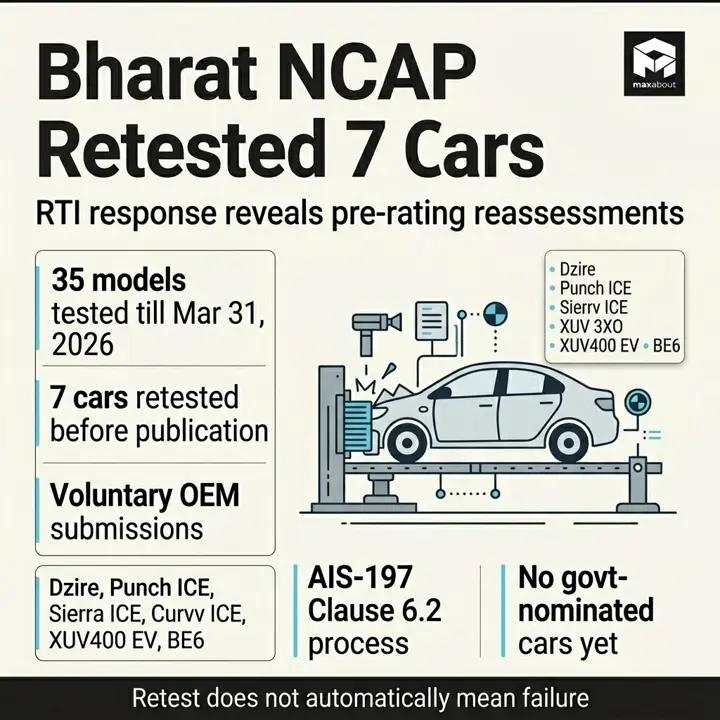
Something quietly significant happened before Bharat NCAP published its latest batch of crash test results. Seven cars were retested. Not one, not two — seven. That number alone should make you pause and think about what it means for the safety ratings we rely on when choosing a family car.For those...
Editorial Team
Something quietly significant happened before Bharat NCAP published its latest batch of crash test results. Seven cars were retested. Not one, not two — seven. That number alone should make you pause and think about what it means for the safety ratings we rely on when choosing a family car.
For those unfamiliar, Bharat NCAP is India's own New Car Assessment Programme — a crash testing framework designed specifically around Indian market vehicles and conditions. It awards star ratings based on how well a car protects adult occupants, child passengers, and pedestrians during a collision. Think of it as a structured, scientific answer to the question every car buyer quietly asks: will this vehicle keep my family alive in a serious accident?
Retesting this many vehicles before releasing official results is genuinely unusual. Crash testing is expensive, time-consuming, and technically demanding. You don't redo it casually. So when seven cars go back through the process, it raises real questions worth asking honestly.
Here's what makes this particularly relevant right now. Transparency around vehicle safety is still a fairly new conversation in India. Many buyers are only just beginning to check star ratings before purchasing. The credibility of Bharat NCAP's process matters enormously — and this development deserves a closer, clearer look.
Understanding Why Bharat NCAP Decided to Retest
The official position from Bharat NCAP points to procedural refinements and protocol standardisation as the primary drivers behind the retesting decision. From what industry reports suggest, this was not triggered by a single dramatic failure but rather a process of internal review that identified inconsistencies in how certain test parameters were being applied across vehicles.
 There appear to be a few distinct possibilities worth separating clearly. First, some manufacturers may have requested retesting after initial results — something that is permitted under certain conditions within the programme's framework. Second, there is a possibility that data discrepancies emerged during technical review, prompting officials to repeat specific assessments rather than validate questionable numbers. Third, and perhaps most likely given the timing, Bharat NCAP may have updated specific testing protocols and needed fresher results to reflect those changes accurately.
What is confirmed versus what is speculative matters here. The retesting itself is confirmed. The exact vehicle-specific reasons remain less transparent publicly.
Retesting can cut both ways. Done with clear communication, it actually strengthens credibility — it signals that the programme refuses to let questionable data stand. Handled poorly or without explanation, it invites doubt. Right now, Bharat NCAP sits somewhere between those two outcomes, and how officials communicate the reasoning will largely determine public trust going forward.
Which Cars Were Retested and What We Know About the Results
Seven vehicles went through Bharat NCAP's retesting process, spanning segments that collectively represent a massive chunk of Indian car sales. These are not obscure models — they include cars that lakhs of families are actively considering or already own.
The retested vehicles include the Maruti Suzuki Swift, Volkswagen Taigun, Skoda Kushaq, Hyundai Exter, Citroen C3, Kia Sonet, and the Mahindra Thar Roxx. That list alone tells you how broad this situation is — you have entry-level hatchbacks sitting alongside popular compact SUVs and even a lifestyle off-roader.
The Swift matters enormously because it targets first-time buyers. A safety rating here directly influences purchase decisions for budget-conscious families. The Taigun and Kushaq share platforms and appeal to buyers stepping up into the mid-size SUV space, where safety credentials are increasingly part of the conversation. The Exter and Sonet compete in the sub-four-metre SUV segment — one of India's most hotly contested categories right now.
As of official announcements, revised results have been published for these models, though specific score changes varied across the group. Some retained their original ratings while others saw adjustments. The broader takeaway is that these are high-visibility nameplates, and any shift in their ratings — even minor — carries real weight in how buyers perceive value and safety together.
How Crash Testing Works Under Bharat NCAP: A Quick Breakdown
Before diving deeper into what these retests mean, it helps to understand how Bharat NCAP actually evaluates a car. The process is more rigorous than many people assume.
At its core, Bharat NCAP puts vehicles through three primary impact tests. The frontal offset impact simulates a head-on collision — the kind that happens far too often on Indian highways. The side impact test replicates a lateral crash, relevant given how frequently intersection accidents occur in cities like Delhi and Pune. There is also a pole impact test, which checks how the car protects occupants when it strikes a narrow fixed object.
Scores are split into two categories: Adult Occupant Protection and Child Occupant Protection. Both matter independently. A car can score well for adults but poorly for child safety — and that distinction is important for families.
The final rating runs from zero to five stars, with five being the benchmark for strong protection. Indian road scenarios — including high-speed rural highway crashes and urban low-speed impacts — informed several test parameters, which gives Bharat NCAP a practical, locally relevant edge.
Compared to Global NCAP, Bharat NCAP follows a broadly similar framework but is administered domestically, making compliance and accountability more direct for manufacturers selling here.
Should Indian Car Buyers Trust Bharat NCAP Ratings After This?
This is genuinely a mixed picture, and I think it deserves an honest look from both sides rather than a quick verdict.
The argument in favour of retesting is actually reasonable. Any credible safety assessment body needs room to correct procedural errors, equipment anomalies, or specimen-related inconsistencies before publishing final results. From what I can see, if Bharat NCAP retested cars to ensure accuracy rather than convenience, that reflects a commitment to getting the numbers right. Global programs like Euro NCAP have faced similar procedural debates in the past, and they emerged stronger for addressing them transparently.
But the concern worth acknowledging is this — without clear, public documentation explaining exactly why each retest was ordered, the process risks looking opaque. That perception alone can erode trust, regardless of intent.
In my view, the healthiest approach for buyers is to treat Bharat NCAP ratings as a useful starting point, not the final word. Cross-reference with real-world ownership feedback from long-term users, insurance claim settlement data, and reliability patterns reported across Indian driving conditions. Ratings tell you about controlled crash performance. Ownership communities tell you everything else.
Use the rating. Just don't use it in isolation.
What This Means for the Car Manufacturers Involved
For the automakers whose vehicles went through retesting, the stakes could not be higher. A Bharat NCAP star rating is no longer just a safety credential — it has become a sales tool. Manufacturers know this. Their marketing teams know this. And increasingly, Indian buyers know this too.
A five-star result gets splashed across showroom banners, television ads, and digital campaigns within days. A poor rating, on the other hand, can quietly stall a model's momentum — especially in fiercely competitive segments where three or four similarly priced rivals are all fighting for the same buyer's attention.
This is precisely why so many manufacturers have been investing heavily in structural reinforcement, improved airbag configurations, and electronic safety systems — not just because regulations demand it, but because the rating directly influences purchase decisions. Safety has become a genuine differentiator in a way it simply was not five years ago.
The pressure is real. Indian buyers, particularly in urban markets, are increasingly walking into showrooms asking pointed questions about crash test performance. That shift in consumer behaviour has pushed manufacturers to treat Bharat NCAP preparation as a serious engineering priority, not an afterthought.
Retesting adds another layer of scrutiny to that entire process.
Practical Advice: How to Use Safety Ratings When Buying a Car in India
A five-star Bharat NCAP rating is genuinely meaningful. But it is not the whole story, and treating it as one is where many buyers go wrong.
Star ratings measure how a vehicle performs in controlled crash scenarios. They do not measure how well a car handles a sudden swerve on the Bengaluru outer ring road at 80 kmph, or whether the brakes respond predictably on a rain-soaked Mumbai flyover. That gap matters enormously in real Indian driving conditions.
Always look beyond the headline number. Check whether the variant you are actually buying — not the top-spec model submitted for testing — comes equipped with Electronic Stability Control, six airbags, and a functioning ABS setup as standard. Manufacturers sometimes test fully loaded variants. The base trim sitting in the showroom may tell a different story.
Speed breakers, potholes, and stop-start city traffic also stress a vehicle's structure over time in ways no crash test replicates. Owner forums and long-term workshop feedback often reveal stress fractures, suspension wear patterns, and structural concerns that ratings simply cannot capture.
Cross-reference Bharat NCAP results with insurance claim frequency data and real owner experiences before finalising anything. A four-star car with ESC, six airbags, and strong owner feedback may genuinely protect you better than a five-star rating without those active safety features included as standard.
Use the rating as a strong starting point. Nothing more, nothing less.
Final Thoughts: A Step Forward for Road Safety Accountability in India
Think about where India stood just a decade ago. No independent crash testing. No public ratings. Manufacturers could sell structurally weak cars with almost zero accountability. The fact that we now have Bharat NCAP retesting vehicles before publishing results — however imperfect that process might be — represents genuine progress.
Retesting is complicated. It raises fair questions about consistency and manufacturer influence. But ultimately, any mechanism that forces carmakers to think harder about structural integrity is worth having. Even an imperfect system creates pressure that simply did not exist before.
Going forward, the responsibility is shared. Buyers should treat ratings as informed starting points rather than final verdicts. Manufacturers should pursue safety genuinely, not just chase stars. And Bharat NCAP itself must continue strengthening its protocols — greater transparency around retesting criteria would help enormously.
India's roads are unforgiving. Potholes, highway fatigue, unpredictable traffic — our conditions demand cars built with real structural honesty. Bharat NCAP, for all its growing pains, is pushing that conversation forward. That matters more than any single rating ever could.
No comments yet
Be the first to share your thoughts!
Want to read more automotive news?
Stay updated with the latest car launches, reviews, and industry insights.
Browse All News