
Bharat NCAP Retest Debate: Safety or Marketing?
When a car scores poorly on a safety test, should the manufacturer get a second chance? It sounds like a reasonable question — until you realize that millions of Indian families are making ₹8 lakh to ₹25 lakh purchasing decisions partly based on those ratings.Bharat NCAP launched in 2023 as a genuin...
Editorial Team
When a car scores poorly on a safety test, should the manufacturer get a second chance? It sounds like a reasonable question — until you realize that millions of Indian families are making ₹8 lakh to ₹25 lakh purchasing decisions partly based on those ratings.
Bharat NCAP launched in 2023 as a genuine landmark. For the first time, India had its own crash testing protocol designed around Indian road realities — our speeds, our road conditions, our vehicle mix. Families driving on the Mumbai-Pune Expressway or navigating the chaotic stretches of the Delhi-Meerut Expressway finally had a local safety benchmark to reference.
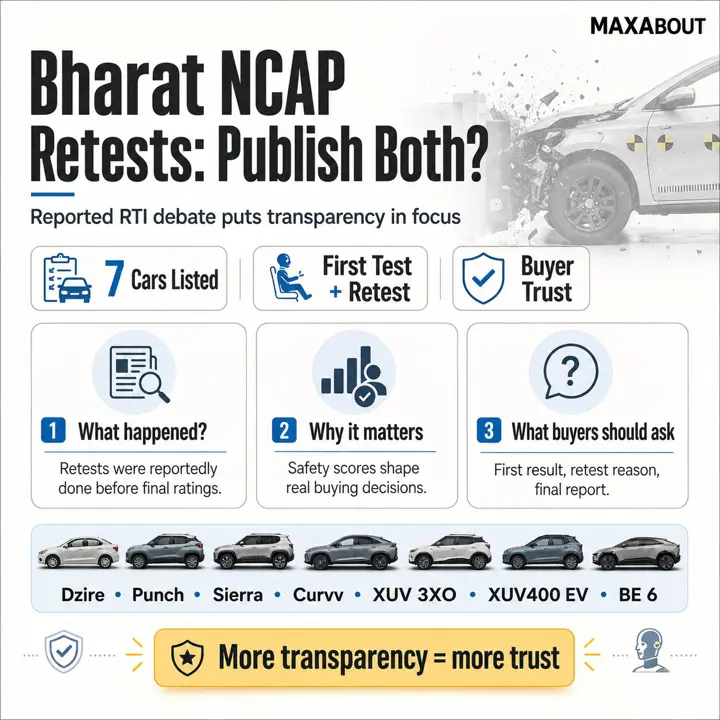
But a quiet controversy has been building. The debate around manufacturer retesting — allowing carmakers to submit updated vehicles for re-evaluation after an initial poor result — raises uncomfortable questions. Does a retest reflect genuine safety improvement, or does it simply let brands polish their scores for marketing purposes?
Indian buyers are more safety-aware than ever before. High-profile highway accidents, widely shared on social media, have made families genuinely scrutinize safety ratings before signing on the dotted line. That shift in consumer behavior is exactly why the integrity of Bharat NCAP's process matters so deeply right now.
What Bharat NCAP Actually Tests and How the Rating System Works
Before diving deeper into the retest debate, it helps to understand what Bharat NCAP is actually measuring. Because without that foundation, star ratings are just numbers on a brochure.
Bharat NCAP evaluates vehicles across three broad categories. Adult Occupant Protection looks at how well the car shields the driver and front passenger during a collision. Child Occupant Protection assesses rear seat safety, particularly for children using child restraint systems. And Safety Assist Technologies covers features like Electronic Stability Control, speed reminder systems, and seatbelt reminders — things that help prevent accidents in the first place.
 Each category carries a separate score, and those scores combine to produce the final star rating. A vehicle can technically earn five stars overall while still performing unevenly across individual categories. That nuance often gets lost when brands splash the headline number across advertisements.
Now, here is where the comparison with other testing programs becomes important. Euro NCAP — widely considered the global benchmark — uses significantly more demanding test conditions. Impact speeds are higher, test configurations are more complex, and the technology requirements are stricter. A five-star Euro NCAP result genuinely represents world-class occupant protection.
Bharat NCAP, by design, is calibrated for Indian market realities — local manufacturing standards, price sensitivity, and the fact that many buyers are only now gaining access to basic safety features. That is not a criticism. It is a practical approach. But it does mean a five-star Bharat NCAP rating and a five-star Euro NCAP rating are simply not equivalent, regardless of how similar they look on paper.
ASEAN NCAP sits somewhere in between, serving developing markets across Southeast Asia with protocols moderately stricter than Bharat NCAP but less demanding than Euro NCAP's full battery of tests.
Understanding this hierarchy matters enormously when a manufacturer retests a vehicle and achieves a higher score. Was the improvement meaningful by any global standard? Or did it reflect a targeted adjustment just sufficient to clear Bharat NCAP's specific thresholds? Those are the kinds of questions that transparency in the retest process could actually answer.
The Retest Provision: What It Allows and Why It Sparked Controversy
Bharat NCAP's guidelines do include a formal provision allowing manufacturers to request a retest after an initial assessment. The official reasoning is straightforward enough: give manufacturers an opportunity to identify structural or safety system shortcomings, make corrections, and submit an updated variant for fresh evaluation. On paper, this sounds reasonable. No program wants to permanently penalize a manufacturer for a fixable problem, especially when the stated goal is improving overall fleet safety across Indian roads.
But here is where the controversy quietly begins. The guidelines place relatively limited public scrutiny on what exactly changed between the original test and the retest. A manufacturer can modify calibration settings, adjust airbag deployment timing, or make targeted structural reinforcements — then present the updated vehicle for reassessment. If the score improves, that higher rating becomes the publicly visible result. The earlier, lower score often receives far less attention.
Critics ask a pointed question: is the vehicle being retested genuinely representative of what buyers find in showrooms? That concern is not trivial. A pre-production or specially prepared sample could theoretically reflect changes that never fully reach mass-manufactured units rolling off assembly lines in Pune or Chennai.
Some international programs handle this more firmly. Euro NCAP, for instance, applies strict conditions around retesting and mandates detailed disclosure of any technical changes made between assessments. That level of accountability ensures the rated vehicle closely mirrors what the general public actually purchases.
Bharat NCAP's current framework does not yet impose equivalent disclosure requirements — and that gap is precisely what consumer advocates find troubling.
The Transparency Gap: What Information Is Being Withheld and Why It Matters
Here is the core problem. When Bharat NCAP publishes a star rating, most buyers see a number and nothing else. Five stars feels safe. Three stars feels concerning. But the rating alone tells you almost nothing about how that result was actually achieved.
Was this the manufacturer's first submission, or a second attempt after an initial failure? What specific changes were made to the vehicle before it was resubmitted? Does the tested variant — with its particular trim level, seat configuration, and optional safety equipment — actually represent the version that most Indian families will drive home from a dealership? None of this information is consistently disclosed in a format that ordinary buyers can access and understand.
That absence of detail matters enormously. Indian consumers have historically placed significant trust in official certifications and government-backed ratings. From fuel efficiency labels to pollution compliance stickers, people tend to accept these markers at face value — reasonably so, because digging deeper requires time, technical knowledge, and access to information that is rarely available in plain language.
In Europe, this problem has largely been addressed. Euro NCAP publishes complete technical datasheets, including the exact vehicle configuration tested, a full breakdown of scores across every assessment category, and a clear record of any retest history. A buyer in Germany or France can trace exactly what was evaluated and compare it against the specific variant they intend to purchase.
Indian buyers deserve the same clarity. A star rating without supporting context is not really consumer information — it is closer to a marketing asset.
The Manufacturer Perspective: Is There a Valid Case for Retesting?
To be fair, this debate is not entirely black and white. Manufacturers are not wrong to want a second chance — at least not always.
Consider a genuine scenario: an early production sample gets submitted for testing, and that specific unit has a documented assembly-line defect that the manufacturer had already identified and corrected before full-scale commercial rollout. Should one flawed sample permanently define the safety reputation of a vehicle that has since been improved? That is a reasonable question, and dismissing it entirely would be intellectually dishonest.
There is also the engineering investment angle. Improving passive safety systems — better crumple zones, stronger cabin structures, more precise airbag deployment timing — is not cheap. These are significant re-engineering efforts that take months of development and testing. When a manufacturer genuinely commits to this work and wants that effort reflected in an updated rating, the argument for retesting has real merit.
The commercial pressure is real too. In a price-sensitive market like India, a poor star rating does not just hurt brand image — it can directly collapse sales volumes for an otherwise competitive product. That is a brutal reality for any business.
But here is the tough question the system has not yet answered clearly: does the consumer ever get to know which version of the car was rated, and when? Good intentions from manufacturers mean very little if the process itself remains opaque.
What Good Transparency Looks Like: Lessons From Global Safety Programs
That question — about which version was tested, and when — is exactly where global programs have built real accountability into their processes. It is worth looking at what they actually do, not just in principle, but in practice.
Euro NCAP is probably the clearest benchmark here. Every test result comes with a full technical report that specifies the exact vehicle variant tested, including trim level, optional safety equipment fitted, and body style. If a manufacturer submits a car for retesting, Euro NCAP clearly labels the new result as a retest and keeps the original score visible alongside it. Consumers can see both numbers. There is no quiet replacement of a bad result with a better one.
Australia's ANCAP follows a similar approach. Retest disclosures are explicit, and critically, they publish whether the retested vehicle had any specification changes compared to the first submission. That matters enormously — because a car that earned five stars after modifications is a fundamentally different product from one that earned five stars on the first attempt with standard equipment.
NHTSA in the United States goes further in one specific area: it publicly documents which variant is the least-equipped version available to retail buyers, and whether that exact variant was the one tested. This directly addresses the nagging concern that showroom buyers might be purchasing a base model that never actually went through the rated configuration.
Bharat NCAP does not need to replicate every element overnight. India's regulatory bandwidth and testing infrastructure are genuinely different. But publishing the tested variant's full specification sheet and clearly labeling retest results are two steps that require no additional investment — only policy intent.
What Indian Car Buyers Should Do Right Now
Policy changes take time. Your purchase decision probably does not. So here is how to protect yourself in the interim.
The star rating on a Bharat NCAP poster is a starting point, not the full answer. Ask specifically which variant was tested. A top-spec trim earning five stars tells you very little about the base variant you are actually considering. Dealers can look this up — push them to do so.
Beyond the headline rating, dig into the category scores. Side impact performance, pole test results, and child occupant protection scores reveal far more than a single number. A car can average out to four stars while performing poorly in one area that genuinely matters to your family situation.
On the features side, verify three things independently before signing anything:
Six airbags — standard fitment or a paid option on your chosen trim
ESC (Electronic Stability Control) — often omitted on entry variants
ISOFIX child seat anchors — particularly relevant for young families
None of this requires technical expertise. It only requires asking direct questions and waiting for direct answers. If a dealer cannot confirm which exact trim was crash-tested, that hesitation itself tells you something worth knowing.
The Road Ahead: Can Bharat NCAP Earn the Trust It Deserves?
Bharat NCAP is young. That is worth remembering before passing any final judgment. The program has done something genuinely difficult — it has made car safety a real conversation in a market where price and features historically dominated every purchase decision. That is not a small achievement.
But a program that wants to be trusted must act like it deserves trust. And right now, the retest transparency gap is the single biggest obstacle standing in its way.
Three reforms would make a meaningful difference. First, mandatory disclosure of retest history — if a manufacturer submitted a vehicle, received a result, and returned for another attempt, buyers deserve to know that. Second, full publication of test configurations, including every safety feature fitted to the tested unit. Third, and most critically, the tested variant must reflect what the majority of buyers actually purchase — not a top-spec model that represents a fraction of real sales.
These are not unreasonable demands. They are the baseline standard that credible safety programs worldwide already meet.
Bharat NCAP has the potential to genuinely protect Indian families on roads that are, frankly, among the most unforgiving in the world. But potential means nothing without accountability. Stay informed, keep asking hard questions, and remember — a star rating is only worth trusting when the system behind it has nothing to hide.
No comments yet
Be the first to share your thoughts!
Want to read more automotive news?
Stay updated with the latest car launches, reviews, and industry insights.
Browse All News