
Ather Scooters Get New Battery Packs: LFP Cells on Rizta, Price, and Specs Explained
Ather Rizta LFP battery news is now in focus after a reported battery-pack revision for the family-oriented electric scooter. The update is said to replace the earlier 2.9kWh and 3.7kWh pack labels with 2.7kWh and 3.5kWh versions, while adding the possibility of lithium iron phosphate (LFP) cells on...
Editorial Team
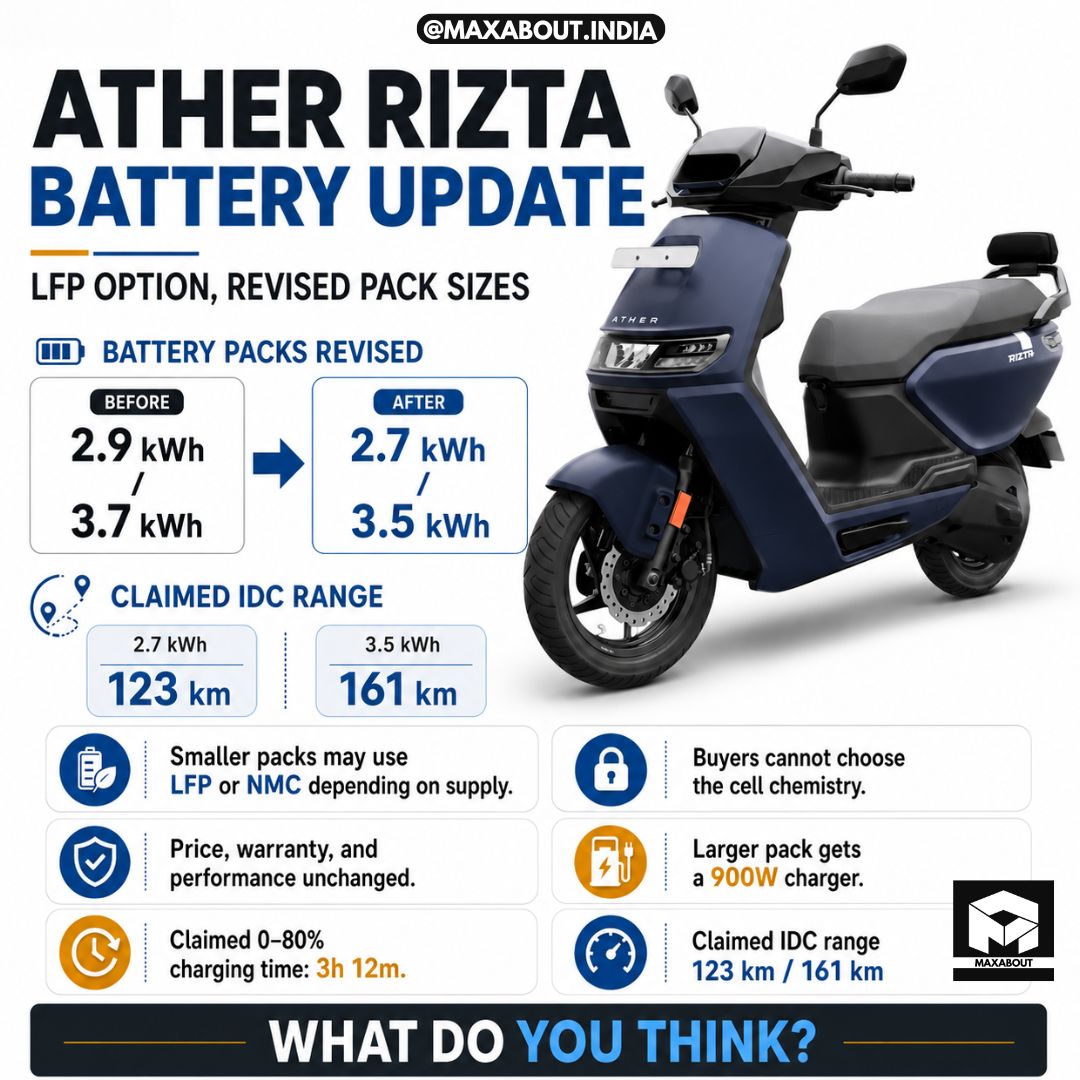
Ather Rizta LFP battery news is now in focus after a reported battery-pack revision for the family-oriented electric scooter. The update is said to replace the earlier 2.9kWh and 3.7kWh pack labels with 2.7kWh and 3.5kWh versions, while adding the possibility of lithium iron phosphate (LFP) cells on smaller-battery variants. The headline takeaway for buyers is not a headline price cut or performance upgrade: the reported change is about battery supply, pack specification and charging convenience, while price, warranty and quoted performance are expected to remain unchanged. Buyers should still confirm the exact battery capacity and chemistry of the scooter being delivered, because current product listings can vary by update cycle and stock.
What you need to know about the Ather Rizta battery update
The reported revision changes the Rizta's earlier 2.9kWh and 3.7kWh pack labels to 2.7kWh and 3.5kWh.
Claimed IDC range is reported at 123km for the smaller pack and 161km for the larger pack.
Smaller-pack scooters may use LFP or NMC cells, depending on supply. Customers are not expected to choose between the two chemistries.
Reportedly, the scooter's price, warranty and performance stay the same.
The larger-pack version is said to receive a 900W charger, reducing the claimed 0-80% charging time to 3 hours 12 minutes.
What has changed on the Ather Rizta?
The important detail is that this is a battery-pack update, not a full model-year redesign. The Rizta remains Ather's practical, family-focused electric scooter, with the same broad ownership proposition: everyday commuting range, a roomy layout and connected-scooter features. The reported revision changes the way its battery capacity is specified and adds flexibility in the cells used for smaller-battery stock.
| Area | Earlier reference | Reported update | What it means for buyers |
|---|---|---|---|
| Smaller battery pack | 2.9kWh | 2.7kWh; LFP or NMC may be used depending on supply | Check the delivered scooter's technical sheet rather than assuming a specific cell chemistry. |
| Larger battery pack | 3.7kWh | 3.5kWh reported; 161km claimed IDC range | Compare the quoted range and charging time on the exact variant being invoiced. |
| Charging | Older larger-pack charging claim | 900W charger; claimed 0-80% in 3h 12m | A quicker home top-up is more useful for many family users than a marginal specification change. |
| Price, warranty and performance | Existing terms | Reported unchanged | The ownership promise should remain familiar, subject to the final dealer quotation and warranty document. |
LFP vs NMC: why the chemistry detail matters
LFP and NMC are two common lithium-ion battery chemistries, but they are not interchangeable marketing labels. LFP batteries are generally associated with thermal robustness and long cycle life, while NMC packs are often chosen where energy density is a priority. In a scooter, the real-world experience depends on the entire battery-management system, usable capacity, riding conditions, charging routine and software calibration—not the chemistry name alone.
That is why the reported supply-dependent allocation is unusual from a buyer's perspective. If the warranty, price and performance commitment remain identical, the ownership decision should still be based on the variant's documented range, charging support and your daily riding pattern. However, buyers who specifically prefer one chemistry should ask for written confirmation before delivery instead of relying on an older brochure, an online listing or a showroom verbal assurance.
Range figures: treat IDC claims as a comparison point
The reported 123km and 161km numbers are IDC claims, which make them useful for comparing variants under a common test method but not for predicting every commute. Passenger load, tyre pressure, terrain, traffic, ride mode, speed and weather can all change the range displayed in daily use. A family using the Rizta for school runs, office travel and local errands should assess their typical daily distance with a healthy charging buffer rather than planning every trip around the peak quoted figure.
There is also a practical reason to double-check the variant sheet. Public product pages can be updated at different times from dealer stock and technical revisions. If a current listing shows a different capacity or range label from the reported update, that does not automatically mean the scooter is wrong; it means the buyer should verify the exact vehicle identification, capacity declaration, advertised range and supplied charger before signing the delivery paperwork.
Why the 900W charger matters more than it first appears
For many urban EV owners, charging time affects convenience more than the difference between two close capacity labels. The reported 900W charger for the larger-pack Rizta is claimed to bring the 0-80% time down to 3 hours 12 minutes. That can make a daytime top-up at home or work more realistic, particularly for households that share a single charging point.
Before treating that figure as a guaranteed routine, confirm the supplied charger type, wall-socket condition and any electrical-installation recommendations. Charging performance can vary with the state of charge and the vehicle's battery temperature. The best question for a dealer is simple: Which charger ships with this exact variant, and what charging time is listed in the delivery documentation?
What Ather Rizta buyers should check before delivery
Ask for the exact battery capacity listed for your variant and keep the document with the invoice.
Confirm the advertised IDC range and do not confuse it with a guaranteed real-world distance.
If chemistry matters to you, ask whether the delivered smaller-pack scooter uses LFP or NMC; do not assume customers can select it.
Verify the included charger rating and the claimed charging time for your chosen variant.
Read the final warranty terms, including battery coverage, rather than relying on a previous model-year page.
What this means for the Indian electric-scooter market
The update underlines how quickly battery sourcing and pack engineering are evolving in India's electric two-wheeler market. Manufacturers are balancing cost, supply continuity, thermal performance, range targets and charging convenience at the same time. For customers, that makes clear, variant-specific documentation increasingly important. The strongest EV purchase decision is not based on a single chemistry buzzword; it is based on the exact battery specification, realistic daily range, charging access, warranty and service support available in your city.
FAQs
Does the Ather Rizta now use an LFP battery?
Reportedly, smaller-battery Rizta variants may receive LFP or NMC cells depending on supply. Buyers are not expected to choose the chemistry, so confirm the delivered scooter's specification if it is important to you.
What is the reported Ather Rizta range after the update?
The reported claimed IDC figures are 123km for the smaller pack and 161km for the larger pack. Real-world range will vary with riding and charging conditions.
Has the Ather Rizta price changed with the battery update?
The reported update says price, warranty and performance remain unchanged. Always confirm the final on-road price and offer with the dealer before booking or delivery.
How fast does the larger-battery Rizta charge?
The reported larger-pack update includes a 900W charger and a claimed 0-80% charging time of 3 hours 12 minutes. Check which charger is supplied with your exact variant.
The bottom line
The Ather Rizta battery update is more than a small spec-sheet edit because it brings cell-chemistry choice, range claims and home-charging convenience into the buying conversation. For most shoppers, the sensible next step is to compare the exact delivered scooter's capacity, range, charger and warranty documents. That keeps the decision focused on day-to-day usability rather than on an assumed battery chemistry alone.
No comments yet
Be the first to share your thoughts!
Want to read more automotive news?
Stay updated with the latest car launches, reviews, and industry insights.
Browse All News