
ARAI Upgrades Safety Tech: Euro NCAP 2026 Far-Side Sled Test Capability Explained
Car safety is changing fast. And for once, India isn't being left behind.Here's something most people don't think about when buying a car: what happens to your body when the crash happens on the other side of the vehicle? Say you're in the passenger seat, and another car slams into the driver's door...
Editorial Team
Car safety is changing fast. And for once, India isn't being left behind.
Here's something most people don't think about when buying a car: what happens to your body when the crash happens on the other side of the vehicle? Say you're in the passenger seat, and another car slams into the driver's door. Your body doesn't just absorb the impact — it swings violently toward the point of collision, like a pendulum. That movement, that secondary impact against interior surfaces or against a fellow occupant, is what safety engineers call a far-side impact. It's surprisingly common, and historically, it's been one of the most underprotected crash scenarios in the world.
This is where a genuinely exciting development comes in. The Automotive Research Association of India (ARAI), based in Pune, is India's apex body for vehicle testing and certification. Think of it as the organization that decides whether a car is road-legal and safe enough for Indian buyers. ARAI has now developed the capability to conduct Euro NCAP 2026-compliant far-side sled tests — putting India firmly on the map of advanced crash safety research.
With Bharat NCAP steadily gaining ground, this milestone signals something bigger: India is aligning its safety expectations with the world's toughest standards. That matters to every single person shopping for a car today.
Understanding ARAI and Its Role in India's Automotive Safety Ecosystem
Most people have heard the name ARAI thrown around in car reviews or news headlines, but few really know what this institution actually does. The Automotive Research Association of India, based in Pune, operates under the Ministry of Heavy Industries and functions as the country's primary authority on vehicle standards. Simply put, if a car or motorcycle is sold legally in India, ARAI has had a hand in certifying it.
Its responsibilities stretch across a surprisingly wide range. Emissions testing, fuel efficiency certification, homologation of new models, component safety research — and increasingly, crash testing. ARAI has been the institutional backbone behind Bharat NCAP, India's own New Car Assessment Programme, which gave Indian consumers a local, credible framework for comparing vehicle safety.
 Think about where things stood just a decade ago. Crash test results were barely part of mainstream buying conversations. Side-impact protection, airbag deployment patterns, structural integrity under collision — these topics lived in engineering papers, not showroom discussions. That has changed considerably, and ARAI has been quietly driving that shift.
What makes this institution interesting is precisely its low-profile nature. No aggressive branding, no flashy campaigns. Just rigorous, unglamorous technical work that ultimately determines whether a vehicle is fit to carry Indian families on Indian roads. And now, with global-standard sled testing capability in place, that quiet institution is earning attention well beyond domestic borders.
Breaking Down the Far-Side Sled Test: What Happens in That Split Second?
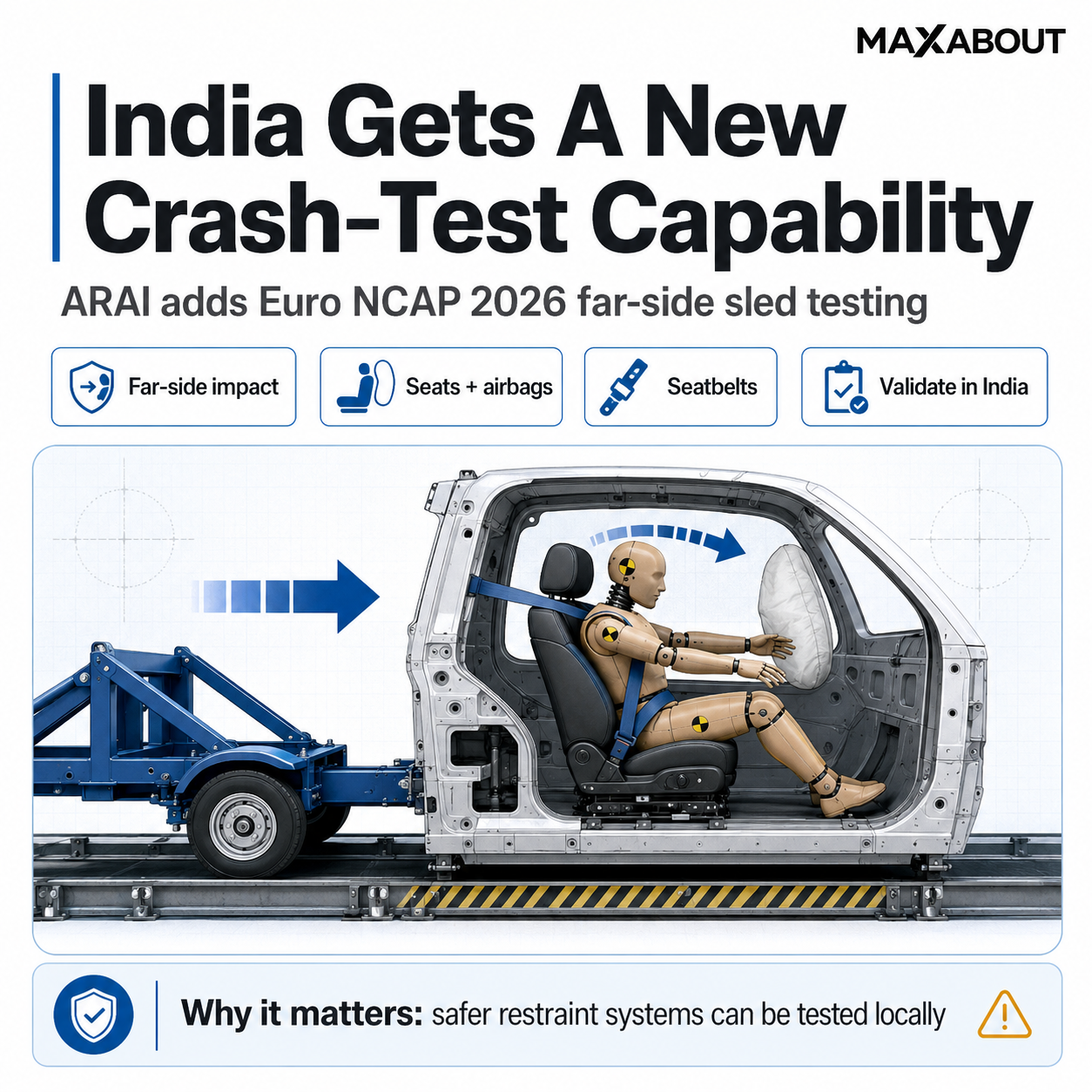
To understand why this capability matters, it helps to first understand what a sled test actually is. Rather than destroying a real vehicle in every experiment, engineers strap crash test dummies onto a motorised platform that replicates the precise forces of a collision. Same deceleration curves, same impact loads — just without writing off an actual car each time. It is efficient, repeatable, and scientifically rigorous.
The far-side scenario is where things get particularly interesting. Imagine you are the driver, and another vehicle strikes your car on the passenger side. The impact comes from your right. Instinctively, you might assume the danger is greatest for the person nearest to that impact. But your body tells a different story. In that split second, your torso and head swing toward the impact zone — away from your door, across the cabin — with significant lateral force. There is very little structure or cushioning in that direction to stop you.
According to global crash data, far-side impacts account for a surprisingly large proportion of serious occupant injuries that conventional frontal and side-impact tests simply do not capture. Recent road safety research suggests these crashes contribute meaningfully to fatalities precisely because restraint systems were never designed with this lateral trajectory in mind.
Euro NCAP recognised this gap. Its 2026 protocol formally incorporates far-side testing because the existing framework was leaving a genuine blind spot in occupant protection assessment. That is exactly the test ARAI can now simulate.
What ARAI Achieving This Test Capability Actually Means
So what exactly has ARAI built here? In practical terms, a sled test facility replicates crash forces without destroying an entire vehicle. A test buck — essentially a partial vehicle structure — is mounted on a sled, then subjected to precisely programmed deceleration pulses that mimic real collision dynamics. For far-side testing specifically, the lateral forces and rotational movements involved demand extraordinarily precise instrumentation. The dummy itself must carry sensors measuring chest compression, head acceleration, and neck loading along axes that standard frontal dummies were never designed to capture.
Getting this right requires more than just hardware. The measurement systems, data acquisition protocols, and dummy calibration procedures all have to meet Euro NCAP 2026 specifications exactly. That is the capability ARAI has now validated domestically.
Before this, Indian manufacturers developing vehicles for European export had a genuinely inconvenient problem. Prototype testing had to happen overseas — meaning shipping vehicles or components to facilities in Europe or the United States, waiting on scheduling, incurring significant costs, and critically, exposing proprietary engineering data to environments outside their direct control.
From what industry observers have noted, that last point matters more than people realise. Early-stage crash test data reveals a great deal about a platform's structural philosophy. Keeping that validation in-house, at a trusted domestic facility, is strategically valuable.
For Indian manufacturers with European ambitions, this development is directly relevant. Euro NCAP 2026 compliance will not be optional for those markets — it will be the entry requirement.
How This Connects to Bharat NCAP and the Future of Indian Crash Testing
Bharat NCAP, launched in 2023, was a genuine milestone. For the first time, Indian buyers had a domestic safety rating system they could reference while making purchase decisions. Awareness has grown steadily since. But the programme, as it currently stands, has gaps — and far-side occupant protection is one of the more significant ones.
Right now, Bharat NCAP covers frontal offset, side pole, and side barrier tests. These are meaningful, no question. But far-side impact protection — what happens to a passenger on the opposite side of a collision — remains outside the scope. ARAI now having a certified far-side sled testing capability creates a realistic foundation for future Bharat NCAP iterations to bridge that gap.
This matters because the two programmes cannot afford to drift too far apart in their standards. As more Indian models are engineered simultaneously for domestic and global markets, a vehicle's safety architecture has to satisfy both audiences. The pressure will only grow as Indian buyers become more safety-conscious and start asking harder questions at showrooms.
Brands like Tata Motors and Mahindra have already invested heavily in safety engineering — their five-star Bharat NCAP results reflect genuine structural commitment, not just compliance. For them, domestic far-side testing capability means faster, more efficient validation cycles without routing every test abroad.
The trajectory is clear. As ARAI's capabilities expand, Bharat NCAP's evolution becomes far more achievable.
What This Means for Indian Manufacturers and the Cars You Will Buy
Here is where things get genuinely interesting for everyday buyers. When ARAI can conduct far-side sled testing domestically, Indian manufacturers no longer need to ship prototypes abroad for this specific validation. That shortens the feedback loop considerably — engineers can iterate faster, identify weaknesses earlier, and bring safer vehicles to market without the delays that international testing logistics create.
Think about what that means across different segments. In affordable hatchbacks and entry-level sedans, side airbags are still not standard equipment on base variants. Far-side protection in these categories is almost nonexistent. Domestic testing capability creates pressure — and opportunity — to address that gap earlier in the development cycle, before a model reaches showrooms.
Family SUVs and MPVs carry the most at stake here. These are vehicles where three-row seating and multiple occupants are the entire point. In a far-side collision, the occupant furthest from the impact point is surprisingly vulnerable — and in an MPV carrying six people, that could be almost anyone on board.
Indian buyers are also paying attention more than ever. Five-star Bharat NCAP ratings have become genuine marketing currency — something brands now lead with in advertisements. As domestic testing grows more comprehensive, consumers can reasonably expect greater transparency about performance in crash scenarios that previously received little attention. That shift in awareness is perhaps the most meaningful outcome of all.
India's Larger Push Toward Global Automotive Safety Standards
Step back for a moment and consider where India sits right now. Third-largest passenger vehicle market in the world. Growing export ambitions. A manufacturing ecosystem that increasingly wants to supply vehicles not just to South Asia but to Europe, Latin America, and beyond. For that to actually happen, domestic testing infrastructure cannot remain a generation behind global benchmarks. This ARAI milestone is one piece of that larger puzzle.
It is not the only piece, either. Recent regulatory movement has been pointed and deliberate. Pedestrian protection norms have been tightened under AIS standards. Bharat NCAP is actively pushing toward incorporating side pole impact tests — a scenario that exposes genuinely dangerous structural weaknesses in many vehicles. The direction is clear, even if the pace sometimes frustrates safety advocates.
Here is what I think deserves more acknowledgment, though. This kind of infrastructure investment never makes headlines the way a flashy electric vehicle launch does. Nobody is posting celebration reels about a sled test facility. But the long-term impact on road safety outcomes and India's manufacturing credibility is arguably far more significant than another range announcement.
That said, being honest matters here. Capability at a testing facility and actual safety improvements reaching consumers are two separate things. Manufacturers still have to voluntarily adopt these learnings — and that is not always guaranteed without regulatory compulsion. Infrastructure without enforcement pressure only goes so far.
Final Thoughts: A Quiet Milestone With Real Consequences
Most car buyers will never hear about this. And honestly, that is fine. You should not need to understand sled test mechanics to make a safer purchase decision. But someone has to do the work — and ARAI quietly doing it matters more than the silence around it suggests.
Think about where India's safety conversation stood not long ago. Dual airbags were considered a premium feature. ABS was optional. Crash testing results for Indian-market vehicles were, in many cases, embarrassing. That has changed, slowly but meaningfully. This is another step in that same direction.
My honest view? This achievement will only deliver real value if it eventually feeds into updated Bharat NCAP protocols. Far-side testing capability sitting unused would be a missed opportunity. There is genuine hope that future protocol revisions will incorporate it — because the infrastructure now exists to make that happen.
Until then, the most practical thing any buyer can do is pay attention to safety ratings. Whether it is Bharat NCAP or Global NCAP results, every star reflects a test like this one — technical, unglamorous, and completely necessary. That is worth remembering the next time you are choosing between two similarly priced options.
No comments yet
Be the first to share your thoughts!
Want to read more automotive news?
Stay updated with the latest car launches, reviews, and industry insights.
Browse All News