
ARAI Praj Diesel Isobutanol Validation Starts June
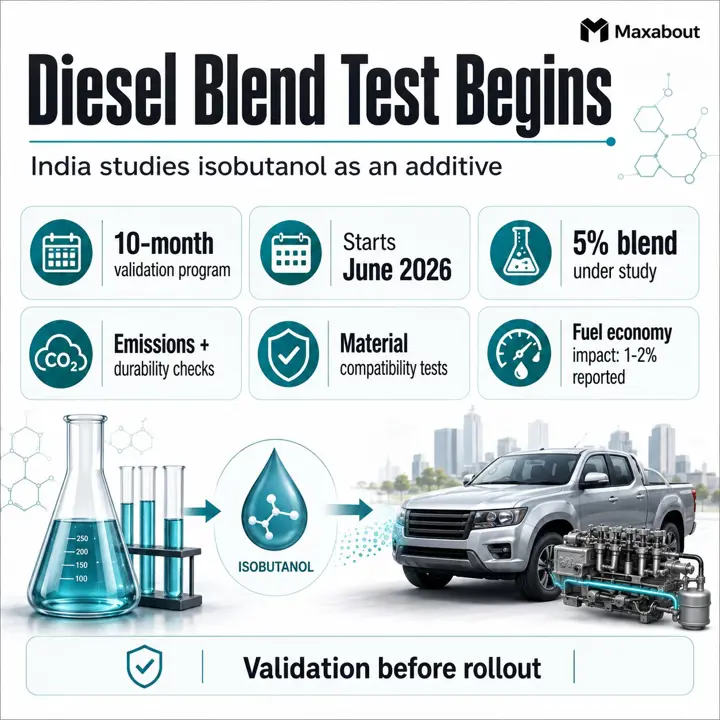
Something quietly significant happened in India's fuel landscape recently. ARAI (Automotive Research Association of India) and Praj Industries have kicked off diesel isobutanol validation testing, with the programme beginning in June. It might not sound like front-page news, but for anyone who drive...
Editorial Team
Something quietly significant happened in India's fuel landscape recently. ARAI (Automotive Research Association of India) and Praj Industries have kicked off diesel isobutanol validation testing, with the programme beginning in June. It might not sound like front-page news, but for anyone who drives a diesel car or owns a diesel-powered vehicle, this development is worth paying attention to.
So what exactly is isobutanol? Without turning this into a chemistry class — it's a bio-based alcohol fuel derived from agricultural feedstocks. Think of it as a cleaner, renewable cousin of conventional diesel additives. The key thing is that it can blend directly with diesel, which means existing engines don't necessarily need radical modifications to use it. That's a big deal in practical terms.
India currently imports a substantial portion of its crude oil, and diesel prices have been anything but stable for consumers. The government has been pushing hard through various national biofuel and energy security programmes to reduce this dependency. ARAI beginning formal validation — not just lab-level experiments, but structured testing — signals that isobutanol is moving toward real-world consideration.
From what industry observers are saying, this collaboration could eventually reshape fuel options for millions of diesel vehicle owners across the country. Early days, yes. But the direction is clear.
What Exactly Is Isobutanol and Why Is It Different from Ethanol?
If you've been following fuel news in India, you've probably heard about ethanol blending in petrol — the government's E20 push has been hard to miss. Isobutanol is a similar idea in principle, but it's a meaningfully different alcohol with some distinct advantages. Think of it as ethanol's more capable cousin.
 Here's the key thing to understand. Ethanol struggles with diesel blending. The two don't mix easily without special additives or co-solvents, which makes large-scale diesel-ethanol blending complicated and expensive. Isobutanol, on the other hand, blends far more smoothly with diesel. For a country where diesel powers everything from your family SUV to heavy trucks and farm equipment, that distinction matters enormously.
A few practical differences worth knowing:
Higher energy density — isobutanol carries more energy per litre than ethanol, meaning less compromise on fuel efficiency
Lower water absorption — ethanol attracts moisture, which creates storage and corrosion headaches; isobutanol is significantly better on this front
Better infrastructure compatibility — existing fuel pipelines, tanks, and engine components handle isobutanol with fewer modifications
What makes this especially relevant for India is where isobutanol can come from. It can be produced from agricultural waste — sugarcane bagasse, rice straw, even municipal organic waste. Given India's massive sugarcane surplus and the stubble-burning crisis in states like Punjab and Haryana, that's a genuinely interesting angle.
Who Are Praj Industries and Why Does Their Involvement Matter?
Praj Industries isn't a name that comes up in everyday automotive conversations, but in India's bioenergy space, they carry real weight. Founded in Pune, Praj has spent decades building expertise in fermentation technology, biorefinery systems, and — most relevantly — large-scale ethanol production. They've supplied ethanol plants across India and internationally. That background matters here.
Moving from ethanol to isobutanol isn't a completely fresh leap. The underlying fermentation science shares common ground, so Praj brings genuine technical familiarity to this validation rather than starting from scratch. If results look promising, scaling production domestically becomes a realistic possibility — not just a distant ambition.
There's also a broader strategic point worth noting. This is Indian technology being tested on Indian terms — aligned with Make in India and Aatmanirbhar Bharat goals in the energy sector. Rather than importing a foreign biofuel solution, India would be developing and validating its own pathway.
As for ARAI — the Automotive Research Association of India, based in Pune — it's the country's premier authority for vehicle testing, certification, and automotive research. When ARAI validates something, the industry takes notice. Their involvement here gives the entire exercise genuine technical credibility.
What the June Validation Process Actually Involves
First, let's be clear about something important: validation is not the same as availability. When ARAI begins testing isobutanol-diesel blends in June, it doesn't mean you'll find this fuel at a pump anytime soon. This is structured, methodical science — and that's actually a good thing.
In practical terms, ARAI's validation work typically covers several distinct areas. Engine performance is the obvious starting point — how does the blended fuel behave under real load conditions? Does combustion remain stable? Are there measurable changes in power output or torque? These aren't small questions.
Then there's emissions compliance, which is frankly the hardest hurdle. Any fuel blend entering the Indian market must meet Bharat Stage 6 norms — full stop. BS6 is stringent, and there's no negotiating around it. The testing will likely examine blends at various ratios, possibly starting conservatively at around 10–20% isobutanol mixed with standard diesel, before pushing higher if early results hold up.
Fuel system compatibility is another critical piece. Seals, injectors, pumps — isobutanol behaves differently from conventional diesel, and long-term material degradation is a genuine concern that needs honest assessment.
Realistically, validation takes time. Results often require iteration. Commercial rollout remains a distant horizon, not an immediate outcome. But the fact that this process is formally beginning — that's genuinely meaningful progress.
How This Could Impact Diesel Car and SUV Owners in India
This is where things get personal for a lot of people. If you own a diesel Scorpio-N, an Innova Hycross, a Fortuner, or run a small fleet of commercial vehicles, the natural question is simple: does any of this actually affect me? Honestly, the full answer isn't available yet — but some early thinking is worth sharing.
The E20 petrol transition offers a useful reference point. Older petrol engines needed attention — certain rubber seals and fuel line materials weren't compatible. Newer vehicles were designed with flex-fuel in mind from the start. A similar pattern could emerge here. Diesel engines built after any hypothetical bio-blend mandate would likely be engineered accordingly. Existing vehicles are the bigger unknown.
Warranty implications matter enormously. If bio-blended diesel eventually becomes standard at pumps, manufacturers will need clear positions on whether using it voids coverage. That clarity hasn't arrived yet.
Fleet operators, cab drivers, and long-distance travellers running on diesel economy will be watching this especially closely. Fuel efficiency changes — even marginal ones — translate directly into earnings and running costs at scale.
From what early research suggests, isobutanol's energy density is closer to conventional diesel than ethanol is to petrol, which is encouraging. But real-world validation data will tell the definitive story — and that data simply isn't published yet.
The Environmental and Economic Case for Isobutanol Blending in India
India's air quality crisis is not abstract. Delhi consistently ranks among the most polluted cities globally, and diesel vehicles are a meaningful part of that problem — contributing significantly to particulate matter and nitrogen oxide emissions. If isobutanol blending can genuinely reduce these outputs without compromising performance, that matters beyond the laboratory.
The environmental argument is straightforward. Cleaner combustion characteristics in isobutanol could mean measurable reductions in tailpipe emissions — the kind that affect respiratory health in dense urban corridors like Mumbai's Western Express Highway or Bengaluru's Outer Ring Road, where diesel trucks and buses run constantly.
Then there is the economic dimension. India's crude oil import bill runs into hundreds of billions of dollars annually. Domestically produced biofuels, even at partial blending ratios, can meaningfully reduce that foreign exchange pressure over time. And isobutanol's feedstocks — agricultural waste, sugarcane derivatives — connect directly to rural India's farming economy, giving this technology genuine political and social relevance.
That said, scale-up economics remain the real question. Domestic production costs must reach a point where blended diesel is comparable at the pump to conventional fuel. Environmental benefit alone will not drive adoption if refiners and distributors face unfavorable margins. The validation work starting now is the essential first step toward answering that harder question.
Challenges Ahead: What Could Slow Down Isobutanol's Road to Your Fuel Tank
Honest question: how many alternative fuel initiatives in India have you heard about over the years that never quite made it past the pilot stage? Quite a few. So while the ARAI-Praj validation is genuinely encouraging, it would be a mistake to read this as a done deal.
The most immediate hurdle is production cost at scale. Isobutanol for diesel blending is at a considerably earlier stage globally than ethanol blending for petrol. There is simply less international precedent to draw from, which means Indian refiners and policymakers cannot just copy a proven playbook from elsewhere.
Then there is the infrastructure question. Handling a new fuel type requires adjustments at refineries, storage facilities, and ultimately fuel stations. That investment is not trivial, and distributors will want regulatory certainty before committing capital.
Regulatory timelines in India can also be lengthy. Even with strong validation data, the journey from successful testing to approved commercial blending mandates involves multiple government bodies and extended review periods.
Fleet operators and transport companies, who would be the earliest large-scale adopters, tend to be cautious around anything unfamiliar in their fuel supply. Reliability concerns are legitimate when livelihoods depend on vehicles running without disruption.
Without sustained policy backing and meaningful private investment, isobutanol risks joining a long list of promising ideas that stalled between the laboratory and the mainstream.
What to Watch For in the Coming Months
The ARAI validation results, expected after June, will be the clearest signal yet. If the numbers hold up — fuel compatibility, emissions performance, engine wear data — it changes the conversation entirely. A positive outcome could open doors to pilot programmes with state transport undertakings, or prompt official policy statements around blending mandates for diesel isobutanol.
Watch for manufacturer responses too. If even one major diesel engine maker acknowledges compatibility without warranty concerns, that matters significantly.
If you own a diesel vehicle, there is genuinely no reason to make any decisions right now. This technology is early-stage. The validation is just beginning. Stay informed, but keep driving normally.
That said, there is real reason for measured optimism here. India moved faster than most expected on ethanol blending once the economics and policy intent aligned. The same ingredients — domestic feedstock, government will, industry pressure — exist in this space too.
The ARAI-Praj collaboration is not a guarantee of anything. But it is exactly the kind of foundational work that serious fuel transitions are built on. Worth following closely.
No comments yet
Be the first to share your thoughts!
Want to read more automotive news?
Stay updated with the latest car launches, reviews, and industry insights.
Browse All News