
APSRTC Diesel Bus Retrofit to Electric AC Coach Explained
Something quietly interesting is happening in Andhra Pradesh's public transport network. APSRTC is retrofitting its existing diesel buses into electric AC coaches — and honestly, this deserves more attention than it's getting.Let's be clear about what retrofitting actually means here. Instead of pur...
Editorial Team
Something quietly interesting is happening in Andhra Pradesh's public transport network. APSRTC is retrofitting its existing diesel buses into electric AC coaches — and honestly, this deserves more attention than it's getting.
Let's be clear about what retrofitting actually means here. Instead of purchasing brand-new electric buses from scratch, the corporation is taking its current diesel fleet and replacing the engine, drivetrain, and related components with an electric powertrain. The bus body, frame, and structure stay largely intact. What changes is essentially the heart of the vehicle.
Now, why does this matter? State transport corporations across India operate under serious financial pressure. Buying a full electric bus fleet sounds great on paper, but the upfront cost is enormous. Retrofitting offers a practical middle path — you extend the useful life of an existing asset while still moving toward electrification. From what industry observers have noted, the per-unit cost of retrofitting can be meaningfully lower than purchasing new EVs outright.
This isn't a perfect solution, and it comes with its own complications. But it's a genuinely thoughtful response to a real problem — how do you modernise public transport on a tight budget without simply doing nothing and waiting for costs to fall?
What Exactly Is the APSRTC Retrofit Program and How Does It Work?
At its core, the idea is straightforward. APSRTC identifies older diesel buses — typically coaches that are ageing in terms of engine life but still have a structurally sound chassis underneath. Instead of scrapping the entire vehicle, the diesel powertrain gets removed and replaced with an electric motor, a battery pack, and the supporting electronics needed to make it all work together.
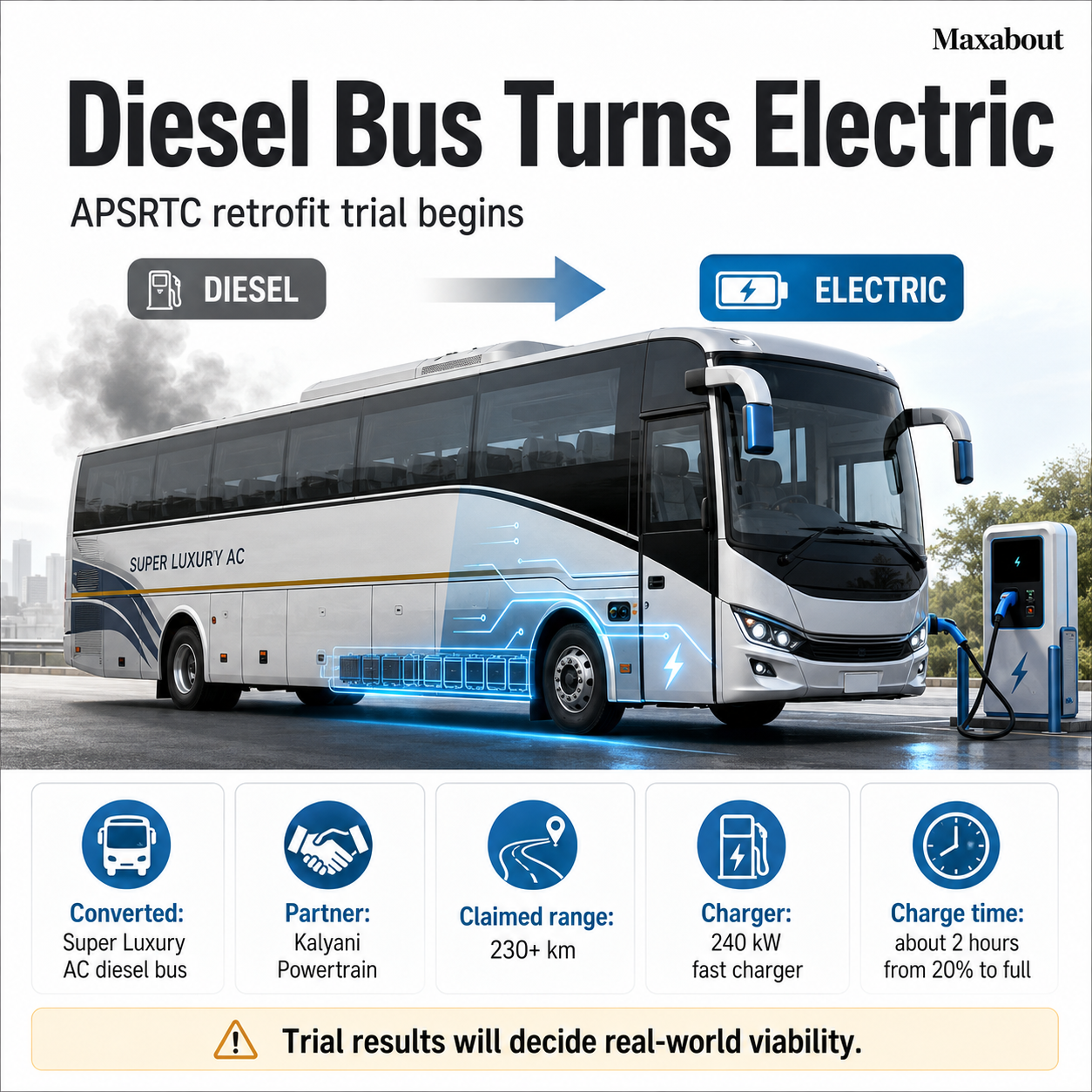 The buses being targeted aren't random picks. The selection focuses on vehicles where the chassis still has meaningful service life remaining — roughly assessed at several more years of road-worthiness. Scrapping a perfectly good frame just because the engine is tired doesn't make much economic sense, and that's precisely the thinking driving this program.
APSRTC is working through approved retrofit kit manufacturers — companies that have gone through certification processes to ensure their conversion systems meet safety and performance standards. This isn't a backyard job. The kits include everything from the electric motor and battery management system to regenerative braking components.
One notable addition is the AC fitment. These retrofitted coaches aren't just going electric — they're also being upgraded with air conditioning, which meaningfully improves the passenger experience on longer intercity routes.
On costs, official announcements and industry reports suggest retrofitting runs considerably cheaper than procuring a new electric bus, which can cost upwards of ₹1.5 crore to ₹2 crore per unit. The retrofit route reportedly brings that figure down substantially, though exact numbers vary by specification.
The Financial Logic: Why Retrofitting Makes More Sense Than New EV Buses for APSRTC
The numbers tell a fairly compelling story here. A brand-new electric bus — depending on battery capacity, range, and air conditioning specs — can cost anywhere from ₹80 lakh to well over ₹1.2 crore. For a state transport undertaking managing hundreds of vehicles across Andhra Pradesh's vast network, that kind of procurement bill adds up fast.
Retrofitting sidesteps a significant chunk of that expense. The existing chassis, body structure, and interior fittings are already paid for. Converting what's already there — rather than scrapping and replacing — stretches the usable life of the fleet meaningfully. From what industry observers note, a quality retrofit program can extend a bus's operational life by several years while simultaneously cutting running costs.
And those operating savings are real. Electric drivetrains have dramatically fewer moving parts compared to diesel engines. No oil changes, fewer brake replacements thanks to regenerative braking, and substantially lower per-kilometre fuel costs. On busy intercity corridors between cities like Vijayawada and Visakhapatnam, those savings compound over time.
That said, battery replacement costs deserve honest attention. Battery packs don't last forever — typically 7 to 10 years under regular use — and replacing them is a significant expense that could offset early savings if not planned for carefully in the overall financial model.
Passenger Experience: What Changes When You Board a Retrofitted Electric AC Bus?
Step onto a retrofitted electric AC bus and the first thing you notice is the silence. That familiar diesel rumble — the vibration under your feet, the low growl at every traffic signal — is simply gone. For anyone who has taken a long APSRTC haul from Guntur to Vijayawada on a hot afternoon, that alone feels like a genuine upgrade.
The air conditioning is the other obvious change. Andhra Pradesh summers are genuinely brutal, and adding climate control to what were previously non-AC diesel coaches meaningfully improves comfort on routes that can stretch two to four hours. The seating, interior panels, and general layout remain largely unchanged though — this is a powertrain swap, not a full refurbishment, so expectations around legroom or seat quality should stay realistic.
Range is where passengers and route planners both need to pay attention. Retrofitted electric buses typically deliver somewhere between 150 to 250 kilometres per charge, depending on load, AC usage, and road conditions. Shorter corridors like Vijayawada to Guntur fit comfortably within that window. Longer routes toward Tirupati or Visakhapatnam raise legitimate questions about whether a mid-route charging stop becomes necessary — which directly affects journey time and schedule reliability.
That is a practical concern worth watching closely as APSRTC expands this programme.
Charging Infrastructure and Operational Challenges
This is where the real-world friction begins. Range anxiety is one problem. Getting these buses charged efficiently across dozens of depots spread across Andhra Pradesh — from Kurnool to Kakinada — is an entirely different challenge.
Depot-level charging is genuinely the right approach here. Relying on public charging infrastructure for fleet operations makes little practical sense. Buses follow fixed schedules, return to base regularly, and can be plugged in overnight or during scheduled rest windows. APSRTC depots becoming self-sufficient charging hubs is far more operationally logical than chasing public stations.
The harder question is turnaround time. A diesel bus refuels in minutes. An electric bus on a standard charger needs several hours. Even fast DC chargers require 60 to 90 minutes for a meaningful top-up. If scheduling doesn't account for that window carefully, one delayed bus creates a ripple effect across an entire route cluster.
Then there's grid reliability. Depots in smaller district towns across Andhra Pradesh face real concerns around consistent power supply. Load management during peak evening hours, occasional outages in semi-urban areas — these aren't theoretical problems. BEST in Mumbai and DTC in Delhi both navigated similar early-stage infrastructure gaps by investing in dedicated feeder lines and on-site energy management systems before scaling their electric fleets. APSRTC would benefit from that same disciplined groundwork.
Driver transition is another underappreciated factor. Shifting from diesel operation to electric requires retraining — not just on controls, but on regenerative braking behaviour and range management habits.
Environmental and Policy Impact: Does This Actually Help Reduce Emissions?
The honest answer is: yes, but with important caveats. Removing diesel engines from APSRTC buses eliminates tailpipe emissions entirely at the point of operation. For densely packed urban corridors in Vijayawada or Kakinada, that is a meaningful and immediate public health benefit. But the fuller picture depends on where that electricity actually comes from.
India's grid still carries a significant coal-based generation load. So calling electric buses "zero emission" without acknowledging upstream power sources is, frankly, incomplete. The net carbon benefit varies considerably by region and by time of day.
This is where Andhra Pradesh's energy story becomes genuinely encouraging. The state has made serious investments in solar and wind capacity, ranking among India's stronger performers in renewable generation. As that clean energy share grows, every electric bus on the road gets progressively cleaner — without any hardware changes. The retrofit made today becomes more environmentally valuable year after year.
There is also one benefit that rarely gets enough attention: noise pollution reduction. Electric buses are substantially quieter than diesel. In stop-and-go city traffic, that difference is striking. Quieter streets genuinely improve the daily experience for pedestrians, residents, and even passengers.
From a policy standpoint, this initiative directly supports India's public transport electrification targets and signals that state operators can move beyond pilot projects into practical, scalable action.
Risks and Concerns: What Could Go Wrong With the Retrofit Approach?
Honestly, the retrofit path is not without real risks. And given that thousands of passengers depend on APSRTC services daily, these concerns deserve straight answers rather than optimistic hand-waving.
Retrofit quality is inconsistent. Unlike factory-built electric buses, the outcome here depends heavily on the kit manufacturer and the installation standards followed. A well-executed retrofit is genuinely impressive. A poorly executed one could end up being less reliable than the diesel bus it replaced — which would be a significant step backward.
Battery degradation is another honest concern. After five to seven years, capacity drops meaningfully. What happens then? Replacement costs, sourcing compatible packs, and whether the original retrofit vendor even supports the vehicle at that stage — these are questions that need clear answers upfront.
Structural integrity also matters. Older bus chassis were simply never engineered to carry heavy battery packs. Weight distribution affects handling, tyre wear, and long-term frame stress — especially on uneven state highways.
Regulatory clarity around retrofitted vehicles in India has been evolving slowly. Certification delays are real, and operational grey areas can create compliance headaches for operators.
None of this means the initiative is flawed. But the execution standards, warranty commitments, and long-term support structures need to be airtight before this scales further.
The Bigger Picture: Can Retrofitting Become a Blueprint for Other Indian State Bus Corporations?
If APSRTC's program holds up over the next two to three years, the implications go well beyond Andhra Pradesh. India's state transport corporations collectively operate tens of thousands of aging diesel buses. Replacing that entire fleet with factory-fresh electric buses would cost an astronomical sum — one that most state governments simply cannot justify right now.
Retrofitting offers something genuinely practical: a phased, lower-cost entry into electrification without scrapping serviceable vehicle frames. KSRTC, MSRTC, TSRTC, and others are watching closely, and understandably so.
In my view, this is a smart interim solution — but only if the execution is honest. It is not a permanent answer. It is a bridge. And bridges need to be maintained carefully or they become liabilities.
The real test will come from actual field data — energy consumption figures, maintenance costs, passenger satisfaction, and breakdown frequency across real routes. That information, tracked transparently over the coming years, will tell us whether retrofitting deserves to scale nationally or quietly fade as a short-lived experiment.
Watch this space closely. The numbers, not the announcements, will decide everything.
No comments yet
Be the first to share your thoughts!
Want to read more automotive news?
Stay updated with the latest car launches, reviews, and industry insights.
Browse All News