

2027 Kawasaki Ninja 300 Launched at ₹3.34 Lakh: Check Price, Specs & What’s New
The 2027 Kawasaki Ninja 300 has launched in India at ₹3.34 lakh ex-showroom, making it ₹17,000 more expensive than the outgoing model. The update does not bring reported mechanical or major visual changes: the familiar 296cc liquid-cooled parallel-twin engine, six-speed gearbox and assist/slip clutc...
The 2027 Kawasaki Ninja 300 has launched in India at ₹3.34 lakh ex-showroom, making it ₹17,000 more expensive than the outgoing model. The update does not bring reported mechanical or major visual changes: the familiar 296cc liquid-cooled parallel-twin engine, six-speed gearbox and assist/slip clutch continue. Lime Green is the sole reported colour for the 2027 model, turning this into a price-and-colour update rather than a substantial product revision.
What you need to know
2027 price: ₹3.34 lakh ex-showroom.
Price increase: ₹17,000 over the outgoing motorcycle.
Engine: 296cc liquid-cooled parallel twin.
Output: 38.4bhp and 26.1Nm.
Gearbox: Six-speed with assist/slip clutch.
Reported changes: Lime Green colour; design and mechanical package otherwise unchanged.
2027 Kawasaki Ninja 300 price and changes
| Item | 2027 Ninja 300 |
|---|---|
| Ex-showroom price | ₹3.34 lakh |
| Increase over outgoing model | ₹17,000 |
| Mechanical update | No reported change |
| Major visual update | No reported change |
| Colour | Lime Green |
| Engine | 296cc parallel twin |
The higher price is the central talking point. A ₹17,000 increase without new hardware puts more pressure on the Ninja 300’s established strengths—its smooth twin-cylinder character, approachable performance and proven package—to justify the premium. Buyers are paying for continuity and familiarity rather than a new generation of features.
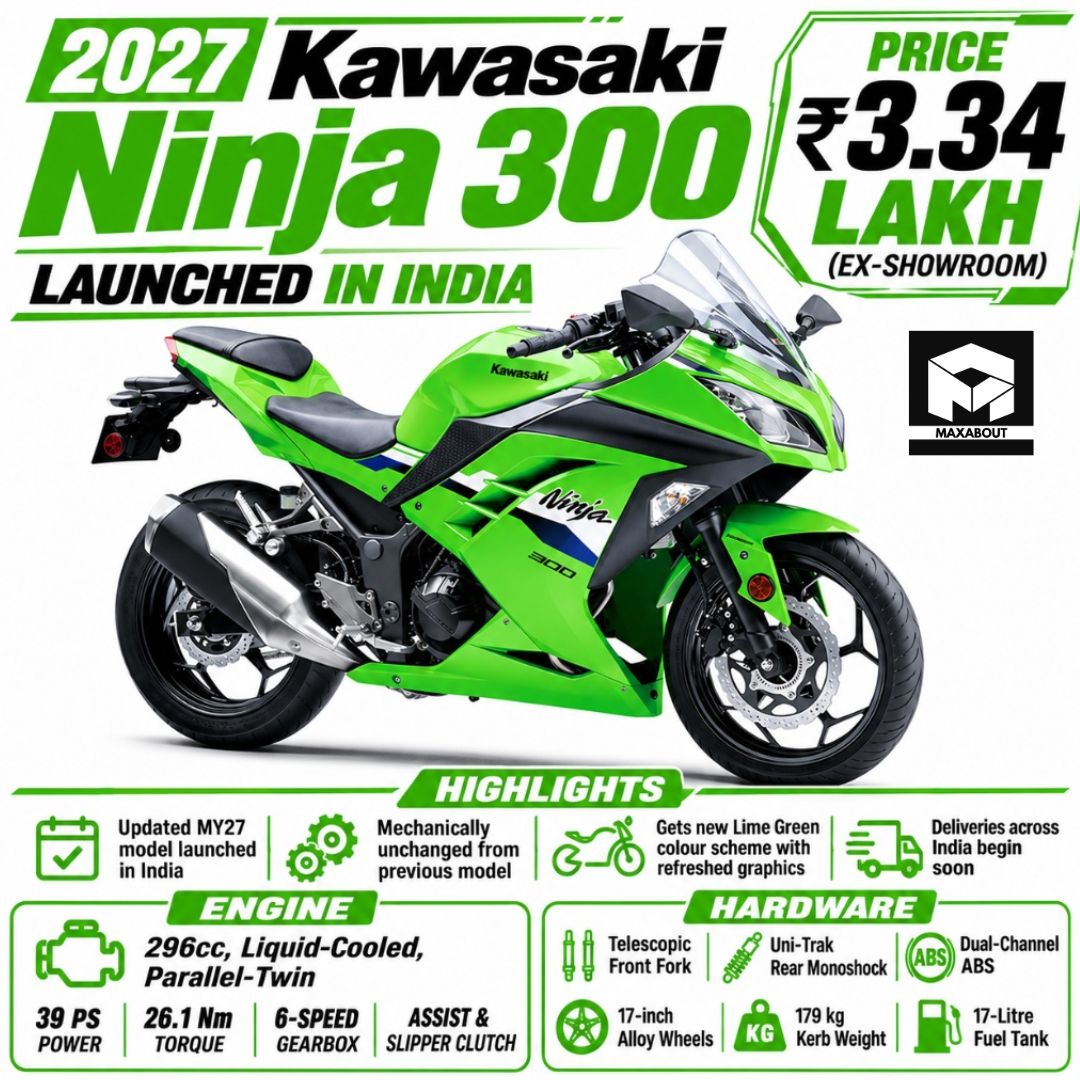
Engine and chassis specifications
The 2027 Ninja 300 continues with a 296cc, liquid-cooled, parallel-twin engine producing 38.4bhp and 26.1Nm. It is paired with a six-speed gearbox and an assist/slip clutch. This twin-cylinder layout remains one of the motorcycle’s defining attractions, particularly for riders who value smooth revs, tractability and a traditional small-capacity supersport feel.
Under the fairing is a steel frame supported by a telescopic front fork and rear monoshock. The bike rides on 17-inch wheels with tubeless tyres, while disc brakes are used at both ends. The hardware is conventional by current segment standards, and the update does not close the equipment gap to newer rivals with more advanced electronics, suspension or braking packages.
What remains appealing about the Ninja 300?
The Ninja 300 has stayed relevant because it offers an accessible entry into a fully-faired parallel-twin motorcycle. Its power delivery is described as rev-happy, with useful tractability and strong top-end character. The design is recognisably part of the Ninja family even if it now shows its age, and the assist/slip clutch remains valuable for urban use and enthusiastic downshifts.
For a first-time supersport buyer, familiarity can be a benefit. The motorcycle’s basic formula is well understood, and riders who prefer a simpler package may value the absence of complicated electronics. However, “proven” should not be confused with “best equipped”; the purchase decision depends heavily on what a buyer values.
Where the 2027 model feels dated
The linked report highlights the lack of modern technology and comparatively basic suspension and braking hardware versus rivals such as the KTM RC 390. That comparison is not purely about peak power: newer alternatives may offer more sophisticated rider aids, displays, chassis equipment or features for the money. The Ninja’s ₹17,000 increase makes those gaps more visible.
Prospective owners should also budget beyond the ex-showroom figure. Kawasaki spares and service costs can be important relative to mass-market competition. Insurance, registration, accessories, consumables and city-specific charges will increase the on-road price, so a full dealer quotation is more useful than comparing ex-showroom prices alone.
Who should consider the 2027 Ninja 300?
Riders specifically seeking a small-capacity parallel-twin sportbike.
Buyers who value proven mechanical character over the latest electronics.
New supersport riders who want manageable performance in a fully-faired package.
Owners prepared for premium-brand service and parts costs.
Feature-focused buyers should compare the Ninja 300 with newer rivals before booking. A test ride should include low-speed tractability, riding posture, heat management, brake feel and suspension comfort on local roads—not just engine sound and styling.
Buyer checklist before booking
Ask for the latest city-specific on-road quotation and delivery estimate.
Confirm the exact model year and Lime Green availability.
Review service intervals, labour rates and common consumable prices.
Compare insurance and extended-warranty options.
Test the riding posture and pillion practicality.
Compare equipment, performance and ownership costs with current rivals.
FAQs
What is the 2027 Kawasaki Ninja 300 price in India?
The 2027 Ninja 300 is priced at ₹3.34 lakh ex-showroom. The final on-road price varies by city and insurance choice.
How much has the Ninja 300 price increased?
The reported increase is ₹17,000 over the outgoing model.
What changed on the 2027 Ninja 300?
The launch report identifies the new price and Lime Green colour, while describing the motorcycle as visually and mechanically unchanged.
What engine does the Ninja 300 use?
It uses a 296cc liquid-cooled parallel-twin engine producing 38.4bhp and 26.1Nm, paired with a six-speed gearbox and assist/slip clutch.
Is the 2027 Ninja 300 worth buying?
It can suit riders who prioritise a proven, rev-happy parallel-twin supersport package. Buyers prioritising modern features, newer chassis hardware or lower ownership costs should compare current alternatives carefully.
Conclusion
The 2027 Kawasaki Ninja 300 price in India is now ₹3.34 lakh ex-showroom, but the motorcycle’s mechanical formula remains familiar. Its parallel-twin engine and approachable supersport character are still the strongest reasons to consider it. The ₹17,000 increase, dated equipment and ownership costs are equally important, making a test ride and full on-road comparison essential before booking.
Maxabout Team
Editorial Team
Specializes in: Automotive News, Reviews, Analysis
Want to read more automotive news?
Stay updated with the latest car launches, reviews, and industry insights.
Browse All News