
2027 Hyundai Creta Renders Based On Spy Shots
The Hyundai Creta is not just a car in India. It is, genuinely, a phenomenon. Month after month, it sits at or near the top of the sales charts, moves off showroom floors faster than dealers can replenish stock, and single-handedly defines what the compact SUV segment looks like in this country. Wai...
Editorial Team
The Hyundai Creta is not just a car in India. It is, genuinely, a phenomenon. Month after month, it sits at or near the top of the sales charts, moves off showroom floors faster than dealers can replenish stock, and single-handedly defines what the compact SUV segment looks like in this country. Waitlists stretching weeks, sometimes months — that kind of demand is rare for any product, let alone one that has been around long enough to face serious competition.
And competition has absolutely arrived. Rivals have sharpened up considerably. The segment is no longer a one-horse race, which makes the question of what Hyundai does next genuinely important.
So when spy shots of what appears to be the next-generation Creta started surfacing recently, people paid attention. Renders based on those shots are now making the rounds online, and they are sparking real conversation. These are not wild guesses — they are grounded in actual visual evidence caught on test routes, interpreted by designers who know how to read camouflage wrap and body proportions.
For Indian buyers specifically, this matters more than most markets. The Creta is sized and priced for our roads, our budgets, and our chaotic urban reality. Whatever direction the 2027 model takes — styling, technology, efficiency — it will likely shape buying decisions across the entire segment for years ahead.
Breaking Down The Spy Shots: What Was Actually Captured
The test mules spotted so far have been caught on what appear to be public roads and semi-restricted testing routes, likely somewhere in South Korea based on the background context visible in the images. Heavy black and white camouflage wrapping covers virtually the entire body, which is standard practice for early-stage development testing.
Here is what industry observers and automotive journalists have actually been able to conclude from careful analysis of these shots — and it is worth being honest about how limited that list really is.
What seems reasonably visible: The overall silhouette suggests the body dimensions are not dramatically different from the current generation. The roofline appears to maintain a similar coupe-ish slope toward the rear, though some analysts believe the shoulder line sits slightly higher. Wheel arches look more pronounced, hinting at a more muscular stance.
What nobody can confirm yet is the front fascia design, headlight shape, grille treatment, or any interior details. The camouflage does exactly what it is designed to do — it distorts panel lines and hides character creases effectively.
The honest conclusion is that these spy shots confirm a test mule exists and development is active. Beyond broad proportions, everything else remains careful interpretation rather than confirmed fact.
The Render Breakdown: Exterior Design Changes We Might Expect
Render artists have been busy. Working from those spy shots and cross-referencing Hyundai's recent global design moves, several independent renders have emerged — and honestly, some of them look genuinely convincing.
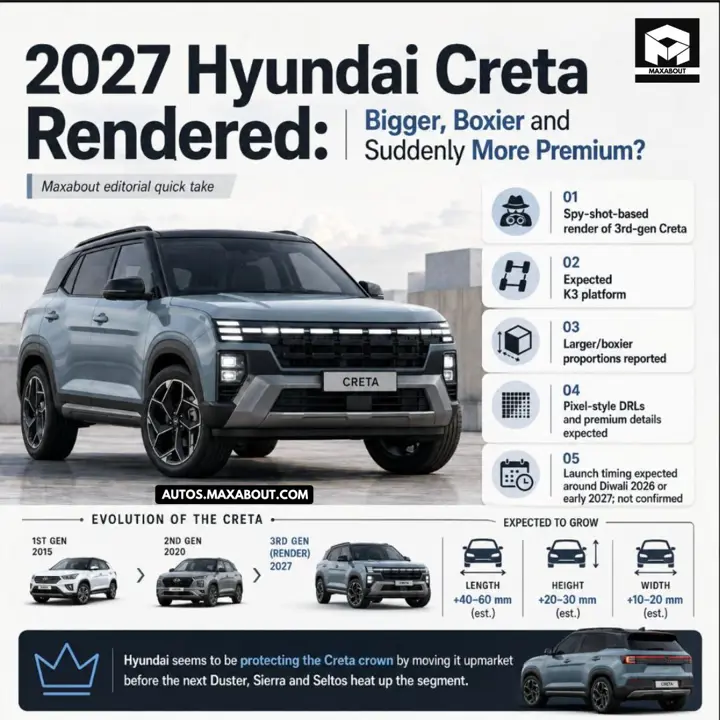
Front Fascia: Bolder and More Structured
Most renders suggest the 2027 Creta could adopt a front end closer in spirit to the updated Tucson and even draw subtle cues from the Ioniq series. Think a wider, more geometric grille — possibly parametric-patterned like we have seen on Hyundai's electric lineup. The headlights in these renders appear slimmer and more angular, stretching further into the hood. This is a significant departure from the current 2024 Creta's rounder, friendlier headlight clusters. Whether that translation actually happens for a mass-market SUV priced for Indian buyers remains debatable.
Side Profile: Where Renders Get Interesting
The shoulder line appears more pronounced in most interpretations. A slightly fastback-leaning roofline is suggested — not dramatically so, but enough to look more contemporary. Wheel arches look more sculpted. Render estimates point toward larger alloy wheels, possibly 17-inch or 18-inch fitments on top variants.
Rear End: Clean but Distinctive
The rear renders show a full-width LED tailamp strip, which feels inevitable given where the segment is heading. The tailgate appears flatter, the bumper treatment more upswept and structured compared to today's softer rear styling.
Overall, these renders suggest an evolutionary upgrade rather than a revolutionary redesign — familiar enough to retain Creta loyalists, fresh enough to feel modern.
Interior And Technology: What Could Change Inside The Cabin
If the exterior renders are promising, the interior is where the 2027 Creta will really need to make its case. Hyundai has been pushing hard on cabin quality across its global lineup, and there's reasonable expectation that some of that will trickle down here.
The current Creta's interior is genuinely good for the segment — the panoramic sunroof remains a crowd favourite, the 10.25-inch touchscreen is responsive, and the overall layout feels premium enough. But owner feedback consistently flags a few irritants: the lower dashboard plastics feel ordinary, rear ventilated seats are missing from most variants, and wireless charging placement feels like an afterthought on some trims.
The 2027 model could address several of these pain points. Based on Hyundai's recent global direction — seen in newer Tucson and Ioniq-influenced designs — a wider, more integrated dual-screen setup looks likely. Think a floating display cluster merging infotainment and driver information into one seamless panel.
ADAS improvements seem almost certain. The current suite is capable but could be refined, particularly for stop-and-go traffic on urban stretches like Mumbai's Western Express Highway or Bengaluru's outer ring road.
What Indian buyers specifically want is fairly well-documented at this point — ventilated rear seats, a larger panoramic sunroof, faster wireless charging, and better ambient lighting. Whether all of these make it to mid-range variants, not just the top-spec trim, will be the real question worth watching.
Powertrain Possibilities: Engines And Electrification For 2027
The engine story for the 2027 Creta is where things get genuinely interesting. Hyundai's current lineup — the 1.5L naturally aspirated petrol, the 1.5L turbo petrol, and the 1.5L diesel — has served the model well. But by 2027, at least some of these will need meaningful updates to stay compliant with tightening CAFE norms and emission regulations that India is steadily moving toward.
The naturally aspirated 1.5L petrol will likely survive in some form, particularly for entry-level variants where keeping costs accessible matters. It is a sensible, low-maintenance option that suits buyers who spend most of their time navigating city traffic rather than chasing highway speeds. Fuel efficiency in real-world Indian conditions — think stop-and-go commutes rather than ARAI test cycles — is where this engine has always made a reasonable case for itself.
The more compelling question is whether Hyundai introduces a mild hybrid system across the petrol range by 2027. Given how aggressively global trends are pushing electrification, and with Maruti already normalizing mild hybrids at competitive price points, Hyundai would face noticeable pressure to respond. A 48V mild hybrid paired with the turbo petrol could offer a practical middle ground — better efficiency without the infrastructure dependency of a full EV.
Speaking of which, positioning the Creta Electric alongside an ICE Creta in 2027 will require careful thinking from Hyundai. The EV variant already exists and has found a respectable audience among urban buyers with home charging access. The ICE Creta, however, still speaks to a much broader demographic — buyers in smaller cities and towns where charging infrastructure remains unreliable.
A strong hybrid option, while desirable, feels ambitious for Indian price expectations by 2027. From what industry observations suggest, strong hybrids carry significant cost premiums that are difficult to absorb in a segment as price-sensitive as this one.
How It Might Stack Up Against Rivals In The Indian Market
By 2027, the Creta will not have an easy road ahead. The compact SUV segment is already one of the most fiercely contested spaces in India, and it will only get sharper. An updated Maruti Grand Vitara with its strong hybrid credentials, a likely next-generation Kia Seltos, a refreshed Tata Harrier, and continued updates to the Honda Elevate — the Creta will need to earn its position actively, not just inherit it.
Right now, the Creta holds real advantages. Its service network is genuinely hard to beat — Hyundai dealerships exist in cities, towns, and places where some rivals are still building presence. Resale values remain strong, which matters enormously to Indian buyers who factor exit costs into purchase decisions. And the feature list has consistently impressed in this segment.
But there is pressure too. Some owners have raised reliability concerns over time — niggles with electronics, inconsistent after-sales experiences in certain regions. Value perception is another point. As Tata and Maruti continue improving quality and features, the Creta's premium positioning gets questioned more frequently.
To stay on top, the 2027 Creta will need meaningful updates beyond just styling — refined build quality, competitive pricing on key variants, and perhaps a stronger warranty story. Being the segment leader is one thing. Staying there, in a market this demanding, is genuinely another challenge altogether.
Expected Launch Timeline And Pricing Speculation For India
Hyundai has a reasonably consistent track record of bringing updated Creta generations to India either simultaneously with or shortly after global reveals. Based on that pattern, a late 2026 reveal with an early-to-mid 2027 India launch feels like a realistic estimate. Nothing confirmed, of course — but history does give us something to work with.
The bigger question is whether India gets a global-spec version or something tailored specifically for our market. From what industry observers have noted, Hyundai has previously adjusted suspension tuning, feature sets, and even powertrain options for Indian conditions. Expect that approach to continue.
On pricing — and I want to be upfront that this is pure speculation — the current range of ₹11 lakh to ₹20 lakh will almost certainly shift upward. Factoring in inflation, likely feature additions, and Hyundai's gradual premium repositioning, a starting price closer to ₹13 lakh with top variants touching ₹22 to ₹23 lakh seems plausible.
Hyundai's pricing strategy has grown noticeably more confident over recent years. If you are planning a purchase around that window, building some additional financial buffer into your budget would be a sensible move.
Should You Wait For The 2027 Creta Or Buy The Current Model Now?
This is genuinely the question most buyers sitting on the fence right now are wrestling with. And honestly, there is no single right answer. It depends heavily on your personal situation.
If you need a car within the next three to six months, waiting simply does not make practical sense. The 2027 Creta is likely still well over a year away from showrooms. That is a long time to manage without personal transportation, especially if you are dealing with daily commutes across cities like Bengaluru or Pune where public transport has its own limitations.
The current Creta is also far from outdated. It remains a strong, well-rounded package that handles Indian road conditions competently. Buying it now means you lock in today's pricing before any further revisions hit.
However, if your situation allows flexibility, waiting could genuinely reward you — particularly if the rumored platform and powertrain upgrades prove substantial. Meaningful improvements in efficiency or ride refinement would matter every single day on Indian roads.
The risk worth acknowledging is real though. Prices will likely climb, waiting periods on a new model can stretch frustratingly long, and early production batches sometimes carry teething issues.
In my view, urgent buyers should move confidently on the current model. Patient buyers with flexible timelines should hold on just a little longer. As spy shots evolve into official reveals, the picture will get much clearer — and this is definitely a story worth watching closely.
No comments yet
Be the first to share your thoughts!
Want to read more automotive news?
Stay updated with the latest car launches, reviews, and industry insights.
Browse All News