
2026 Kawasaki Ninja 500 Launched in India at ₹5.76 Lakh: Now with E20 Compliance and Iconic Lime Green Shade
India Kawasaki Motor (IKM) has officially introduced the updated 2026 Kawasaki Ninja 500 to the domestic market. Coming in at ₹5.76,000 (ex-showroom, Delhi), the Model Year 2026 (MY26) edition brings vital mechanical and aesthetic upgrades designed to meet modern environmental standards while inject...
Editorial Team
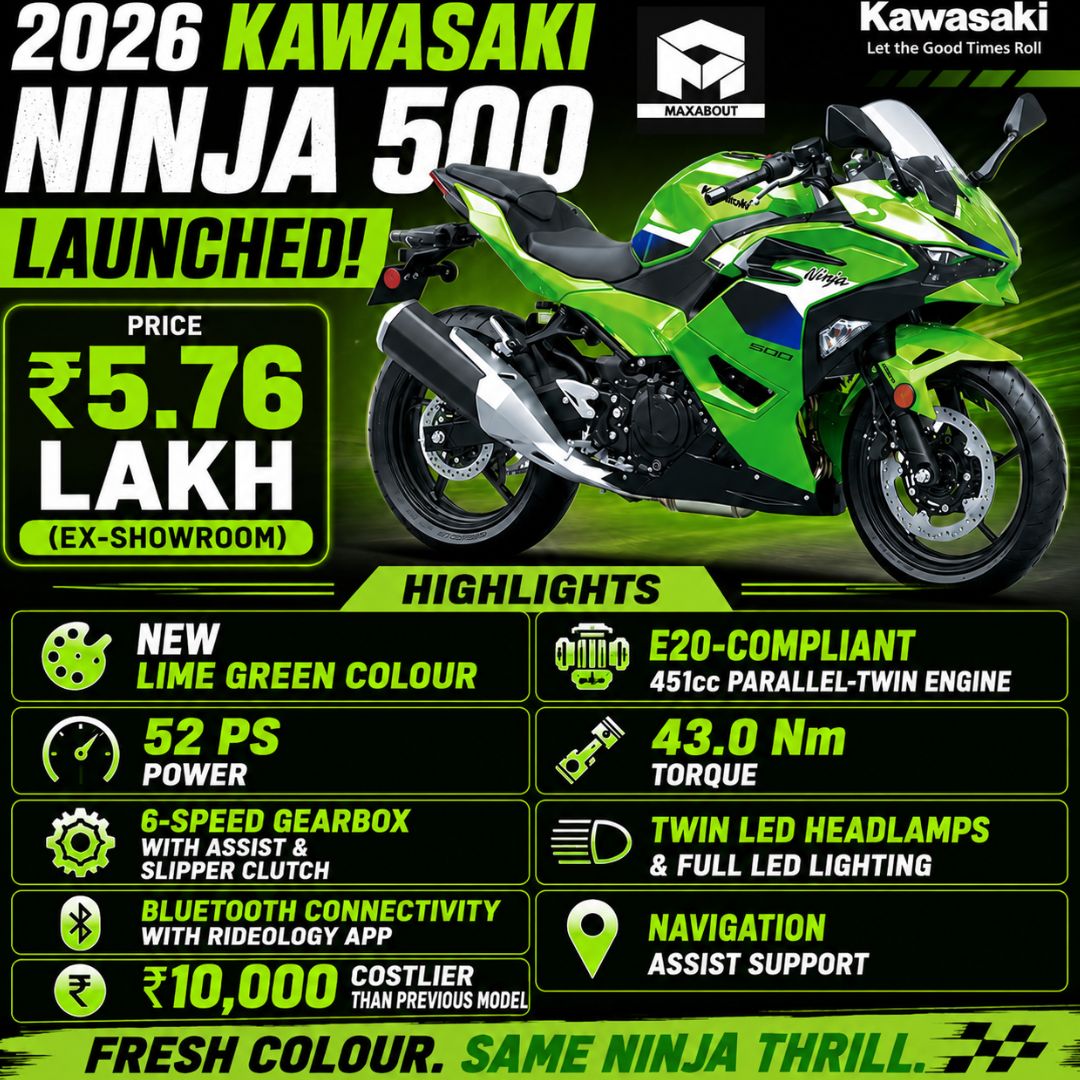
India Kawasaki Motor (IKM) has officially introduced the updated 2026 Kawasaki Ninja 500 to the domestic market. Coming in at ₹5.76,000 (ex-showroom, Delhi), the Model Year 2026 (MY26) edition brings vital mechanical and aesthetic upgrades designed to meet modern environmental standards while injecting a fresh, race-inspired look.
This latest iteration carries a minor price increase of ₹10,000 over the outgoing variant. For this adjustment, riders benefit from E20 fuel compatibility and the arrival of the brand's iconic signature Lime Green paint scheme. Reservation books are officially open at all authorized Kawasaki dealerships across the country, with customer deliveries scheduled to kick off by the end of June 2026.
2026 Kawasaki Ninja 500 Price and Competitive Positioning
The mid-capacity premium motorcycle space in India is fiercely contested. Kawasaki is positioning the MY26 Ninja 500 as an upscale, highly refined option for riders looking to step up from entry-level sportbikes.
| Specification | Details |
| Ex-Showroom Price (Delhi) | ₹5,76,000 |
| Estimated On-Road Price (Delhi) | ₹6,48,957 |
| Primary Launch Colourway | Lime Green with Dark Blue & White Graphics |
| Import Status | Completely Built Unit (CBU) |
While arriving via the CBU route inevitably places its price point above locally manufactured alternatives, the Ninja 500 justifies its premium through exceptional build quality, linear power delivery, and high brand equity.
Key Updates for the 2026 Model Year
1. Eco-Friendly E20 Ethanol Compliance
The most significant engineering update is hidden beneath the bodywork. To align with India’s evolving clean energy objectives, the 2026 Ninja 500 features an overhauled fuel injection system and revised ECU mapping. This allows the engine to run seamlessly on E20 fuel (a mixture of 20% ethanol and 80% petrol) for reduced tailpipe emissions.
2. The Return of Racing Heritage Aesthetics
For MY26, the brand has swapped out the previous understated, darker color options for the traditional Lime Green bodywork. Paired with minimalist dark blue and sharp white racing decals, this new graphic package closely mirrors the visual identity of the high-performance Ninja ZX-6R and ZX-10R stablemates.
Powertrain, Performance, and Gearbox Dynamics
Propelling the 2026 Ninja 500 is a highly flexible 451cc liquid-cooled, parallel-twin, DOHC, 8-valve engine. Engineered to provide a broader, more usable torque spread than the older Ninja 400, this powerplant transitions effortlessly from congested city commutes to open highway touring.
Maximum Output: 45.4 PS @ 9,000 rpm
Peak Torque: 42.6 Nm @ 6,000 rpm
Gearbox: 6-speed manual transmission
Clutch: Assist & Slipper system
The integration of the Assist & Slipper Clutch yields two distinct benefits: it lightens the clutch lever pull to ease strain in stop-and-go urban traffic, and it mitigates rear-wheel lockup or skidding during rapid downshifts before entering corners.
Furthermore, the parallel-twin unit acts as a stressed member within the chassis architecture, structurally optimizing overall rigidity while filtering out unwanted high-frequency engine vibrations.
Lightweight Trellis Framework and Handling
Kawasaki engineers utilized advanced structural rigidity analysis to develop a lightweight steel trellis frame. The design philosophy draws inspiration directly from the flagship Ninja H2 hyperbike.
Curb Weight: 171 kg
Seat Height: 785 mm
Ground Clearance: 145 mm
The combination of a short wheelbase and a long swingarm configuration gives the motorcycle neutral steering geometry, allowing it to drop into corners with minimal steering effort. Combined with the low curb weight, parking lot turnarounds and slow-speed balancing are exceptionally manageable.
Hardware and Braking Specification
The cycle parts are tuned to deliver a progressive balance between sports riding and daily comfort:
Front Suspension: Conventional 41mm telescopic forks.
Rear Suspension: Bottom-link Uni-Trak gas-charged monoshock featuring adjustable spring preload.
Front Braking: A single 310mm semi-floating disc clamped by a dual-piston caliper.
Rear Braking: A 220mm petal disc paired with a dual-piston caliper.
Safety Features: Dual-channel ABS comes standard.
The bike rides on stylish 17-inch star-pattern five-spoke alloy wheels wrapped in a 110/70-17 tyre at the front and a muscular 150/60-17 tyre at the rear, ensuring a reliable footprint when cornering hard.
Ergonomics and Daily Practicality
While the aggressive front fascia borrows heavily from Kawasaki’s dedicated track machinery, the actual rider triangle is tailored for everyday versatility.
Ergonomic Insight: The clip-on handlebars are mounted relatively high, and the footpegs are placed forward just enough to avoid an extreme crouch. This design keeps excess pressure off the rider's wrists and lower back, transforming the machine into an excellent companion for weekend touring.
A notably narrow midsection paired with an accessible 785 mm seat height allows shorter riders to comfortably place both feet flat on the ground at traffic signals, boosting confidence in heavy traffic.
Digital Cockpit and Smart Technology
The high-grade instrument cluster centers around a high-contrast, fully digital LCD display. This screen neatly compiles crucial data, including a sweeping bar-style tachometer, a digital speedometer, dual trip meters, an odometer, a gear position indicator, a fuel gauge, and an eco-riding prompt.
Bluetooth Connectivity via the Rideology App
Using a built-in Bluetooth sensor, riders can link their smartphones directly to the bike via the Kawasaki Rideology App. This unlocks a variety of interactive features:
Dashboard Alerts: Notifications for incoming phone calls, emails, and text messages appear right on the LCD console.
Telemetry Logging: Records GPS routes, travel speeds, gear selections, and fuel efficiency metrics for trip reviews.
Health Checkups: Displays vital vehicle diagnostics, battery voltage levels, and upcoming service reminders on your mobile device.
Market Rivals and Alternatives
Retailing at ₹5.76 lakh, the 2026 Kawasaki Ninja 500 competes directly with several prominent offerings in the sub-500cc parallel-twin and single-cylinder performance categories:
Aprilia RS 457: Built locally in India, offering a highly competitive price tag, advanced rider electronics, and a powerful twin-cylinder motor.
Yamaha YZF-R3: A classic, high-revving alternative known for its buttery-smooth engine, though it lacks some of the modern low-end torque characteristics of the Ninja 500.
KTM RC 390: A track-oriented single-cylinder option that provides aggressive performance and electronics at a lower cost, though it lacks parallel-twin engine refinement.
The Verdict: Is the Updated Ninja 500 a Smart Buy?
The 2026 Kawasaki Ninja 500 marks a natural, mature evolution for the nameplate. By blending future-ready E20 fuel compatibility with the iconic, crowd-pleasing Lime Green livery, the manufacturer has kept its middleweight contender relevant and highly desirable.
For riders seeking an incredibly linear twin-cylinder engine, approachable daily comfort, modern smartphone integration, and sharp supersport styling, the newly updated Ninja 500 remains an exceptionally well-rounded option. Test rides and display models will hit showroom floors across India later this June.
Would you like me to put together a comparative specification table between the Ninja 500 and the Aprilia RS 457?
No comments yet
Be the first to share your thoughts!
Want to read more automotive news?
Stay updated with the latest car launches, reviews, and industry insights.
Browse All News